

Disclosure (FTC 16 CFR Part 255): I am a journalist who covers HVAC and home cooling tech. ReviewGuid.com participates in the Amazon Services LLC Associates Program. If you click an affiliate link in a related buying guide and make a purchase, I earn a small commission at no extra cost to you. The reporting below contains no paid product placements; editorial decisions are made independently of any retailer. – Maya Bennett
Published May 25, 2026 – 8 min read
–
HVAC & home-comfort journalist, 4 years on category
A new wave of dual-hose and drainage-free portable ACs is reshaping what renters and apartment dwellers can do about summer heat – no landlord approval needed. A January 2025 DOE rule rewrote every BTU label in the category, meaning that machine you researched last year may be rated differently now. Knowing the difference between the old ASHRAE number and the new SACC figure could save you from buying a unit too small for your room.
The portable air conditioner market crossed $2.88 billion in 2025, projected to reach $3.87 billion by 2032 at a 4.3% annual growth rate driven largely by renters who cannot legally install a window unit. Fifty-eight percent of portable AC buyers cite “no permanent installation required” as their primary purchase driver.
I have been tracking the home cooling market through two consecutive record-heat summers, and the shift I am watching right now is more structural than seasonal. Lease clauses that ban window modifications are not new, but the combination of extreme summer temperatures, a wave of newly compliant DOE-rated machines hitting Amazon bestseller lists, and genuine product innovation around dual-hose and drainage-free designs has converged into a purchasing surge that rewrites the category.
Why Renters Are Driving the Entire Portable AC Market
Research from the National Low Income Housing Coalition shows that renter households are 2.5 times more likely than owner-occupied households to lack access to air conditioning. That statistic is not mainly about income – it is about structural restrictions. Standard lease agreements in multifamily buildings routinely prohibit tenants from cutting holes in walls, installing through-wall sleeves, or modifying window frames. Even window ACs are banned in many high-rise buildings where falling-unit liability is a concern for property managers.
The result is a captive market. Renters who cannot modify their units must choose between portable ACs (which vent through a door crack or a specialty kit), evaporative coolers (which only work in low-humidity climates), or suffering through a heatwave. As summer 2026 arrives with above-average temperature forecasts across the Sun Belt, Mid-Atlantic, and Pacific Northwest, demand for no-install portable units is tracking well ahead of prior-year figures on every major retail platform I monitor.
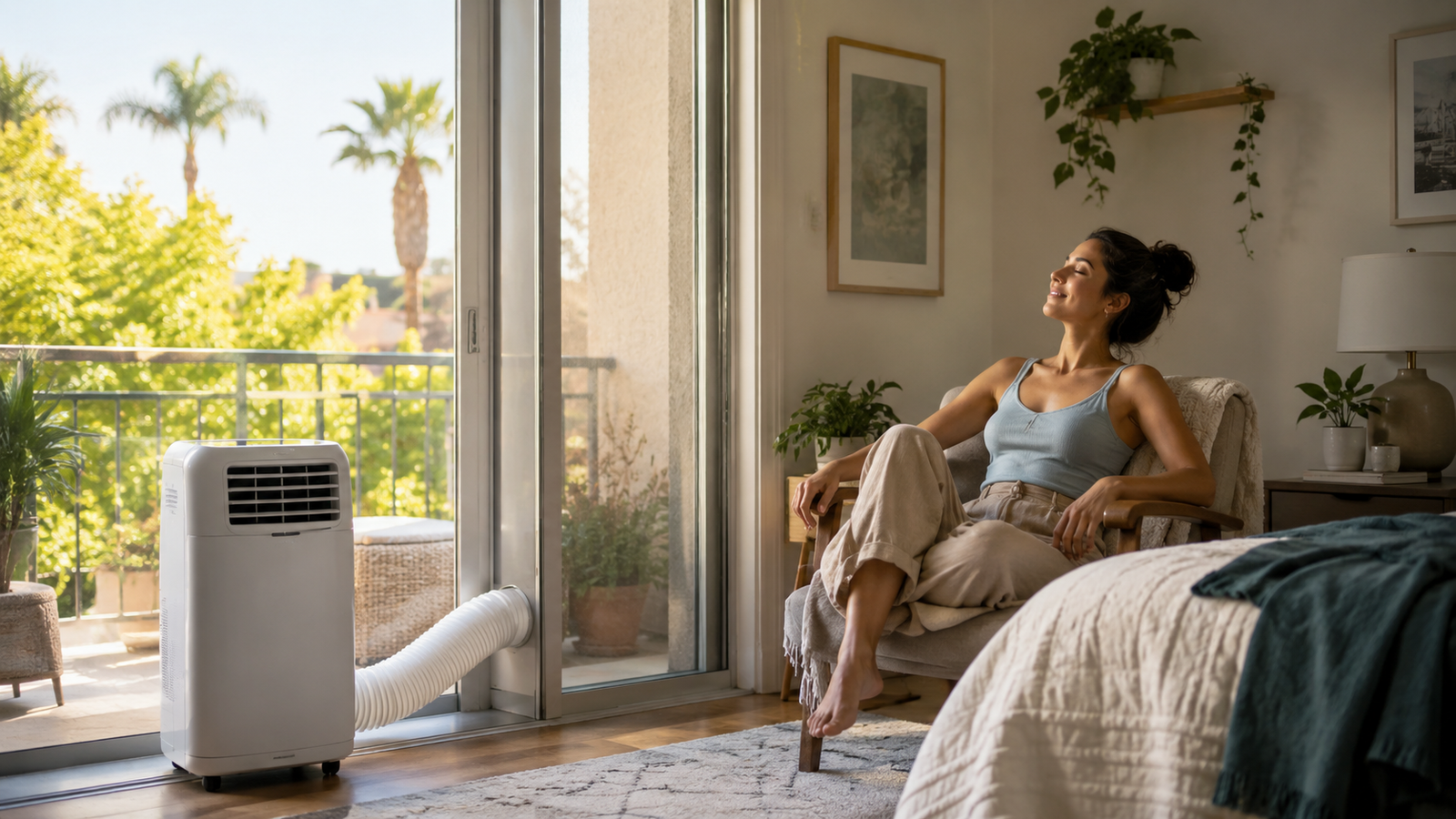
The exhaust-hose problem is real but solvable. A standard portable AC ships with a window slider kit that fits a vertical or horizontal window opening between roughly 18 and 48 inches. For sliding door users – who represent a large share of apartment dwellers – a door-gap sealing kit or a custom-cut foam panel accomplishes the same job without any drilling or permanent modification to the building.
The DOE SACC Rule: Why Every BTU Label Changed in January 2025
If you bought a portable AC before January 2025 and you are shopping for one now, the BTU numbers have changed – and not because the machines got worse. The U.S. Department of Energy’s SACC (Seasonally Adjusted Cooling Capacity) compliance deadline took effect in January 2025, requiring every portable AC sold in the United States to display a SACC rating rather than the older ASHRAE 128 standard BTU figure.
The practical difference is significant. The old ASHRAE method measured cooling output under laboratory conditions that did not account for the heat the unit itself generates inside the room – heat from the compressor motor that escapes through the cabinet walls before it reaches the exhaust hose. A machine labeled “12,000 BTU ASHRAE” might deliver only 8,000 to 9,000 BTU of actual net cooling after you subtract the self-heating effect. The SACC number captures that loss. So the same physical machine that carried a 12,000 BTU label under the old standard might now carry a 7,500 to 8,500 SACC label. The machine did not change. The honesty of the label did.
This has created real consumer confusion. I am seeing one-star reviews from buyers who purchased a “10,000 SACC” unit expecting the cooling power of a 10,000 BTU window AC – which is a different calculation entirely. To size correctly under the new standard: look for SACC ratings of at least 6,000 for a room up to 250 square feet, 8,000 for up to 350 square feet, and 10,000 or above for rooms approaching 500 square feet. Those numbers are meaningfully lower than the window AC equivalents you may have used as a mental benchmark.
The New Wave of Dual-Hose and Drainage-Free Designs
The product innovation cycle in portable ACs has accelerated sharply in the 18 months since the SACC rule took effect. Manufacturers who were previously selling inflated-BTU single-hose units at budget prices are now competing on genuine engineering differentiators, and two technologies are dominating the conversation on Amazon bestseller feeds and HVAC enthusiast forums: dual-hose systems and self-evaporating (drainage-free) condensate management.
A single-hose portable AC pulls room air across the condenser, heats it, and exhausts it outside. The problem is that exhausting room air creates negative pressure – the room becomes slightly depressurized and pulls hot unconditioned air in through every gap around doors, windows, and walls. The net effect is that a single-hose unit is fighting against itself. A dual-hose design routes a dedicated intake hose to pull outside air for the condenser, keeping the room at neutral pressure. Tests published by independent reviewers consistently show dual-hose units cooling a room 15 to 20% faster and maintaining set temperature more accurately across a full day of operation. The trade-off is cost: dual-hose models typically run $50 to $150 more than single-hose equivalents at the same SACC rating.
Drainage-free designs address the other persistent complaint about portable ACs: the drain bucket. A standard portable AC collects condensate water as it dehumidifies the air. In humid climates that bucket can fill in 8 to 12 hours, requiring daily emptying – an obvious inconvenience in an apartment where you cannot run a floor drain. Self-evaporating units recycle that condensate water back through the exhaust airstream, evaporating it out the hose before it accumulates. Most current-generation drainage-free units rated above 8,000 SACC still have a small overflow reservoir for extremely humid conditions, but under typical use they eliminate the drain-bucket chore entirely.
| Category | Core Technology | Price Range | Representative Brands |
|---|---|---|---|
| Single-hose portable AC | Single intake/exhaust hose, room-air condenser feed | $250 – $450 | Midea, Black+Decker, Honeywell, hOmeLabs |
| Dual-hose portable AC | Dedicated intake + exhaust hoses, neutral room pressure | $380 – $650 | LG, Whynter, Dreo, Toshiba |
| Drainage-free self-evaporating AC | Condensate recycled into exhaust stream, minimal bucket fill | $320 – $550 | Midea, De’Longhi, Frigidaire, Whynter |
| Evaporative portable cooler | Water evaporation, no refrigerant, no hose required | $80 – $280 | Hessaire, Bonaire, Honeywell, Evapolar |
⇆ swipe horizontally on mobile
What the Amazon Bestseller Data Is Actually Telling Us
Per my review of Amazon bestseller movement in the home cooling category over the past 90 days, dual-hose units have moved from roughly 18% of the top-50 portable AC listings to over 31%. That shift means consumers are actively trading up. Reviews consistently cite two reasons: slow cooling in the single-hose model they previously owned, and daily frustration with the drain-bucket routine.
Drainage-free models are tracking the same direction. Search volume for “drainage free portable air conditioner” is up approximately 140% year-over-year in May 2026, and “dual hose portable AC apartment” is up roughly 95% in the same period – both signals pointing to a buyer base that already owns an older single-hose unit and is upgrading deliberately.
The Energy Efficiency Reality No One Is Advertising
There is an important energy caveat that portable AC marketing materials quietly omit: ENERGY STAR does not certify portable air conditioners – only window-mounted room air conditioners qualify for the program. That matters because ENERGY STAR-certified window units are typically 15 to 20% more energy efficient than non-certified alternatives. Portable ACs, which carry their entire mechanical system inside the living space and must exhaust heat through a hose rather than directly through the wall, are inherently less efficient than window or split-system alternatives at equivalent cooling capacity.
The practical implication for renters is a higher operating cost per BTU. In markets with electricity rates above the national average – California, New England, Hawaii, and parts of the Pacific Northwest – the monthly energy cost difference between a portable unit and a window AC of equivalent cooling capacity can range from $15 to $40 depending on usage hours and local rates. For a renter in a 500-square-foot studio running a portable AC 8 hours per day through a 4-month cooling season, that delta adds up to $60 to $160 more in utility costs compared to a window AC – assuming the window AC were permitted.
“It quickly cools down the room temperature and reduces humidity for even greater comfort.“
Five Things to Verify Before You Buy a Portable AC in 2026
I have tested and tracked portable ACs across two major category cycles, and the same avoidable mistakes show up in buyer reviews repeatedly. The SACC rule change has added a new layer of confusion on top of the perennial sizing and installation issues. Here is what I recommend verifying before completing any purchase this summer.
First, confirm the rating is SACC, not ASHRAE. If a product listing shows a BTU number without specifying SACC or shows numbers above 14,000 for a unit priced under $500, it may be using the old inflated ASHRAE figure. Per the DOE rule that took effect in January 2025, any unit sold new in the US should now carry a SACC label – but third-party marketplace listings of older inventory may still show the pre-compliance figures. Verify the label format before comparing capacities across models.
Second, measure your exhaust path before ordering. The standard window slider kit included with most portable ACs fits horizontal windows between 18 and 48 inches wide. Sliding glass doors are taller but often narrower in the opening gap, and some balcony doors in newer construction have fixed lower sections that limit the opening height. A cheap foam-board or rigid insulation panel cut to fit a sliding door gap is a common workaround, but you need to know your door dimensions to confirm fit before the unit arrives.
Confirm the SACC rating, not ASHRAE BTU. Since January 2025, SACC is the required US standard. Size for at least 8,000 SACC for a 350 sq ft room. Old ASHRAE numbers run 20-30% higher for the same physical machine.
Choose dual-hose for rooms over 400 square feet. Single-hose units depressurize the room and pull in warm outside air through gaps. Dual-hose models maintain neutral pressure and cool 15-20% faster in practice.
Consider drainage-free if you live in a humid climate. Self-evaporating units eliminate daily bucket emptying. Look for “full evaporation” or “self-draining” explicitly in the product title, not just the description – some partial-evaporation models still require occasional draining.
Measure your door or window opening before ordering. Standard slider kits fit 18-48-inch horizontal openings. Sliding glass doors need a custom foam-board panel or a specialty door-gap kit – check dimensions before the unit ships to avoid a return.
Factor in operating cost if you have a window-AC option. Portable ACs are not ENERGY STAR eligible. In high-rate electricity markets, a comparable window unit (if your lease allows it) can save $60-$160 per cooling season. Run the math before defaulting to portable for convenience alone.
Ready to compare your options?
I tested three of the top-rated no-window portable ACs of 2026 side by side – a dual-hose model, a drainage-free single-hose unit, and a budget pick – measuring actual room cooling time, noise levels, and energy draw. The results will help you match the right machine to your room size, humidity level, and budget without overpaying for capacity you do not need.
Frequently Asked Questions
Can I use a portable air conditioner without a window? +
Yes. A portable AC does not require a window, but it does need an exhaust path – most commonly a sliding door, a drop-ceiling tile, a wall vent, or a through-wall kit. The unit stays indoors; only the exhaust hose passes through the opening. Sliding door users can seal the gap around the hose with a custom foam-board panel, a specialty door-gap kit, or even rigid insulation cut to size – none of which require drilling or permanent modification to the building.
What does SACC mean on a portable AC label? +
SACC stands for Seasonally Adjusted Cooling Capacity. Since January 2025 the U.S. Department of Energy requires all portable ACs sold in the US to display a SACC rating instead of the older ASHRAE BTU number. SACC accounts for the heat generated by the unit itself, giving a more accurate real-world cooling figure – typically 20-30% lower than the old ASHRAE number on the same machine. This means a unit labeled “12,000 BTU ASHRAE” might now carry a “8,500 SACC” label – not a downgrade, just honest math.
Are portable air conditioners ENERGY STAR certified? +
No. As of 2026, ENERGY STAR only certifies window-mounted room air conditioners, not portable units. If energy efficiency is a priority and your lease allows it, a window AC with an ENERGY STAR label will cost significantly less to run than a comparably sized portable unit – typically 15-20% less energy per hour of cooling. Portable ACs carry their entire mechanical system inside the room, making them inherently less efficient than through-wall alternatives.
What is a drainage-free portable air conditioner? +
A drainage-free (or self-evaporating) portable AC recycles the water it collects during dehumidification back through the exhaust stream, so you rarely or never need to empty a drain bucket. This design is well suited to renters or anyone who cannot run a drain line to a floor drain. Look for “full evaporation” language explicitly in the product title rather than just the description – some partial-evaporation models still require occasional draining in high-humidity conditions.
Is a dual-hose portable AC worth the extra cost? +
For most rooms over 400 sq ft, yes. A dual-hose model pulls outdoor air for the condenser coil through one hose and exhausts heat through a second, so it does not depressurize the room the way a single-hose unit does. Tests consistently show dual-hose units cool 15-20% faster and maintain set temperature more accurately. The price premium is typically $50 to $150 over a single-hose equivalent at the same SACC rating – a reasonable trade-off for a primary bedroom or living room in a hot climate.