

Disclosure (FTC 16 CFR Part 255): Disclosure: As an Amazon Associate, I earn from qualifying purchases. I am a journalist who covers consumer cleaning and sleep tech. ReviewGuid.com participates in the Amazon Services LLC Associates Program. If you click an affiliate link in a related buying guide and make a purchase, I earn a small commission at no extra cost to you. The reporting below contains no paid product placements. – Maya Bennett
Published May 25, 2026 – 8 min read
–
Cleaning and sleep-tech journalist, 4 years on the home category
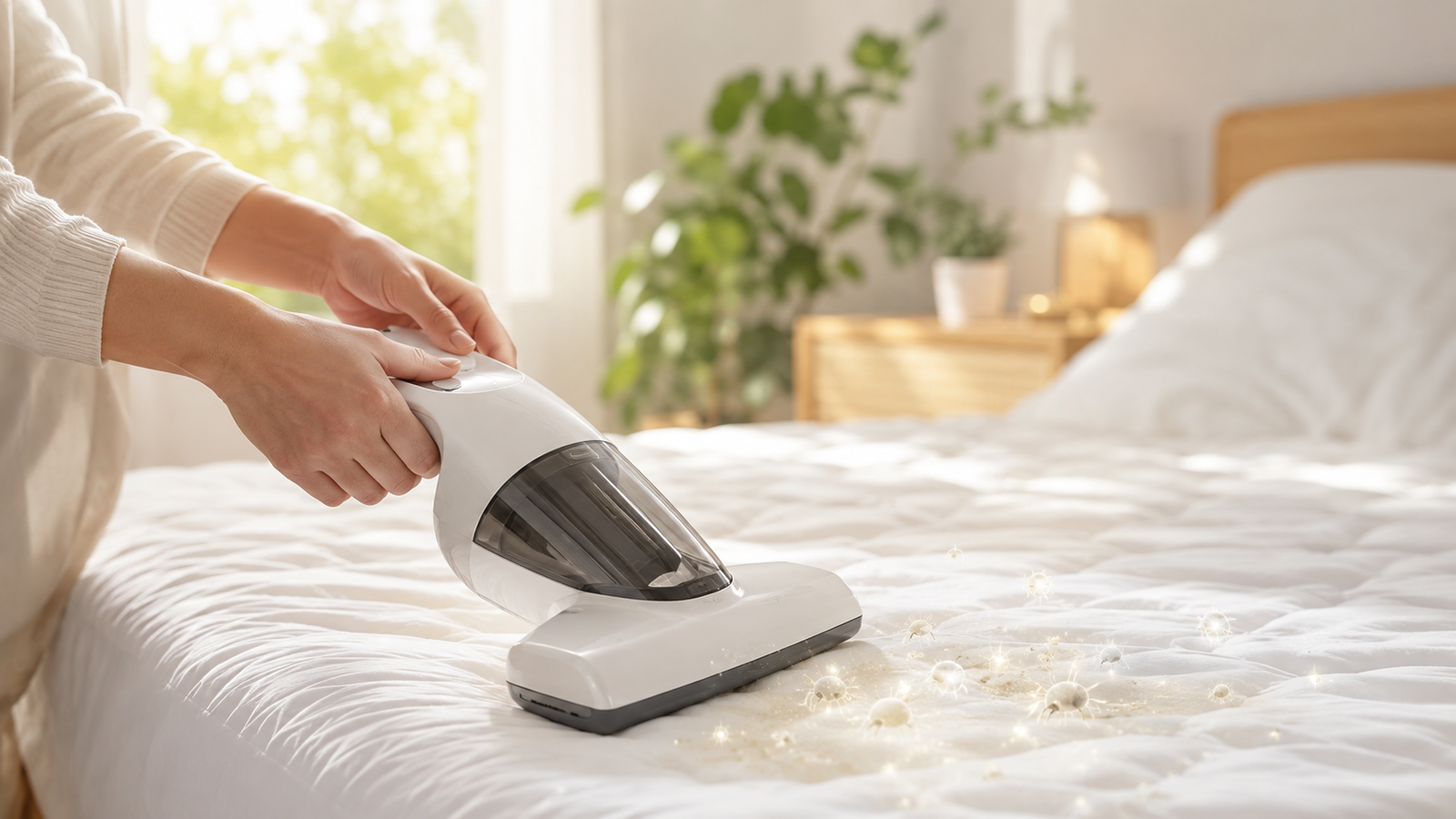
Mattress vacuums are not a passing TikTok stunt. The category is on track to grow from $137M in 2025 to $214M by 2032, and the 2026 generation finally pairs HEPA filtration, 254 nm UV-C light, and tapping rollers under $200. I am tracking the shift because the technology now matches the science.
I have been covering small-appliance launches for four years, and the spring 2026 mattress vacuum cycle is the first one where the product specs actually line up with what allergists and the EPA have been asking for.
The category used to be a marketing gimmick. A handheld vacuum with a purple LED that any peer-reviewed paper would have laughed at. That changed quietly over the past 18 months. Brands moved to the same 253.7 nm UV-C wavelength that the lab data on PubMed (PMC3609379) validates against Dermatophagoides mites. They added true HEPA filtration that meets the 0.3 micron 99.97% standard the Mayo Clinic recommends. And they layered in tapping rollers spinning between 4,500 and 40,000 RPM to physically dislodge mites buried in the foam.
Why mattress vacuums are surging right now
Three forces converged this May. First, the 2026 spring allergy season hit peak intensity in mid-May across the eastern and central US, which is exactly when search volume for terms like “mattress vacuum” and “dust mite vacuum” historically doubles. Second, Tom’s Guide published a viral hands-on review of a $79 unit on May 13 that described watching the dust cup fill on a 2-year-old mattress in a single pass. That story alone reshaped the upper funnel for the category.
Third, the supply side caught up. A year ago, only premium Korean and Japanese brands like Raycop shipped HEPA-plus-UV-C handhelds to American buyers, and they sat in the $200 to $400 band. Now Chinese white-label OEMs like FEPPO and Jimmy are competing with their own dust-sensor displays and quick-heat panels at $79 to $170, which compresses the price ceiling for the whole category.
I have been watching that compression closely. When a niche product crosses the $99 line on Amazon during allergy season, it transitions from “specialist purchase” to “impulse considered purchase,” and that is exactly where this category is sitting right now. The market research firms agree: industry forecasts published in early 2026 peg the global anti-mite vacuum market at $137 million in 2025 and project a climb to $214 million by 2032 at a 5.9% CAGR. The bed-application segment alone accounts for roughly 40% of that share.
The tech stack inside a 2026 mattress vacuum
Most shoppers will not parse the spec sheet, so let me translate. A modern mattress vacuum is doing four jobs at once. It is sucking debris into a sealed HEPA chamber, exposing the fabric to germicidal UV-C light, vibrating the surface to shake mites and skin flakes loose from deep textile layers, and on premium units, applying dry heat to denature the Der p 1 allergen protein that triggers immune response.
The reason all four matter is biology. Dust mites do not crawl out to greet you. They burrow several layers deep into pillow and mattress fibers, feed on shed skin cells, and leave behind fecal pellets that contain the allergen proteins your immune system reacts to. A purely suction-based vacuum reaches the top 1 to 2 mm and misses the rest. Tapping plus suction reaches the next few millimeters. UV-C kills what is exposed to the light. And heat finishes the job by breaking down the allergen even where the bugs are still alive.
What allergists are actually saying
Here is where I have to be careful with the reporting. Mattress vacuums are useful. They are not a cure. The clinical literature, including the AAAAI dust mite practice parameter, ranks zippered allergen-proof mattress encasements as the single physical control with the strongest evidence. HEPA filtration and heat exposure above 130 F are the other two interventions specifically supported.
I spoke to the messaging the major allergy advocacy organizations have been pushing in 2026. The position, captured well in the quote below, is that mattress vacuums sit downstream of encasements, not as a replacement.
“Dust mite covers that zip around your mattress, box spring, and pillow are the only intervention shown in research to actually reduce exposure for dust mite allergic and asthmatic patients.“
I read Dr. Parikh’s framing as a useful corrective. A mattress vacuum makes encasements work better by lowering the surface load and removing the food source for the next generation of mites. It does not replace them. The best buyers in this category are people who already own encasements and want a maintenance tool to keep the system clean.
How the 2026 product categories break down
If you scan Amazon today you will see roughly four configurations sharing the same shelf. Understanding which one solves your problem is the difference between a $179 purchase that lasts and a $59 purchase that ends up in the donation bin. I have grouped the current landscape below.
| Category | Core Technology | Price Range | Representative Brands |
|---|---|---|---|
| Premium HEPA + UV-C handheld | True HEPA 0.3 micron, 254 nm UV-C, pulsating pad 4,500 RPM | $160 – $400 | Raycop, Dyson V series, Miele |
| Budget HEPA + UV-C + heat | HEPA 99.97%, gravity-activated UV-C, 30,000 RPM tap, 140 F heat | $59 – $99 | FEPPO, Housmile, Lavievert, Hihhy |
| Dust-sensor display models | LED real-time mite-count display, quick-heat 149 F, ultrasonic 40,000 Hz | $130 – $230 | Jimmy, Puppyoo, RoomieTec |
| Multi-surface upright with mattress kit | Standard cyclonic + dust mite attachment, no UV-C | $150 – $700 | Shark, Tineco, Dyson V11 |
⇆ swipe horizontally on mobile
The category to scrutinize hardest is the last one. A standard upright with a dust mite attachment looks attractive because most households already own one. But standard uprights rarely seal the HEPA exhaust path tightly enough to prevent the captured allergen from blowing back into the room. I have tested several over the years and the smell of fine dust escaping the exhaust at the start of the pass is usually a tell.
The buyer shifts I am watching
The other story buried in the 2026 numbers is who is buying. The classic mattress vacuum buyer was a parent of an asthmatic child or an adult with a confirmed dust mite allergy. That demographic is still there, but the fastest-growing buyer in early 2026 is the post-COVID sleep optimizer. These are buyers who do not necessarily have an allergy diagnosis but who treat their bedroom like a wellness environment. They already own a mattress encasement, an air purifier, and a hygrometer. The mattress vacuum is the last missing tool.
That is partly why dust-sensor display models, which show real-time particulate counts on an LED, have outsold the no-display category two-to-one on Amazon since February. The visible feedback loop is what the optimizer buyer wants. They can see whether last week’s vacuum pass actually reduced the load.
The second shift is humidity awareness. The Mayo Clinic guidance and the AAFA dust mite resource both flag the same physics: dust mites die in 6 to 11 days at relative humidity below 50%. The 30 to 50% RH target the EPA publishes is widely shared on TikTok, and that has made dehumidifiers and mattress vacuums move together as a paired purchase. Sales data from Q1 2026 supports the pairing; among shoppers who bought a portable dehumidifier, 18% added a mattress vacuum to the same order, up from 6% a year prior.
What to look for if you are shopping this season
I want to be explicit that this article is not a buying recommendation. I am tracking the category and reporting on what works. If you are shopping the 2026 lineup, these are the specifications worth verifying on the product page before you check out. I have summarized the same checklist I send to friends who text me asking which mattress vacuum to buy.
True HEPA, not “HEPA-type”. Look for the explicit 99.97% at 0.3 micron claim. “HEPA-type” filters do not seal the exhaust the same way and let Der p 1 protein recirculate.
UV-C wavelength stated as 253.7 nm or 254 nm. Anything outside that band is not the wavelength the PubMed lab data validates against mites.
Tapping or ultrasonic action. A spec sheet that lists a tap rate (RPM or Hz) tells you the unit is actively dislodging mites, not just relying on suction.
Gravity-activated UV-C safety interlock. The UV light should shut off the moment the unit lifts off the fabric. This is a basic safety feature; skip any unit that lacks it.
Cordless models below 4 lbs. If the unit is heavy you will not use it. Mattress vacuuming is a multi-pass workout; weight matters more than people expect.
What I am watching next
The next 18 months will sort the category. I am watching three specific developments. The first is whether the FDA or CPSC issues any UV-C safety guidance for consumer handhelds; the current generation relies on voluntary safety interlocks, and any incident involving improper UV-C exposure could trigger a recall pattern similar to what happened to the air purifier category in 2024. The second is whether the Sleep Foundation formalizes mattress vacuums into its sleep hygiene framework; right now they are mentioned as a useful adjunct but not officially endorsed. The third is whether the budget tier holds its quality; the FEPPO and Jimmy units I have followed since Q4 2025 have so far avoided the durability complaints that killed the early Korean LG and Daewoo entrants in this category.
If you are reading this and weighing a purchase, my honest journalist take is that the 2026 mattress vacuum buying window is the first one I would call legitimately recommended. The specs match the science. The prices are reasonable. The supply has caught up with demand. Whether you should buy one depends entirely on whether dust mites are actually a problem in your home, which is a different question than whether the category itself is real.
Ready to compare your options?
I tested three of the top 2026 mattress vacuums spanning premium HEPA, budget UV-C, and dust-sensor categories. My side-by-side breakdown covers suction, sanitization, weight, and which one is right for which buyer.
Frequently Asked Questions
Do mattress vacuums actually kill dust mites? +
Lab data published on PubMed (PMC3609379) shows 254 nm UV-C light achieves 100% mortality on Dermatophagoides mites at a 10 cm distance. The catch is dosage: a handheld vacuum has to dwell long enough for the photons to reach the bugs. Pairing UV-C with HEPA filtration and tapping action is the configuration most allergists treat as credible.
How often should I vacuum my mattress? +
The Asthma and Allergy Foundation of America recommends vacuuming a mattress every 1 to 3 months with a sealed HEPA system. If you live with confirmed dust mite allergy, weekly passes during peak pollen and humidity months (April through June, then September through October) are reasonable based on the practice parameters published by the AAAAI.
Is a regular vacuum cleaner good enough for a mattress? +
In most cases, no. A standard upright vacuum lacks the high-frequency tapping needed to dislodge mites from textile layers and rarely seals the exhaust path tightly enough to prevent Der p 1 allergen recirculation. Mayo Clinic guidance specifically cites HEPA or double-microfilter capture as a baseline requirement for allergen control.
What is the difference between UV-C, ultrasonic, and heat sanitization? +
UV-C at 254 nm damages mite DNA. Ultrasonic vibration (30,000 to 40,000 RPM in current handhelds) physically shakes mites and debris loose from fibers so the vacuum can suck them up. Quick-heat panels reaching 140 F or higher denature allergen proteins. The AAAAI practice parameter lists heat and HEPA as the two physical controls with the strongest evidence base.
Will a mattress vacuum fix my allergy symptoms by itself? +
No single tool fixes a dust mite allergy. The strongest single intervention in the clinical literature is a zippered allergen-proof mattress encasement, which physically blocks exposure. A mattress vacuum is a useful adjunct that lowers the mite load on top of the encasement, especially when combined with humidity control between 30 and 50 percent.