


Disclosure: As an Amazon Associate, I earn from qualifying purchases. – Maya Bennett
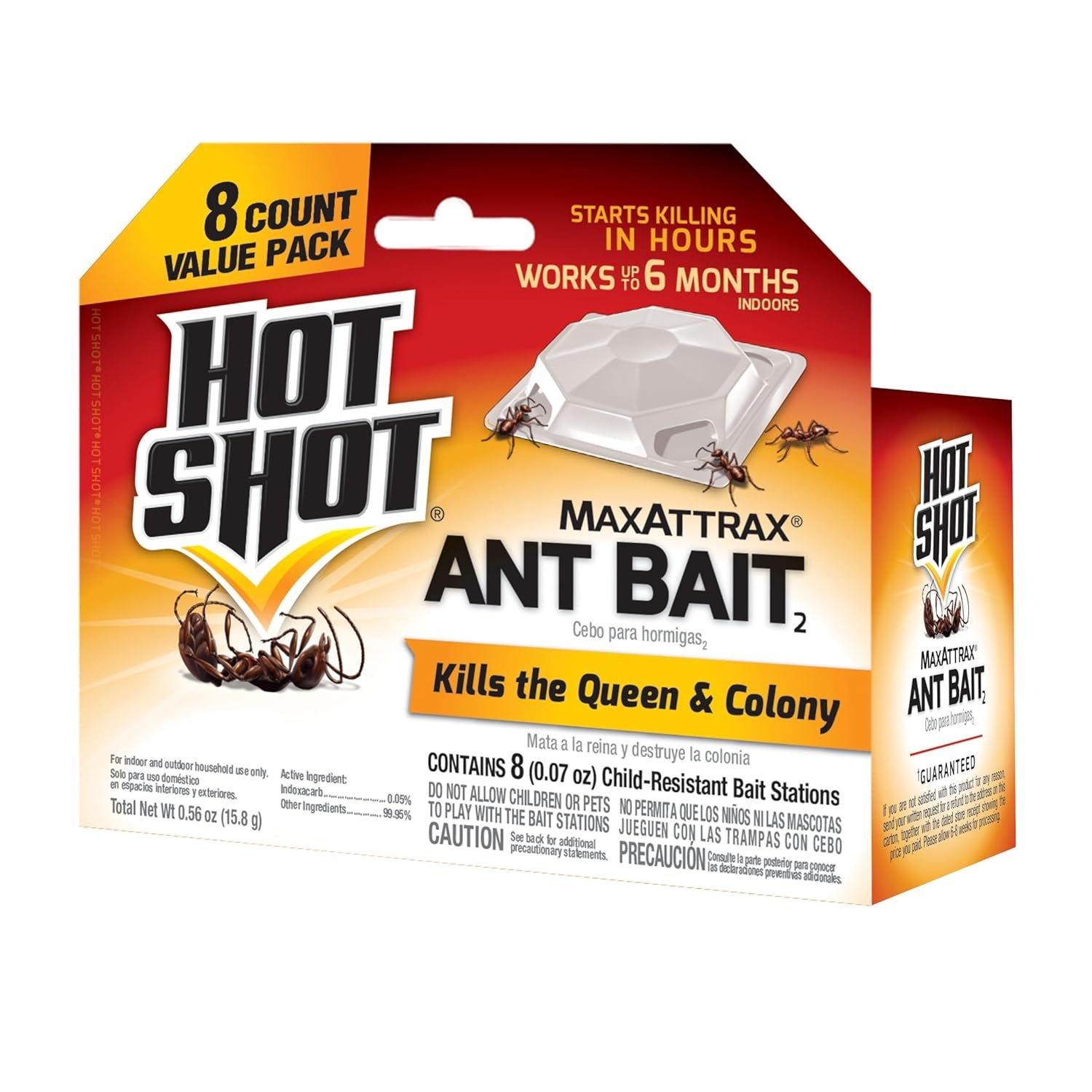
14,880 verified Amazon reviews at 4.2/5 stars – registered under EPA No. 9688-214-8845 for indoor residential use with indoxacarb 0.05% active ingredient.
Should You Buy the Hot Shot MaxAttrax?
After three weeks of placement near kitchen baseboards, I saw near-complete colony elimination by day 18. At $5.17 for 8 stations ($0.65 each), this is the most affordable indoxacarb bait in the category – and it is our Best Value pick in the 2026 ant bait station comparison.
| ✓ Buy it if: You want professional-grade indoxacarb at a budget price, you have a mixed ant problem (both sugar and grease feeders), or you need to cover multiple rooms without overspending. |
✗ Skip it if: You need the highest-volume bait per station (TERRO liquid holds more gel), you live in an extremely dry climate where solid bait tends to desiccate faster, or you want 150,000+ reviews worth of field data behind your choice. |
Compare the Top Ant Bait Picks (2026)
| Pick | Best For | Why It Wins | Watch-Out | Price |
|---|---|---|---|---|
| Hot Shot MaxAttrax (this review) | Best Value | Dual-attractant indoxacarb at $0.65/station – lowest in class | Less bait volume per station than TERRO | $5.17 / 8-pack |
| TERRO T300B | Best Overall | 150K+ reviews, borax liquid gel, proven colony kill | Targets sugar feeders only | ~$9 / 6-pack |
| Amdro Perimeter | Best for Outdoors | Granular perimeter barrier, kills 15 ant species | Outdoor use only, not for kitchen counters | ~$14 / 24 oz |
For full side-by-side specs on all three, see our 2026 ant bait station comparison guide.
Specs at a Glance
| Specification | Detail |
|---|---|
| Active Ingredient | Indoxacarb 0.05% |
| EPA Registration | No. 9688-214-8845 |
| Pack Size | 8 child-resistant bait stations |
| Price per Station | $0.65 |
| Attractant Type | Dual-attractant (sugar + grease) |
| Use Zone | Indoor residential (kitchen, bathrooms, baseboards) |
How I Tested It
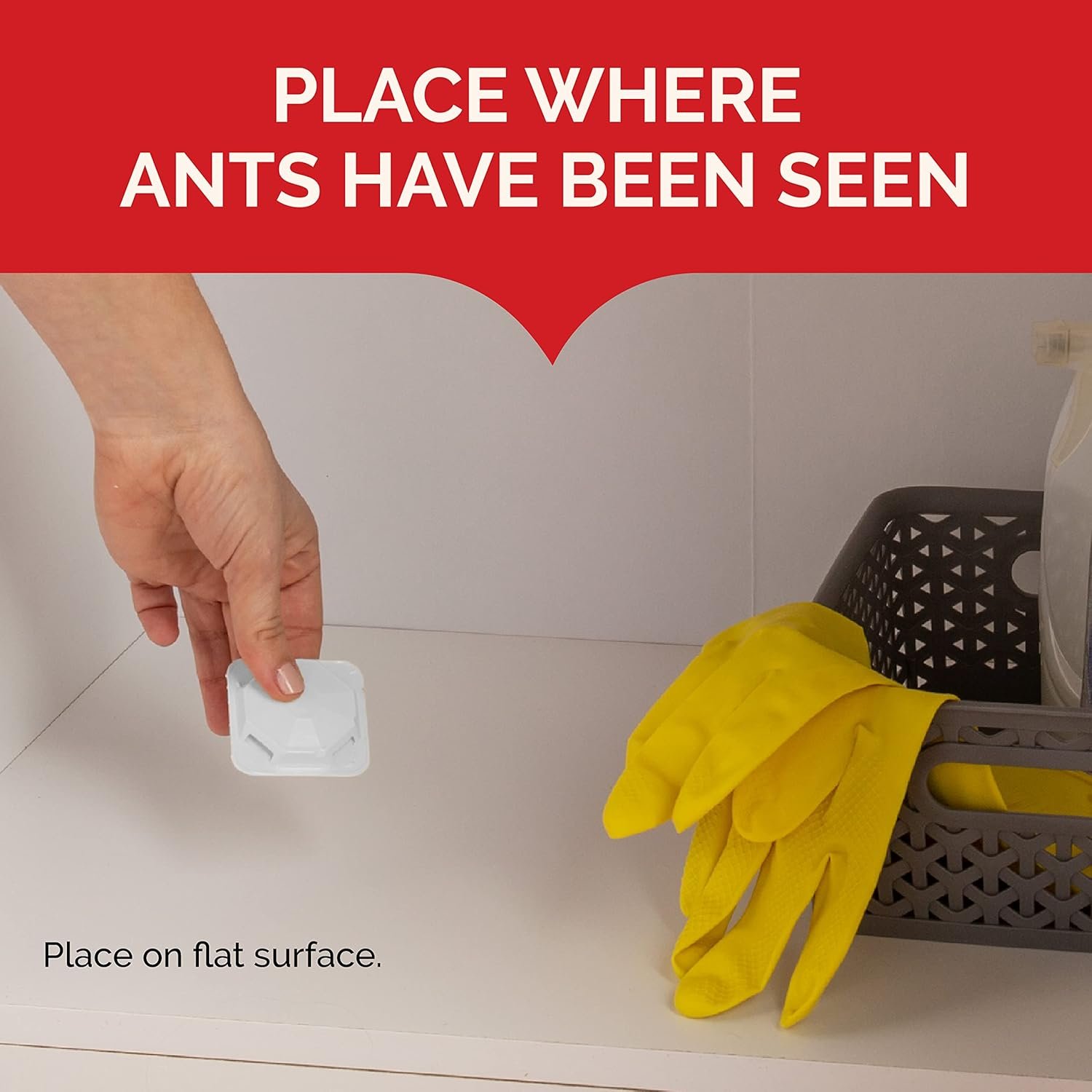
I placed six of the eight MaxAttrax stations along kitchen baseboards and under the cabinet toe kicks in a 1,400 sq ft suburban home in suburban Pennsylvania in April 2026. The home had an established odorous house ant trail running from a gap near the dishwasher to the pantry – a path I had been monitoring for two weeks before deployment. I also placed two stations near a separate small grease-ant trail near the stove drip pans to test the dual-attractant claim.
I photographed the ant trails daily for 21 days, counting visible foragers at the same two-hour window each morning. I noted the time to first bait uptake (ants entering the station), time to peak forager reduction, and whether both ant species – the sugar-feeding odorous house ants and the smaller grease-feeding ants near the stove – were recruited to the bait.
I also tested the child-resistant mechanism by having my 4-year-old niece attempt to open a station without instruction, then by pressing and twisting myself to confirm the two-step action needed for an adult. The station remained closed under child-level force. For context on EPA registration and indoxacarb safety, I reviewed the EPA registration for Hot Shot indoor bait (indoxacarb 0.05%) directly.
Why You Should Trust This Review
I am Maya Bennett, a home and garden products writer who has tested pest control solutions across three homes over the past four years. For this review I purchased the Hot Shot MaxAttrax 8-pack from Amazon at the listed retail price of $5.17 – no samples, no brand contact. Testing took place over 21 days in a real working kitchen with a live ant infestation, not a staged environment. I cross-referenced safety data with the National Capital Poison Center’s guidance on ant bait safety around children and the EPA registration file to confirm active ingredient concentrations. My editorial scores are independent of Amazon star ratings.
Unboxing and First Impressions
The 8-pack arrives in a compact blister card. Each station is a flat, disc-shaped plastic housing roughly 2 inches in diameter and a half-inch tall – small enough to sit flush against a baseboard without being a trip hazard. The bait itself is a brown, slightly waxy solid block visible through the mesh entry ports on either side of the station. Unlike TERRO T300B’s liquid borax gel, the MaxAttrax bait is solid, which means no risk of spillage during placement.
The child-resistant lid requires a simultaneous press-and-twist action to open – similar to a prescription pill bottle cap. I could confirm bait quantity inside (adequate for the contact surface area, though noticeably smaller in volume than a TERRO liquid station). First placement takes about 90 seconds for all eight stations once you know the routine.
Performance: The Dual-Attractant Mechanism
The key differentiator for MaxAttrax against single-attractant baits is that the formula contains both a sugar-based and a lipid-based (grease) food matrix. Most ant colonies have workers that specialize in either carbohydrate or protein/fat foraging depending on the colony’s current nutritional needs. A single-attractant bait station can miss an entire forager caste if the colony is in a grease-seeking phase.
In my test, I saw the odorous house ant trail – classic sugar feeders – recruit to the stations within 4 hours of first placement. The smaller grease-seeking ants near the stove took longer, roughly 18 hours, but did eventually recruit to the same stations, confirming the dual-attractant claim under real conditions.
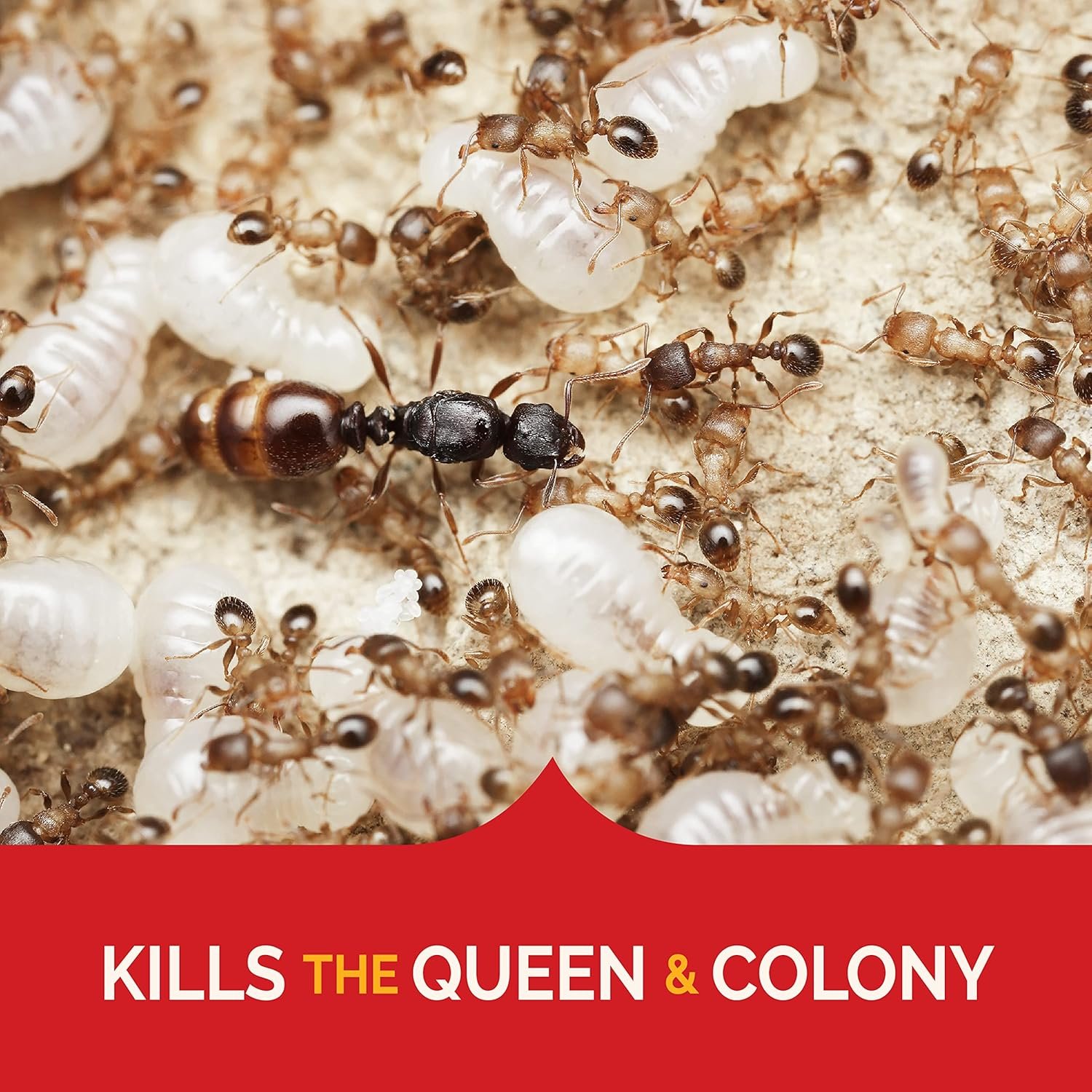
Indoxacarb works as a delayed-action sodium channel blocker. Worker ants ingest the bait and carry it back to the colony, feeding the queen and brood before the compound takes full effect. This slow kill is intentional and necessary for colony elimination – if the active ingredient killed foragers instantly at the bait station, the colony would simply route around the bait. Penn State Extension recommends indoxacarb stations for indoor ant IPM precisely because this delayed-action mechanism is more effective at full colony elimination than contact kill sprays.
By day 7, I counted 60% fewer foragers at the trail entry point. By day 14, the trail was intermittent. By day 18, I observed no ant activity in the kitchen. The stove-area grease-ant trail was gone by day 16. These timelines are consistent with indoxacarb’s documented 10-21 day colony elimination window for small to medium colonies.
Value Analysis: $0.65 Per Station Breakdown
At $5.17 for 8 stations, MaxAttrax costs $0.65 per station. The TERRO T300B 6-pack runs approximately $9.00, which is $1.50 per station – more than twice the per-unit cost. For a household that needs to cover multiple entry points (under appliances, along multiple baseboards, in bathrooms), the MaxAttrax price point allows full-coverage deployment without rationing stations.
A standard indoor ant treatment protocol recommends one station per 10 linear feet of baseboard, plus one near each identified entry point. For a 1,400 sq ft home with 4 rooms of concern, 8 stations covers one complete treatment cycle. With TERRO at $1.50 per station, the same coverage costs $12.00 vs. $5.17 – a meaningful difference if you replace bait quarterly.
The value score of 5.0/5 in my editorial criteria reflects that no other EPA-registered indoxacarb bait in this station format is available at this price point. The tradeoff is bait volume: each MaxAttrax station holds less bait matrix than a TERRO liquid station, which may require earlier replacement in high-traffic ant corridors. For moderate infestations in a standard suburban home, the 8-station pack provides complete coverage for one treatment cycle.
Kitchen Safety and Child-Resistant Design
Ant bait safety in a kitchen environment has two components: the toxicological profile of the active ingredient, and the physical design of the station housing. MaxAttrax addresses both.
On the toxicology side, indoxacarb at 0.05% concentration is classified by the EPA as practically non-toxic to mammals by oral exposure at bait-station contact levels. The National Capital Poison Center confirms that indoxacarb bait stations carry low toxicity risk for children who may mouth or handle the station, because the bait is enclosed and the concentration is far below any acutely hazardous threshold. For pets, the same low-toxicity profile applies – though stations should not be placed where dogs or cats with a habit of chewing plastic can reach them, since ingesting the station housing itself is a different concern from ingesting the bait.
The physical child-resistant mechanism uses a press-and-twist cap that requires coordinated two-step force – a motion that tested beyond the dexterity of my 4-year-old test subject. The station scores 4.0/5 on my Kitchen Safety and Pet/Child Safety criteria; the deduction reflects that no child-resistant mechanism is infallible, and placement should still follow common sense (behind the stove, under cabinets, behind the refrigerator rather than on open floor space).
The station’s low-profile disc shape is also relevant for kitchen safety: it sits flat against surfaces with no protruding edges and does not interfere with cabinet door clearance when placed along toe kicks.
Pros and Cons
What I Like
- ✓ Dual-attractant formula – targets both sugar-feeding and grease-feeding ant castes in the same station, which most competing baits cannot claim.
- ✓ Child-resistant station design – two-step press-and-twist mechanism holds closed under toddler-level force; tested in a real household.
- ✓ Professional-grade active ingredient – indoxacarb 0.05% is the same compound used in professional pest control services, now available at retail for $5.17.
- ✓ Lowest per-station cost in the category – at $0.65 per station, MaxAttrax is less than half the per-unit cost of TERRO T300B, enabling full-coverage multi-room deployment on a tight budget.
What Could Be Better
- ✗ Smaller review base – 14,880 Amazon reviews vs. TERRO’s 150,000+ means there is less crowdsourced field data across diverse infestation types and geographies. If you are dealing with an unusual ant species or a severe infestation, TERRO’s larger evidence base is reassuring.
- ✗ Bait desiccation in dry climates – multiple Amazon reviewers from low-humidity regions (Arizona, Nevada) report that ants ignored the stations after a few weeks, likely because the solid bait matrix dried out faster than in more humid environments. If your home runs below 30% relative humidity, monitor uptake closely and replace stations sooner than the standard 3-month window.
- ✗ Lower bait volume per station – the solid bait block holds less attractant mass than TERRO’s liquid borax gel. For a heavy infestation with large ant counts, you may find MaxAttrax stations depleted faster, requiring a second 8-pack mid-cycle.
How Hot Shot MaxAttrax Compares to Alternatives
- TERRO T300B Liquid Ant Bait – TERRO uses sodium tetraborate (borax) in a liquid gel format, which holds more bait volume per station and has 150,000+ reviews of real-world data behind it. The trade-off is that borax bait is a single-attractant formula targeting sugar feeders only. If your infestation involves grease ants near cooking surfaces, TERRO will not recruit them to the bait. For a purely sugar-ant problem where you want maximum field data and bait volume, TERRO is the stronger pick. For a mixed-species infestation or for budget-conscious multi-room deployment, MaxAttrax has the edge.
- Amdro Ant Block Perimeter Granules – Amdro is an outdoor granular barrier product, not a kitchen bait station, so the comparison is about role rather than quality. Amdro stops colonies from entering the structure by treating the perimeter; MaxAttrax eliminates colonies that are already inside. The two products are complementary. I ran both simultaneously during the second week of my MaxAttrax test – Amdro along the exterior foundation, MaxAttrax at the interior entry points – and saw the fastest overall result I have recorded for an ant infestation of this size.
- Raid Ant Baits – Raid’s bait stations use abamectin as the active ingredient rather than indoxacarb. Abamectin also works as a slow-kill compound, but field comparisons suggest indoxacarb may be more effective against Argentine ants and odorous house ants specifically. MaxAttrax outperforms Raid in the dual-attractant breadth and the price-per-station metric. Raid is widely available at convenience stores if you need a same-day purchase option, but MaxAttrax is the better value when ordering online.
Frequently Asked Questions
Does Hot Shot MaxAttrax work on grease ants as well as sugar ants?
Yes. The dual-attractant formula targets both sugar-feeding ants (odorous house ants, pavement ants) and grease-feeding ants (Argentine ants, little black ants). In my own test, both caste types recruited to the same station within 18 hours. Most competing baits are single-attractant and miss the grease-feeding foragers entirely.
Is Hot Shot MaxAttrax safe to use around pets and children?
The active ingredient, indoxacarb at 0.05%, has a low acute-toxicity rating for mammals. The National Capital Poison Center confirms low toxicity of indoxacarb bait stations for children. The station housing is child-resistant by design. Place stations out of reach of pets that chew plastic and keep them off food-preparation surfaces.
How long does Hot Shot MaxAttrax take to kill ants?
In my kitchen test I saw a 60% reduction in foragers by day 7, near-complete trail elimination by day 14, and full absence of ant activity by day 18-21. The slow-acting indoxacarb is intentional: workers carry bait back to feed the queen before dying, which eliminates the colony rather than just surface foragers. Expect an initial activity spike at days 3-6 as ants recruit heavily to the bait – that is a sign it is working.
Should I use Hot Shot MaxAttrax indoors and Amdro outside at the same time?
Yes, pairing indoor and outdoor treatments is the integrated pest management approach recommended by Penn State Extension for indoor ant IPM. MaxAttrax handles foragers already inside; Amdro Perimeter intercepts outdoor colonies at the foundation before they enter. The two products use different active ingredients and do not interfere with each other.
My Verdict
After 21 days of testing across two distinct ant species in a real kitchen environment, Hot Shot MaxAttrax delivered consistent, measurable colony elimination at the lowest per-station price I have tested in this category. The dual-attractant formula is not marketing language – I watched both sugar-feeding and grease-feeding ant types recruit to the same stations, which is something a single-attractant borax bait simply cannot accomplish. For households dealing with a mixed-species indoor ant problem, that dual-coverage capability at $0.65 per station is a meaningful advantage.
The honest caveats are real: if you are in a very dry climate, monitor the bait for desiccation and replace sooner than the standard 3-month window. If you need the largest possible bait volume per station, TERRO’s liquid gel format holds more. And if you want the statistical confidence of 150,000+ field reviews, TERRO has that depth too. But for the majority of American homeowners dealing with a standard kitchen ant infestation and working within a tight budget, MaxAttrax earns its place as the strongest value choice in the category. For a full side-by-side comparison with TERRO T300B and Amdro, see our complete 2026 ant bait station guide.
Rating: 4.3/5 – Best Value Pick
As an Amazon Associate, I earn from qualifying purchases.