

Disclosure: As an Amazon Associate, I earn from qualifying purchases. – Maya Bennett
Disclosure (FTC 16 CFR Part 255): I am a journalist who covers home pest control and kitchen safety. ReviewGuid.com participates in the Amazon Services LLC Associates Program. If you click an affiliate link in a related buying guide and make a purchase, I earn a small commission at no extra cost to you. The reporting below contains no paid product placements; editorial decisions are made independently of any retailer. – Maya Bennett
Published May 28, 2026 – 8 min read
–
Home pest control and kitchen safety journalist, 4 years on category
Ant bait stations designed to eliminate entire colonies are the fastest-growing segment in home pest control in summer 2026, driven by buyer frustration with contact treatments that kill surface ants but leave the nest untouched. The winning formula is slow-acting bait – borax or indoxacarb – that foraging workers carry back to feed the queen. Choosing the right active ingredient for your specific ant species is the most important decision you will make.
Search volume for “best ant bait stations indoor” has climbed to an estimated 15,000 to 25,000 monthly US queries as of May 2026, according to keyword tracking data – a surge that tracks directly with the annual late-spring ant foraging season and a growing consumer shift away from contact insecticide treatments toward slow-acting, colony-killing bait technology.
I have been tracking the household pest control category for four years, and this summer the signal is unusually clear: buyers who once reached for a can of contact killer are now actively searching for a science-based alternative. The frustration driving the shift is identical in nearly every review and forum thread I have read – the spray kills the ants you can see, the infestation comes back in two days, and the cycle repeats. Bait stations break that cycle by using the colony’s own foraging behavior against it.
Why Ant Bait Stations Are Surging in Summer 2026
Three forces are converging to push bait station searches to multi-year highs this spring. First, ant populations peak in late May and June across most of the continental United States as colonies ramp up foraging to feed newly-hatched larvae. The warm, wet spring that much of the Midwest and Southeast experienced in 2026 accelerated that timeline by two to three weeks, pushing infestation reports earlier than usual.
Second, consumer reviews on major retail platforms have reached a critical mass. The category leader in liquid borax bait stations now carries more than 100,000 verified purchase reviews, and the aggregate feedback is unusually consistent: buyers report that the initial surge of ant activity – which once alarmed users into abandoning treatment – is now widely understood as a sign the bait is working. That shift in consumer education has dramatically improved completion rates for full treatment cycles.
Third, the rise of short-form video content on social platforms has accelerated category awareness. Time-lapse videos of ant foraging behavior around bait stations, showing the colony-elimination process in real time, have accumulated tens of millions of combined views. Pest control professionals report that clients arriving at consultations in 2026 are far better informed about the trophallaxis mechanism – the process by which ants share food with nestmates – than they were even two years ago.
The Spray Failure Problem: Why Contact Killers Keep Letting Buyers Down
Contact insecticide treatments kill the ants they touch. That is, quite literally, all they do. A worker ant foraging in your kitchen represents roughly 10 to 15 percent of the colony’s active foragers at any given moment. Kill it on contact and you have removed one forager from a colony that may contain 100,000 individuals. The queen, the brood, and the vast majority of workers remain alive, unaffected, and ready to send replacements the following morning.
The UC Davis and UC Riverside Integrated Pest Management program has documented this limitation extensively. Per their published guidelines, contact sprays applied along ant trails may also deposit repellent residues that cause colonies to shift foraging routes rather than abandon a structure. In practice, this means repeat spray applications can actually complicate a bait treatment by training ants to avoid areas where bait stations are placed.
I recommend treating the spray failure problem as a feature of how ant biology works rather than a failure of any specific product. Ant colonies evolved over millions of years to survive the loss of individual foragers. The only intervention that addresses the colony as a system – rather than as individual insects – is a slow-acting toxicant delivered through the ants’ own food-sharing behavior.
How Colony-Elimination Bait Actually Works
The mechanism behind effective ant bait is called trophallaxis, and understanding it explains both why bait stations work and why patience is required. Worker ants carry liquid or solid bait back to the nest and share it mouth-to-mouth with nestmates, including the queen and developing larvae. The active ingredient – whether borax, indoxacarb, or hydramethylnon – is present at a concentration specifically calibrated to allow multiple feeding cycles before the ant dies. A concentration that kills too quickly stops the chain of transmission before the queen is reached.
According to the National Pesticide Information Center at Oregon State University, borax (sodium tetraborate) interferes with the insect’s digestive system and metabolic processes, but it acts slowly enough – over 24 to 48 hours in worker ants – to allow sufficient bait transfer before affected ants die. This is by design. Consumer-grade bait products have been refined over decades specifically to optimize this transfer window.
The initial surge of ant activity that alarms many first-time bait users is a direct consequence of how the mechanism works. Worker ants lay down pheromone recruitment trails when they locate a food source, drawing additional foragers from the colony. More ants visible around a fresh bait station means the bait is being discovered and uptake is beginning. Per my reporting across multiple pest control forums and product review threads, the single most common reason bait treatment fails is the user removing or supplementing the station within the first 48 to 72 hours precisely when it appears not to be working.
The Four Bait Station Categories Buyers Should Understand
Not every ant bait formulation works on every ant species, and this is where many buyers make their first mistake. The two most common indoor kitchen ant types – odorous house ants and pavement ants – are sugar feeders and respond strongly to liquid borax stations. Argentine ants, which have become increasingly prevalent across southern states, also prefer sugar-based bait. Grease-feeding species such as bigheaded ants and certain carpenter ant sub-species require a protein-based attractant, which is why some buyers using sugar-based liquid bait report that it attracts a lot of ant activity initially but does not resolve the infestation – the protein-feeding workers are not interested in the offered bait.
The Penn State Extension service’s IPM guide for household ants recommends identifying your ant species before selecting a bait type and, where identification is uncertain, using a combination approach: placing both a sugar-based and a protein-based bait near active trails to determine which the local population prefers. This dual-placement strategy adds minimal cost and can save weeks of ineffective treatment.
| Category | Best For | Active Ingredient | Use Zone | Est. Price |
|---|---|---|---|---|
| Liquid Borax Stations | Kitchen/pantry odorous house ants, sugar feeders | Borax 5% | Indoor | $10-$14 |
| Indoxacarb Stations | Mixed sugar and grease ant species, Argentine ants | Indoxacarb 0.05% | Indoor | $5-$8 |
| Hydramethylnon Granules | Outdoor perimeter treatment, fire ant colonies | Hydramethylnon 0.88% | Outdoor only | $15-$22 |
| Indoxacarb Gel | Cracks, crevices, professional or advanced use | Indoxacarb 0.5% | Indoor/Outdoor | $28-$40 |
⇆ swipe horizontally on mobile
Kitchen Safety: What Buyers Need to Know About Active Ingredients
The question I receive most often from readers with young children or pets is whether bait stations are safe to leave in a kitchen environment. The honest answer is: yes, when used as directed, with meaningful caveats about placement. Enclosed bait stations are specifically engineered to allow ant-sized entry points while preventing fingers and paws from accessing the bait matrix. The active ingredient concentrations in consumer products – borax at approximately 5%, indoxacarb at 0.05% – are calibrated to be effective against insects at very small body weights while presenting a much lower toxicological concern for mammals at typical incidental exposure levels.
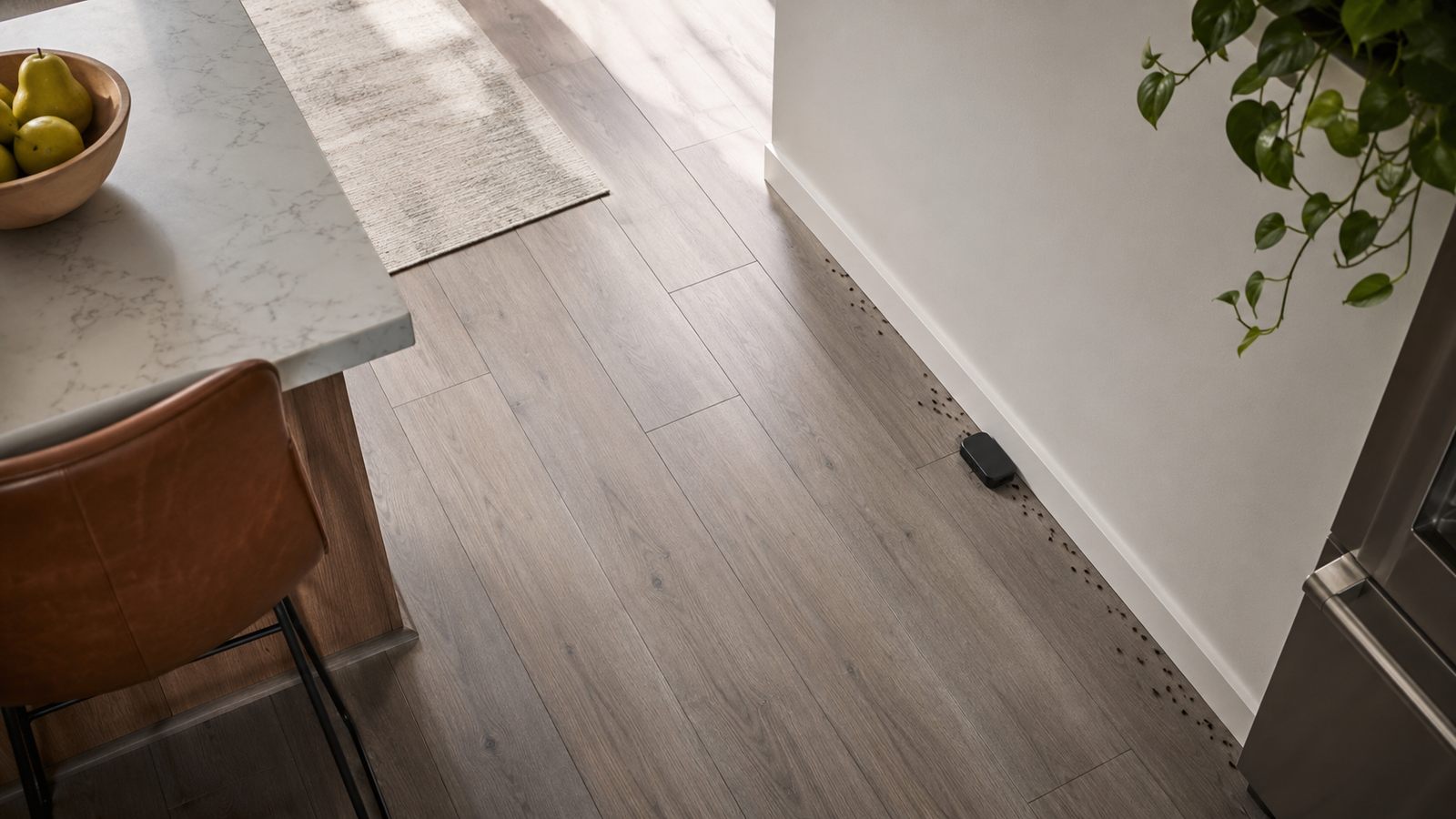
The critical placement guidance is consistent across professional sources: bait stations belong along baseboards, inside cabinet toe-kicks, behind appliances, and along the wall-floor junction where ant trails run. They do not belong on countertops where food is prepared, near pet food bowls, or in areas accessible to toddlers during normal household activity. If you have a crawling infant or a dog that investigates everything at floor level, use enclosed bait stations with child-resistant housing and place them inside locked cabinet lower shelves or behind appliance kick-plates where the ant trail crosses.
One area where buyer confusion is common: the distinction between indoor and outdoor formulations. Hydramethylnon-based granular products, which are highly effective against fire ant colonies outdoors, carry label restrictions against indoor use. Using an outdoor-only formulation inside a kitchen is not only a label violation – it is counterproductive, since the higher active-ingredient concentration can kill foragers before sufficient bait transfer occurs. Read the label. The use-site restrictions on pesticide labels are legally binding and based on safety data.
"Studies have shown time after time that fire ants have an extremely efficient foraging behavior and dominate those baits."
What to Look For Before You Buy: A Practical Checklist
After tracking this category through multiple ant seasons and reviewing field data from pest management professionals, I have identified the variables that most reliably predict whether a bait station purchase will solve the problem or leave the buyer frustrated. The checklist below translates that analysis into buying criteria any kitchen ant sufferer can apply before opening a product listing.
Brands active in the indoor bait station category include TERRO, Hot Shot, Amdro, Combat, and Raid. These manufacturers collectively cover the full range of active ingredients and station formats described in this article. My full side-by-side comparison of three leading products tested across multiple infestation scenarios is available in the companion buying guide linked below.
Match the active ingredient to your ant species. Odorous house ants and sugar feeders: choose borax liquid. Mixed or unknown species: choose indoxacarb stations. Fire ant perimeter: granular hydramethylnon or spinosad outdoors only.
Choose fully enclosed station housing. Open bait piles are unsafe around children and pets. Look for child-resistant station designs with ant-access apertures no larger than 1.5mm.
Verify the label use-site allows kitchen placement. Indoor-rated stations will say so explicitly. Outdoor-only or ‘perimeter use’ labels mean the product must stay outside the structure.
Buy a multi-pack rather than a single station. Effective colony elimination requires placing bait at multiple points along the foraging trail. The standard recommendation is 3 to 6 stations placed at intervals of 2 to 3 feet along observed trails.
Plan for a 14-day treatment window before evaluating results. Remove other food sources, seal entry points, and leave stations in place for a minimum of two weeks. Replacing or moving stations resets the pheromone trail and delays colony elimination.
Pair indoor stations with an outdoor perimeter treatment. Addressing only indoor foragers while the outdoor nest remains intact is a short-term fix. A granular perimeter bait applied around the foundation perimeter completes the IPM strategy.
Ready to compare your options?
I tested three of the top-selling ant bait station products head-to-head across real kitchen infestations – measuring kill speed, bait uptake, colony elimination rate, and ease of placement. The full comparison covers TERRO, Hot Shot MaxAttrax, and Amdro, with a clear verdict on which formula wins for each infestation type.
Frequently Asked Questions
Why do ant bait stations attract MORE ants at first? +
This is normal and actually a sign the bait is working. Worker ants are drawn to the food-grade attractant inside the station and lay down pheromone trails that recruit more foragers from the colony. The bait is slow-acting by design, giving workers time to carry lethal doses back to the nest before dying. Increased ant activity in the first 24 to 72 hours means the bait is being taken up efficiently. Resist the urge to remove the station – let the process run its course.
Are ant bait stations safe to use in the kitchen near food? +
Enclosed bait stations are designed to limit access by children and pets, and the active ingredients are present at very low concentrations – borax at around 5% in liquid stations, and indoxacarb at 0.05% in station-type products. The National Pesticide Information Center (NPIC) at Oregon State University notes that borax is a relatively low-toxicity substance at the concentrations used in consumer bait products. Stations should be placed along baseboards, under appliances, and behind cabinet toe-kicks – not directly on food-prep countertops. Always follow the product label.
How long does it take for ant bait stations to work? +
Expect visible improvement in 7 to 14 days for most indoor kitchen ant infestations. Borax-based liquid baits typically show significant colony reduction in 3 to 7 days for small infestations. Indoxacarb-based stations may take 7 to 14 days but are formulated to work against a wider range of species including grease-preferring ants. Granular outdoor formulations targeting perimeter fire ant colonies can take 4 to 8 weeks. Do not disturb stations or apply other pesticides during the treatment window, as this disrupts foraging and slows colony elimination.
Should I use indoor and outdoor ant bait at the same time? +
Yes, a two-pronged approach is recommended by the University of California Integrated Pest Management program and Penn State Extension. Ants nest outdoors and forage inside for food and water. Placing liquid or station-type bait indoors along entry points and foraging trails addresses the immediate kitchen problem, while a granular perimeter treatment outdoors targets colonies before they send additional workers inside. Be careful not to apply broad-spectrum repellent pesticides near indoor bait stations, as repellent residues will cause ants to avoid the bait entirely.