

Disclosure: As an Amazon Associate, I earn from qualifying purchases. – Maya Bennett
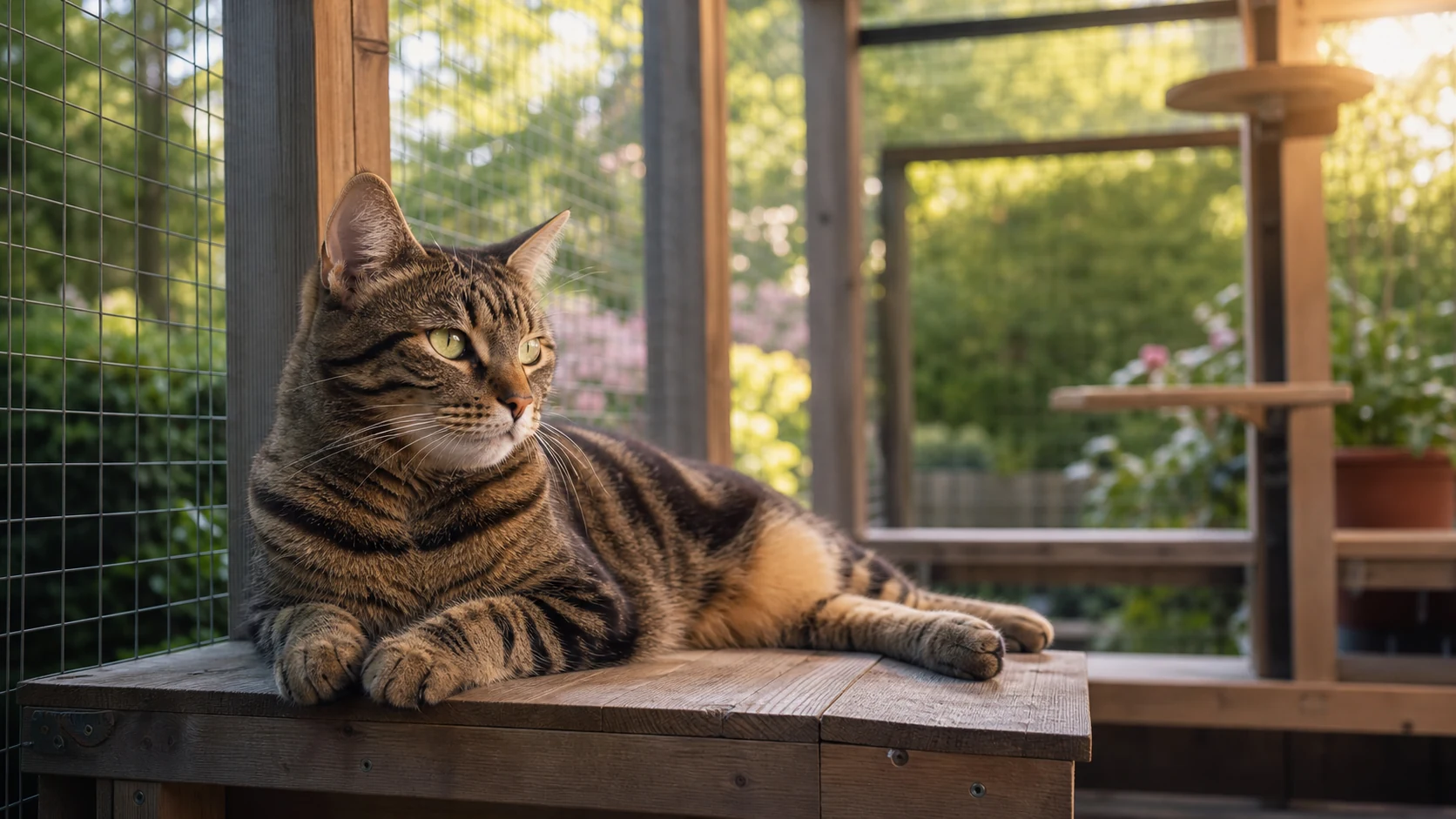
Outdoor cat enclosures – catios – are the breakout pet purchase of summer 2026, because affordable ready-made kits now solve the old dilemma between indoor-cat boredom and outdoor danger. Veterinary and humane-society guidance broadly endorses supervised outdoor access, but only when the enclosure is genuinely escape-proof, shaded, and built for enrichment – not just containment.
Catios have crossed over from a weekend DIY hobby into one of the most-bought pet products of the season, and the data behind the surge is more clinical than cute: protected indoor cats commonly live 12 to 18 years against 2 to 5 for outdoor-only cats, and a screened enclosure is now the cheapest way to capture both the longevity and the enrichment.
That tension – between the boredom of a fully indoor life and the very real dangers of a free-roaming one – has nagged at cat owners for decades. What changed in 2026 is supply. Flat-packed freestanding frames, pop-up mesh tunnels, and bolt-on window boxes have driven the entry price down far enough that renters and small-yard households can finally act on advice vets have given for years.
Why catios broke out this summer
I have been tracking the catio category across Amazon and pet-trend roundups since early spring, and the shift this year is hard to miss. What used to be a niche DIY project – cobbling together cedar frames and hardware cloth over a weekend – has been overtaken by ready-made freestanding and window-box kits that ship flat-packed for under a long afternoon of assembly. Listings for these enclosures are now showing 100 or more recent purchases per model heading into the warm-weather window, the period when searches for outdoor cat spaces climb sharply from late April through August.
The appeal is structural, not just seasonal. Renters and small-yard owners who could never justify a permanent backyard build can now drop a pop-up mesh tunnel onto a balcony or bolt a window box to a single sash. That removes the two biggest historic barriers to giving an indoor cat outdoor access: cost and landlord permission. Per my reporting, the brands competing hardest in this space right now include YITAHOME, PawHut, PetsCosset, and Nyeekoy, alongside established catio specialists – a crowded field that signals real demand rather than a passing curiosity.
The veterinary case for supervised outdoor access
The trend lines up neatly with where animal-welfare authorities have landed. The American Veterinary Medical Association holds that housing owned cats in an outdoor enclosure minimizes risks to the cat, to wildlife, to humans, and to the environment – a policy position that effectively endorses the catio concept without naming any product. The same guidance notes that free-roaming raises a cat’s exposure to vehicles, predator attacks, poisons, weather extremes, and infectious, parasitic, and zoonotic disease.
The lifespan gap is the statistic that tends to stop owners mid-scroll. Veterinary consensus, including a UC Davis lifestyle analysis, puts protected indoor cats at roughly 12 to 18 years against just 2 to 5 years for outdoor-only cats. A catio is the bridge: it preserves that indoor longevity while restoring the sensory stimulation – birdsong, breeze, sun, and the chance to stalk a passing leaf – that confinement alone strips away. The ASPCA likewise recommends supervised outdoor access over free-roaming for owned cats.
Enrichment is the real driver, not novelty
It would be easy to write catios off as a social-media aesthetic, but the underlying problem they solve is clinical. Indoor-only cats deprived of stimulation commonly develop boredom, stress, weight gain, and destructive behaviors – the scratched furniture and 3 a.m. zoomies that owners quietly tolerate. Behaviorists frame play and predatory opportunity not as enrichment extras but as core pillars of feline wellbeing.
That is the distinction buyers are starting to understand: a catio is only worth the money if it delivers genuine enrichment, not merely containment. A bare wire box parked in the shade checks the safety box and fails the welfare one. The models gaining traction this season tend to include perches at varied heights, tunnels that encourage movement, and sightlines onto a yard or street where there is something to watch.
The three catio formats buyers are choosing
The market has effectively sorted itself into three formats, each matched to a different living situation. Freestanding wooden enclosures suit homeowners who want a permanent fixture on a patio or lawn. Pop-up mesh tents and tunnels suit renters, travelers, and anyone testing the waters on a tight budget. Large window-box and walk-in units suit multi-cat households that need room for more than one animal to perch and pass without crowding.
The category table below maps those formats against their core construction, typical price band, and the brands competing in each. It is a buyer’s map, not a recommendation – I am leaving the head-to-head verdict to the companion comparison guide, where the picks are tested against the safety criteria below.
| Catio Format | Core Construction | Price Range | Representative Brands |
|---|---|---|---|
| Freestanding wooden | Cedar/fir frame + wire mesh panels, multi-tier, weather roof | $250 – $400 | Aivituvin, YITAHOME, Aosom |
| Pop-up mesh / portable | Collapsible polyester mesh tent + tunnel, no tools | $30 – $80 | LUCKITTY, PetsCosset, Nyeekoy |
| Window-box / walk-in | Large wooden walk-in, window passthrough, multi-cat | $400 – $550 | PawHut, Habitat Haven, Catio Spaces |
⇆ swipe horizontally on mobile
What a safe catio actually requires
The single biggest mistake I see in this category is treating any mesh box as predator-proof. Humane World is blunt on the point: cats are climbers and wily diggers, and an enclosure has to be built to be escape-proof, with 1/2-inch or smaller hardware cloth, a solid roof, locking latches, and ideally a double-door vestibule so a cat cannot bolt past you at the threshold. Coyotes and hawks defeat flimsy screening, and a determined cat will exploit any gap at the base.
Heat is the second, season-specific hazard. PetMD warns that heatstroke becomes a danger once a cat’s body temperature climbs past 104 degrees, and mesh tents in particular heat up fast on hot, humid days. Any enclosure used in summer needs reliable shade and fresh water, and should be avoided during peak afternoon heat. Parasite exposure is the quiet third risk: even screened outdoor time raises the odds of fleas, ticks, and intestinal worms, so year-round prevention stays on the schedule regardless of how secure the catio is.
“Safety alone does not guarantee good overall health and welfare for indoor cats.“
How to shop a catio without getting burned
If you are weighing a purchase this summer, the checklist below distills the vet and humane-society guidance into the handful of specifications that actually separate a safe enclosure from a flimsy one. None of it requires expertise – it is mostly about reading the listing closely before you click buy.
What I am watching next
Two things will shape this category through the back half of 2026. First, durability claims: the freestanding wooden units make year-round, weatherproof promises that are easy to print and hard to verify, and I expect buyer reviews to start separating the genuinely weather-rated frames from the ones that warp by August. Second, modularity. The brands that let owners bolt tunnels, extensions, and window passthroughs onto a base unit are the ones turning a one-time catio buyer into a repeat one.
For now, the takeaway for shoppers is simple. A catio is one of the few pet purchases that vets, behaviorists, and humane societies broadly endorse – provided it is built right. Get the mesh, roof, latches, and shade correct, keep the parasite prevention going, and a screened porch becomes the rare upgrade that is good for the cat, the local wildlife, and your furniture all at once.
Ready to compare your options?
In the companion buying guide I put three catio formats head to head – a permanent freestanding 4-tier enclosure, a budget pop-up tent for renters and travel, and a large multi-cat window-box walk-in – and score each against the vet and humane-society safety criteria above.
Frequently Asked Questions
Why are catios trending for indoor cats in 2026? +
Catios are surging because ready-made freestanding and window-box kits have replaced costly DIY wood builds, making supervised outdoor access affordable for renters and small-yard owners. The spring-summer warm-weather window drives the seasonal spike, and veterinary groups increasingly frame enrichment as a welfare need, not a luxury. Amazon catio listings now routinely show 100+ recent purchases per model.
Do catios actually keep cats safer than free-roaming? +
Yes. The AVMA states that housing owned cats in an outdoor enclosure minimizes risks to the cat, wildlife, humans, and the environment. Free-roaming raises a cat’s exposure to vehicles, predator attacks, poisons, and infectious or parasitic disease. Protected cats commonly live 12 to 18 years versus 2 to 5 years for outdoor-only cats, per veterinary lifespan data.
Are catios safe from predators like hawks and coyotes? +
A catio is only predator-safe if it is built to be escape-proof and intrusion-proof. Humane World guidance recommends 1/2-inch or smaller hardware-cloth mesh, a solid roof, locking latches, and ideally a double-door vestibule. Cats are climbers and diggers, and coyotes or hawks will defeat flimsy screening, so mesh gauge and a covered top matter more than square footage.
Do indoor cats with a catio still need parasite prevention? +
Yes. Any outdoor access, even inside an enclosure, increases exposure to fleas, ticks, and intestinal worms such as roundworm, hookworm, and tapeworm, some of which are zoonotic. Veterinary sources including VCA Hospitals and PetMD advise maintaining year-round, vet-recommended parasite prevention even when a cat only uses a screened catio.