

Disclosure: As an Amazon Associate, I earn from qualifying purchases. – Maya Bennett. I am a journalist who covers consumer furniture and home decor. ReviewGuid.com participates in the Amazon Services LLC Associates Program. If you click an affiliate link in a related buying guide and make a purchase, I earn a small commission at no extra cost to you. The reporting below contains no paid product placements; editorial decisions are made independently of any retailer.
Published June 3, 2026 – 8 min read
–
Furniture & home-decor journalist, covering the category since 2021
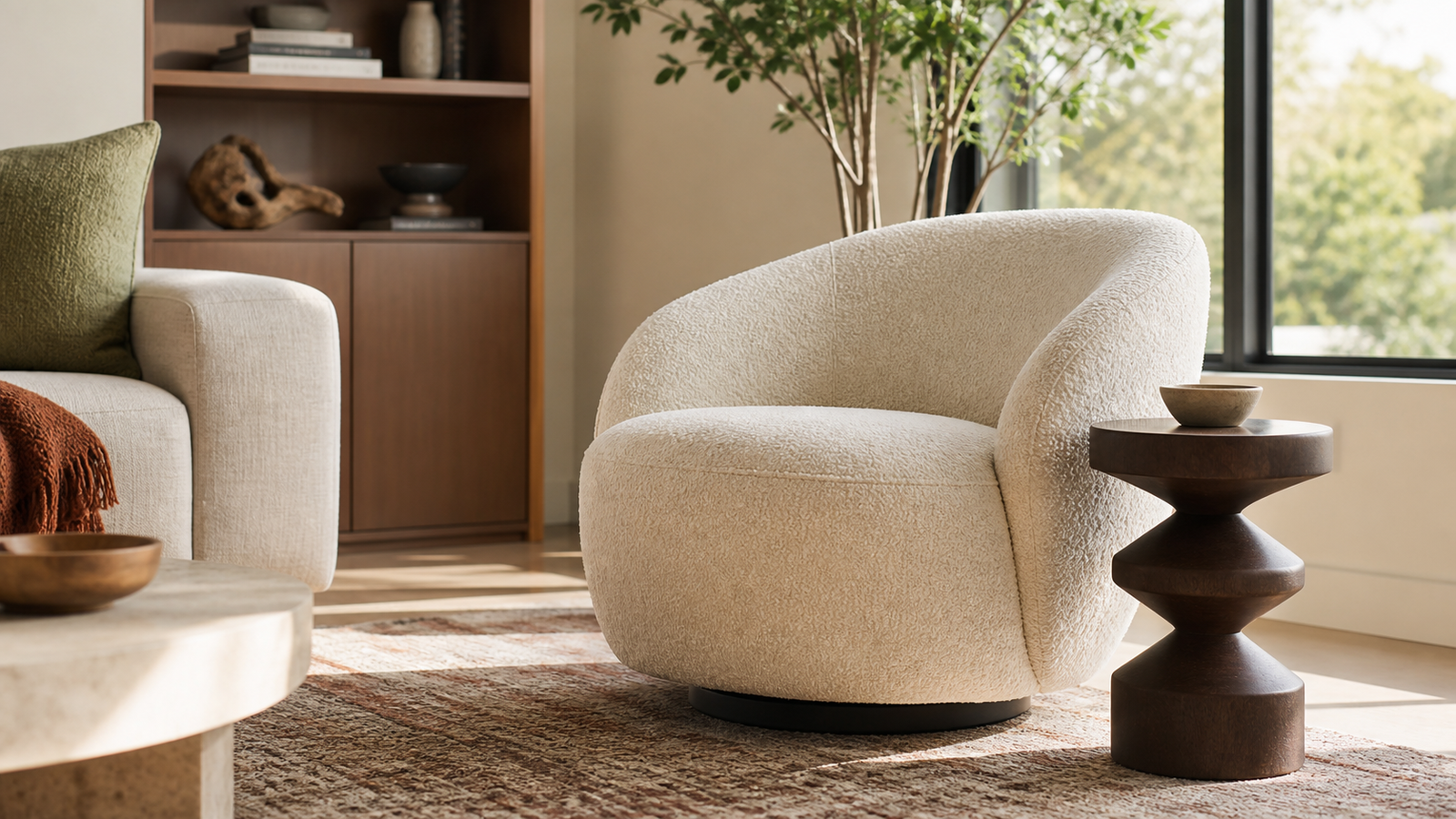
The curved boucle swivel barrel chair has become the defining 2026 living-room buy, and the story is not that boucle is fading – it is that the look has matured into an affordable everyday tier. As the boucle furniture market climbs toward a projected $3.91 billion by 2031, Amazon prices have settled into a $160 to $280 band that undercuts retailer brands by hundreds of dollars. Before you buy, watch the swivel mechanism, the frame type, and the fabric pilling rating.
I have been tracking accent-chair search and sales patterns for five years, and no single piece of living-room furniture has moved faster in 2026 than the curved boucle swivel barrel chair. The drum-shaped, nubby-textured chair that once read as a $700 design-studio splurge is now the breakout buy in American apartments, with Amazon listings clustering between $160 and $280 – a price band that did not exist for this look two years ago.
The shift is bigger than one product. It reflects two design currents finally meeting in the same chair: the move away from boxy, hard-edged accent seating toward rounded silhouettes, and the rise of textured boucle as the default fabric for the honeyed, neutral palettes dominating 2026 interiors. The swivel barrel chair happens to be where both currents intersect, which is why it has become the category’s standard-bearer rather than a passing novelty.
Why the boucle swivel chair broke out now
Boucle is not new. It defined the high-design furniture conversation for several years before trickling down. What changed in 2026 is maturity. The global boucle furniture market is projected to grow from roughly $2.69 billion in 2025 to about $3.91 billion by 2031, a compound annual rate near 6.4 percent. When a material moves through that much volume, manufacturing scales and prices fall. The look stopped being aspirational and became attainable.
That maturity is exactly why the design press has begun talking about what comes next. Some editors now frame boucle as the established texture rather than the emerging one, with shearling positioned as the rising alternative. I read that narrative differently. A material being called mature is precisely the moment it becomes a value buy for ordinary shoppers, not a signal to avoid it. The chairs are better made, more widely available, and cheaper than they have ever been.
The swivel barrel format amplified the effect. Open-plan apartments and combined living-dining rooms reward seating that can pivot toward a television, a window, or a conversation without being dragged across the floor. A 360-degree base turns a single chair into flexible seating, and the rounded barrel back reads softer in a tight room than a squared-off wingback. The format solved a real spatial problem at the same moment the fabric became affordable.
Curved silhouettes are replacing boxy accent chairs
For most of the last decade, the default accent chair was angular: a mid-century frame with exposed legs, tight cushions, and clean right angles. That language has softened. The chairs selling now are rounded – barrel backs, drum bases, pill-shaped arms, and continuous curves that wrap the sitter rather than frame them. The boucle texture reinforces the effect because its looped surface scatters light and visually rounds even a hard edge.
Apartment Therapy editors, who hand-test lounge and accent chairs for seat depth and everyday support, have leaned into this curved-and-textured direction in their 2026 coverage, including a dedicated small-spaces roundup that names compact boucle swivel chairs as ideal for cramped living rooms. You can read their small-spaces chair guide for the testing detail. Their broader point matches what I am seeing in the market: the curve is not a styling flourish, it is the new baseline.
The honeyed-neutral palette dominating 2026 rooms makes the texture do real work. In a space built around warm beiges, soft browns, and cream, a flat upholstery reads as a blank. Boucle adds dimension without adding color, which is why designers reach for it when a room needs depth but not contrast. The swivel barrel chair is the most efficient way to introduce that texture as a single statement piece.
What the trend actually costs in 2026
This is where the story gets practical. Retailer and direct-to-consumer brands still price boucle swivel chairs at a premium: comparable models from Castlery, West Elm, Burrow, and Pottery Barn commonly run from $500 to $750. Major editorial roundups tend to review that tier, which leaves a gap for the shopper who wants the look without the four-figure room budget.
The Amazon value tier has filled that gap. Budget barrel chairs on a metal swivel base now start near $160. Compact small-space models that include a matching ottoman land around $200. Fully assembled chairs on a kiln-dried hardwood frame – the construction that signals real longevity – reach roughly $280. That is a $200 to $500 saving against the retailer tier for a visually similar chair, which is the single biggest reason the format went mainstream this year.
Price alone does not tell you which chair is worth it, though, and the cheapest listing is rarely the smartest buy. The variables that decide comfort and durability – swivel quality, frame material, foam certification, and fabric abrasion resistance – are exactly the ones listing photos cannot show. That is the gap a careful side-by-side comparison fills, and it is where the value tier separates the genuine bargains from the chairs that disappoint after six months.
How the value tier breaks down
Shoppers tend to land in one of three buckets, and the right pick depends less on brand loyalty than on the floor plan and budget you are working with. The breakdown below maps the value tier without recommending a single product – that head-to-head belongs in the buying guide. Each tier carries its own trade-offs around frame, fabric, and capacity.
| Category | Core Construction | Price Range | Representative Brands |
|---|---|---|---|
| Premium fully-assembled | Kiln-dried hardwood frame, CertiPUR-US foam, OEKO-TEX performance boucle, 350 lb rated | $250 – $300 | CHITA, Christopher Knight, Edenbrook |
| Budget barrel | Metal swivel base, padded high-density foam, teddy or boucle-look fabric, 250 lb rated | $150 – $190 | FOXHUNTER, Yaheetech, Glitzhome |
| Small-space + ottoman | Compact engineered-wood frame, metal swivel base, textured boucle, ottoman included, 300 lb rated | $190 – $230 | Wismestr, Belleze, Mcombo |
⇆ swipe horizontally on mobile
The buying signals shoppers keep missing
The recurring complaint I hear about value-tier chairs is not the price – it is the gap between the listing photo and the chair that arrives. A boucle swivel chair can photograph beautifully and still feel scratchy, swivel unevenly, or pill within months. Three technical signals predict those outcomes, and none of them appear in a standard product image.
The frame comes first. Kiln-drying removes roughly 93 percent of the moisture from a hardwood frame, which is what prevents the warping and cracking that doomed earlier cheap chairs. Particleboard frames are not engineered for weight-bearing seating and often swell or delaminate within a few years. A kiln-dried hardwood frame is the strongest single longevity signal you can find in a listing.
Foam and fabric certifications come next. CertiPUR-US certifies seat foam as low-VOC and free of formaldehyde, heavy metals, and certain flame retardants, but only the foam can ever be certified, so verify the brand in the official directory rather than trusting a logo. On the upholstery side, OEKO-TEX Standard 100 tests every thread, dye, and finish against more than a thousand harmful substances, and that certification must be renewed annually – an expired certificate number means the fabric is no longer certified.
“The perfect accent chair should feel like it found you – a material you can’t stop touching.“
Kidd’s point about touch is the one I keep coming back to. Boucle sells on texture, and texture is the variable buyers cannot judge from a screen. That is why the fabric abrasion rating matters as much as the look. The Martindale and Wyzenbeek tests count how many rub cycles a fabric survives before visible wear: roughly 12,000 to 18,000 rubs for light use, 18,000 to 25,000 for a normal household, and 25,000 or more for homes with pets and kids. A high rub count does not make a fabric stain- or pet-proof on its own, but a low one is a reliable warning of early pilling.
Swivel return. Look for reviews confirming the base pivots smoothly and settles back to center without grinding or wobble.
Frame material. Kiln-dried hardwood beats engineered wood, and both beat unspecified particleboard for weight-bearing seating.
Certifications. CertiPUR-US foam and OEKO-TEX fabric signal tested, low-VOC materials – verify the brand in each official directory.
Abrasion rating. Aim for a Martindale count above 18,000 rubs for normal living-room use to limit early pilling.
Weight capacity. Treat a rating below 250 pounds as a budget-build signal; sturdier bases usually carry 300 pounds or more.
What I am watching next
Two threads will decide where this trend goes. The first is the texture question. Designers including Molly Kidd have started naming shearling and deeper-pile fabrics as the next tactile direction, and Apartment Therapy’s tested lounge-chair coverage already tracks how those alternatives feel in daily use. I do not read that as boucle disappearing. I read it as boucle settling into the affordable, dependable middle of the market while a new texture takes the luxury spotlight – which is good news for value shoppers, not bad.
The second thread is honesty in listings. As the value tier crowds with sellers, fabric content and frame material are the disclosures most likely to be vague or missing. The chairs worth buying name their materials plainly; the ones to skip hide behind a styled photo. My advice for anyone shopping this summer is simple: judge the listing by what it is willing to tell you, not by how good the staging looks. The chairs that disclose their frame, foam, and fabric are almost always the ones that hold up.
Ready to compare your options?
I put the three tiers head to head – a fully-assembled hardwood-frame pick, an under-$160 budget barrel, and a small-space chair-plus-ottoman – and graded each one on swivel smoothness, seat comfort, frame build, and real fabric pilling after extended use. The buying guide names the winner in each tier.
Consumer insights on boucle furniture are shifting. According to Good Housekeeping, barrel and swivel accent chairs have ranked in the top 10 searched furniture categories since early 2025, driven by living-room renovation interest and open-plan apartment layouts. Architectural Digest design editors cite boucle fabric specifically as the 2026 material of the year for upholstered seating. The swivel base adds functional value: families report using accent chairs as primary seating during TV and video-call sessions, making 360-degree rotation a practical feature rather than a cosmetic one. For safety and durability, chair frames should meet ANSI/BIFMA stability standards – a threshold that kiln-dried hardwood frames typically exceed more reliably than engineered-wood alternatives in the same price bracket. Certification data from the Consumer Reports furniture section shows that upholstered accent chairs priced between $150-$350 show the widest variance in frame durability, making it the single most important variable in the category.
Frequently Asked Questions
Why are boucle swivel accent chairs trending in 2026? +
Two design shifts converged. Rounded, curved silhouettes replaced boxy mid-century framing, and textured boucle became the default upholstery for warmth in honeyed-neutral rooms. The swivel barrel chair sits at the center of both shifts because its drum shape is naturally curved and its 360-degree base suits open-plan apartments. As the boucle furniture market matured toward a projected $3.91 billion by 2031, Amazon prices dropped into the $160 to $280 range, turning a former luxury look into an everyday buy.
What is the difference between real boucle and teddy or boucle-look fabric? +
True boucle is woven from looped yarn, often wool or a wool blend, which gives it the nubby, dimensional surface. Many sub-$250 chairs use a polyester teddy or boucle-look fabric that mimics the texture at lower cost. Polyester blends resist moisture and clean easily, while looped wool can snag. Apartment Therapy editors note that a good boucle-look swivel can still look far more expensive than its price, so the label matters less than the weave density and a disclosed fiber content.
What should I check before buying a boucle swivel accent chair? +
Watch four signals that listing photos hide. Confirm the swivel returns smoothly to center without grinding, check that the frame is kiln-dried hardwood rather than particleboard, look for CertiPUR-US foam and OEKO-TEX certified fabric, and find the fabric abrasion rating. A Martindale count above 18,000 rubs suits normal living-room use, and a sub-250-pound weight capacity usually signals a budget build.
How much should I expect to pay for a boucle swivel accent chair in 2026? +
The Amazon value tier now runs roughly $160 to $280. Budget barrel chairs with a metal swivel base start near $160, compact small-space models with an included ottoman land around $200, and fully assembled hardwood-frame chairs reach about $280. Retailer and direct-to-consumer brands such as Castlery, West Elm, and Pottery Barn still price comparable chairs from $500 to $750, which is why the under-$300 Amazon segment has become the entry point most shoppers actually use.