

Disclosure: As an Amazon Associate, I earn from qualifying purchases. This article contains affiliate links at no additional cost to you. – Maya Bennett
Robotic pool skimmers are moving from novelty to a distinct pool-care category in 2026. Larger baskets, 28-35 hour battery claims, solar plus adapter charging and app controls now address the daily leaf problem without pretending to replace a floor vacuum or water-safety routine.
largest basket here
longest stated reserve
finest stated filter
longest warranty
current Amazon models
Why robotic pool skimmers are surging now
Robotic pool skimmers are separating into their own shopping category in 2026. These machines float on the surface and intercept leaves, pollen, insects, hair and small twigs before that material becomes waterlogged and sinks. They are not floor vacuums, and that distinction is the reason buyers are searching for them separately.
The timing is unusually strong. Beatbot launched a lower-priced iSkim in North America this spring, Aiper continues to push app-controlled solar operation, and Betta has accumulated a much deeper owner-review history. At the same time, summer coverage from large technology publications has made the category visible beyond specialist pool forums.
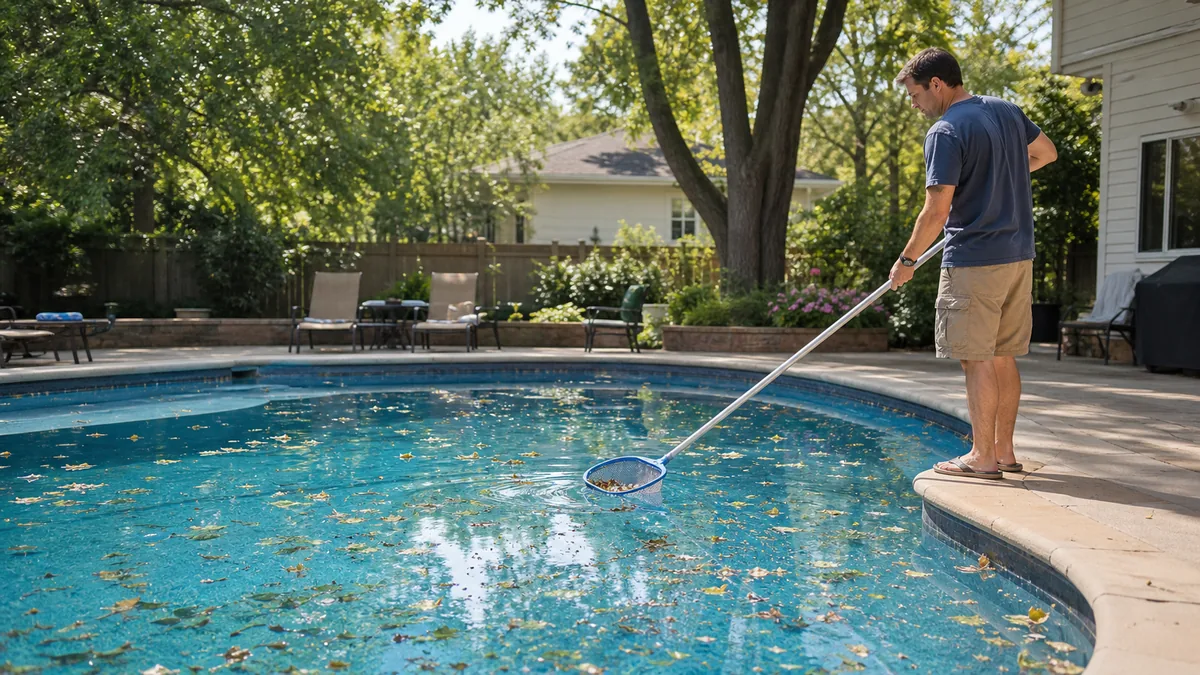
Leaves create a simple but persistent maintenance loop. A windy afternoon can refill a clean surface in minutes, while a manual net only works when someone is standing beside the pool. If the debris sinks, a floor robot, suction cleaner or manual vacuum must handle it later. Surface interception changes when the work happens.
Solar power makes the proposition easier to understand. A large panel can support daytime movement, while an internal battery carries the robot through shade or night. Dual-charging models add an adapter for cloudy stretches. The practical comparison is not solar versus electricity; it is how much useful reserve remains when the pool receives poor sun.
Basket size is becoming the clearest category metric. Beatbot advertises 9L, Aiper lists 4L, and Betta emphasizes a large fine-mesh top basket without using the same directly comparable volume. A pool under mature deciduous trees should value volume first. A screened pool fighting pollen may value finer mesh more.
Filtration numbers also need context. A 150-micron filter can retain finer particles than a 200-micron basket, but fine mesh can restrict flow sooner when covered by wet organic matter. The best design depends on the debris mix, not the smallest number printed in a specification table.
The timing is supported by fresh reporting. Tom’s Guide published a July 2026 field report on the new Beatbot iSkim, while the manufacturer documented its North American launch and 9L basket in an April product announcement. Manufacturer claims remain claims until they are supported by broader ownership history.
“We set out to solve a straightforward but recurring issue, keeping the pool surface clean without constant intervention.”
Jimmy Hu, Beatbot VP – manufacturer perspective
What changed in the 2026 product generation
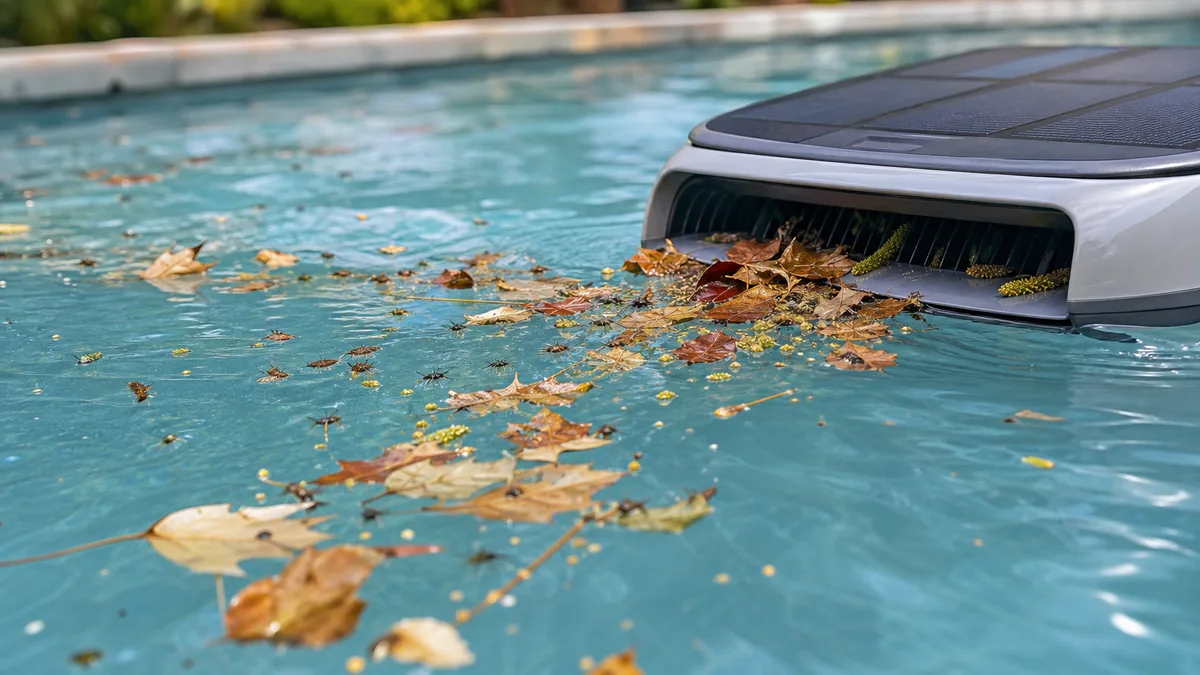
Navigation is less like a robot vacuum map and more like persistent surface patrol. Wind, return jets, built-in skimmers, waterfalls, floating loungers and shallow tanning shelves can all redirect or trap a machine. Sensors and anti-stranding hardware reduce intervention, but no current model understands every custom pool feature.
App control is moving from novelty to maintenance tool. Scheduling lets an owner run the robot before swimming hours, obstruction alerts reveal repeated trouble spots, and edge-return commands make retrieval easier. The Aiper app requires 2.4 GHz Wi-Fi, a detail worth checking before setup day.
A robotic skimmer does not sanitize water. It removes visible debris and may reduce the organic load reaching the circulation system, but chlorine or bromine, pH checks, filtration and contamination response still follow separate rules. Buyers should reject any marketing language that treats cleaner-looking water as proof of safe water.
Child safety is equally separate. A floating robot is equipment in the pool, not a supervision system, alarm, barrier or rescue device. It should be removed when it interferes with swimming, and the pool still needs the layers of protection recommended by federal safety guidance.
The purchase decision therefore starts with the yard. Count how many hours of direct sun reach the water, identify the trees that shed into it, note the dominant leaf size, and photograph recurring trap points. That information predicts ownership better than a generic promise of continuous cleaning.
Heavy-leaf owners should inspect inlet width and basket access. A wide mouth can accept curled leaves and small clusters, while a top-opening basket is easier to lift without spilling. The best routine is frequent inspection during the first week, followed by a schedule based on real fill rate.
| Pool problem | Metric to prioritize | Watch-out |
|---|---|---|
| Large dry leaves | Basket volume and inlet width | Frequent emptying in peak fall |
| Pollen and insects | Micron rating and easy rinsing | Fine mesh can restrict flow |
| Shaded pool | Battery reserve and adapter | Solar claims need direct light |
| Complex ledges | Sensors and anti-stranding design | No robot escapes every feature |
What buyers should check before ordering
Pollen-heavy owners should compare filtration and rinsing effort. Yellow pollen can coat fine mesh and make a basket appear full before its volume is used. A garden hose rinse may restore flow quickly, but the basket must be handled away from swimmers and returned securely.
Shaded-pool owners should prioritize adapter charging and battery reserve. Solar panels are useful, but tree cover that causes the leaf problem can also limit the energy available to solve it. Betta and Aiper include backup adapter charging, while the standard Beatbot adapter is sold separately.
Warranty length matters because these products combine batteries, motors, sensors and outdoor exposure. Beatbot lists three years, Aiper lists two and Betta lists one. Coverage terms, registration requirements and shipping responsibility should be read before the retailer return window closes.
Price is volatile during pool season. The three products in this cluster sit roughly in the mid-$300 to $400 range during the current research window, but coupons and event pricing move quickly. The right comparison is total value after charger, warranty and expected basket workload, not a single sale badge.
The strongest use case is a pool that looks dirty every afternoon despite a functioning circulation system. A surface robot can patrol while the owner works, travel or sleeps. The weakest use case is a tiny covered pool with little debris, where a hand net solves the problem in two minutes.
What I am watching next is reliability over a full leaf season. The new Beatbot has compelling capacity, Betta has the deepest owner history, and Aiper combines fine filtration with stronger software. The category has reached the point where the differences are practical enough to support a real comparison rather than a novelty roundup.
A cleaner surface is not a safety system
The CDC healthy-swimming guidance keeps disinfectant, pH, supervision and chemical handling in their proper roles. The CPSC Pool Safely program addresses barriers and drowning prevention. A robot changes neither responsibility.
Direct sun and recurring trap points.
Basket size to leaf volume.
Warranty and charging accessories.
Water chemistry and safety layers.
Compare the three current picks
See Beatbot, Betta and Aiper compared by leaf capacity, filtration, runtime, charging and warranty.
Frequently asked questions
Why are robotic pool skimmers trending in 2026?
New solar models combine longer battery reserve, larger baskets, app controls and mid-$300 pricing, making continuous surface patrol more practical for ordinary backyard pools.
Do robotic pool skimmers replace a pool vacuum?
No. A surface skimmer collects floating leaves, pollen and insects. A pool vacuum cleans material that has already sunk to the floor or attached to walls.
Can a solar pool skimmer work overnight?
Yes, if its battery has enough stored energy. Current models advertise roughly 28 to 35 hours of reserve, but actual runtime changes with sun, water movement and obstacles.
Do robotic skimmers make pool water safe?
No. They remove visible debris but do not replace disinfectant, pH testing, circulation, filtration, contamination response or child-safety barriers and supervision.