

As an Amazon Associate, I earn from qualifying purchases. This article contains affiliate links at no additional cost to you. – Maya Bennett
$129.99
Updated July 23, 2026 – Maya Bennett – 24 min read
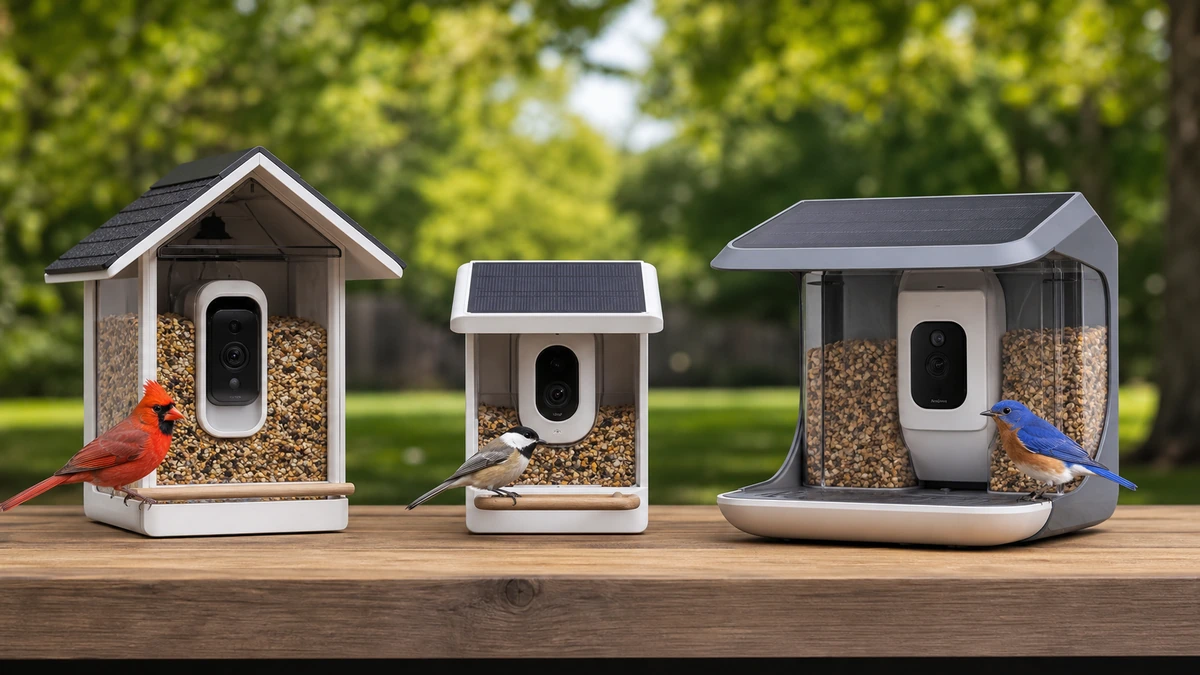
Birdfy is the best overall choice for buyers who want a balanced 2K camera, solar charging, a mature app, and free cloud clips; HEAPETS is the lower-cost 2K option, while Camojojo is the stronger local-video choice with 4K recording, an included 32GB card, and dual-band Wi-Fi. Here, no subscription means useful core viewing or storage remains available without a required plan – it does not promise free lifetime access to every AI identification feature or unlimited cloud history.
How we picked these 3 smart bird feeder cameras
This is a documentation-led comparison, not a claim that ReviewGuid installed and field-tested all three feeders. We reviewed the product listings and supplied manufacturer information available on July 23, 2026, then compared the details that change everyday ownership: what works before a paid plan is added, where clips are stored, camera resolution, live-view resolution, Wi-Fi bands, solar or battery support, weather protection, price, rating, and the size of the visible buyer-review base. We weighted core no-subscription usefulness and storage clarity more heavily than broad AI marketing because an impressive species count is less useful if basic clips are difficult to access. We also separated local recording from cloud history and separated recorded resolution from remote live-stream resolution. Ratings and prices are snapshots, not permanent guarantees.
Wildlife safety and maintenance were part of the comparison because camera features do not excuse poor feeder care. The Project FeederWatch feeding guidance supports regular cleaning and complete drying before refilling. The U.S. Fish and Wildlife Service explains that feeding decisions should account for local conditions and responsible management. The National Audubon Society provides context for placement that reduces window-collision risk. These sources informed the ownership guidance, but they do not endorse any product here.
Research context: published product data, Amazon US listing snapshots, official product pages, Project FeederWatch, U.S. Fish and Wildlife Service, and National Audubon Society. See our editorial methodology and the companion smart bird feeder camera trend report.
Full spec sheet at a glance
| Feature | Birdfy | HEAPETS | Camojojo |
|---|---|---|---|
| Best for | Best overall balance | Budget 2K setup | 4K local video |
| Camera | 2K HD, color night vision | 2K HD live video | 4K local, 32MP stills |
| Price checked | $129.99 | $59.99 Prime, $79.99 regular | $142.87 |
| Amazon rating | 4.4/5 | 4.3/5 | 4.5/5 |
| Review count | 1,493 | 1,386 | 324 |
| Storage | Free cloud clips | 3-day rolling cloud, microSD to 128GB | 32GB card included, to 128GB, 7-day cloud |
| Wi-Fi | 2.4GHz | 2.4GHz | 2.4GHz and 5GHz |
| Core plan status | Free clips; advanced AI paid | Core use free; AI optional after trial | Core use free; extended cloud and unlimited AI optional |
| Power and protection | 5200mAh plus solar; weather and UV resistant | Solar-powered camera; weatherproof listing | Solar listing; IP66 housing |
| Warranty | Confirm current seller terms | Confirm current seller terms | Confirm current seller terms |
⇆ swipe horizontally on mobile – prices last verified July 23, 2026
The 3 picks, in detail
The rankings below favor ownership clarity over the longest feature list. A feeder camera should still be useful if you decline an optional AI plan, and it should make storage choices understandable before checkout. Each section separates documented capabilities from reasonable buying implications. We did not install these units side by side, so references to likely fit are comparisons of published specifications, not measurements from a ReviewGuid backyard test.
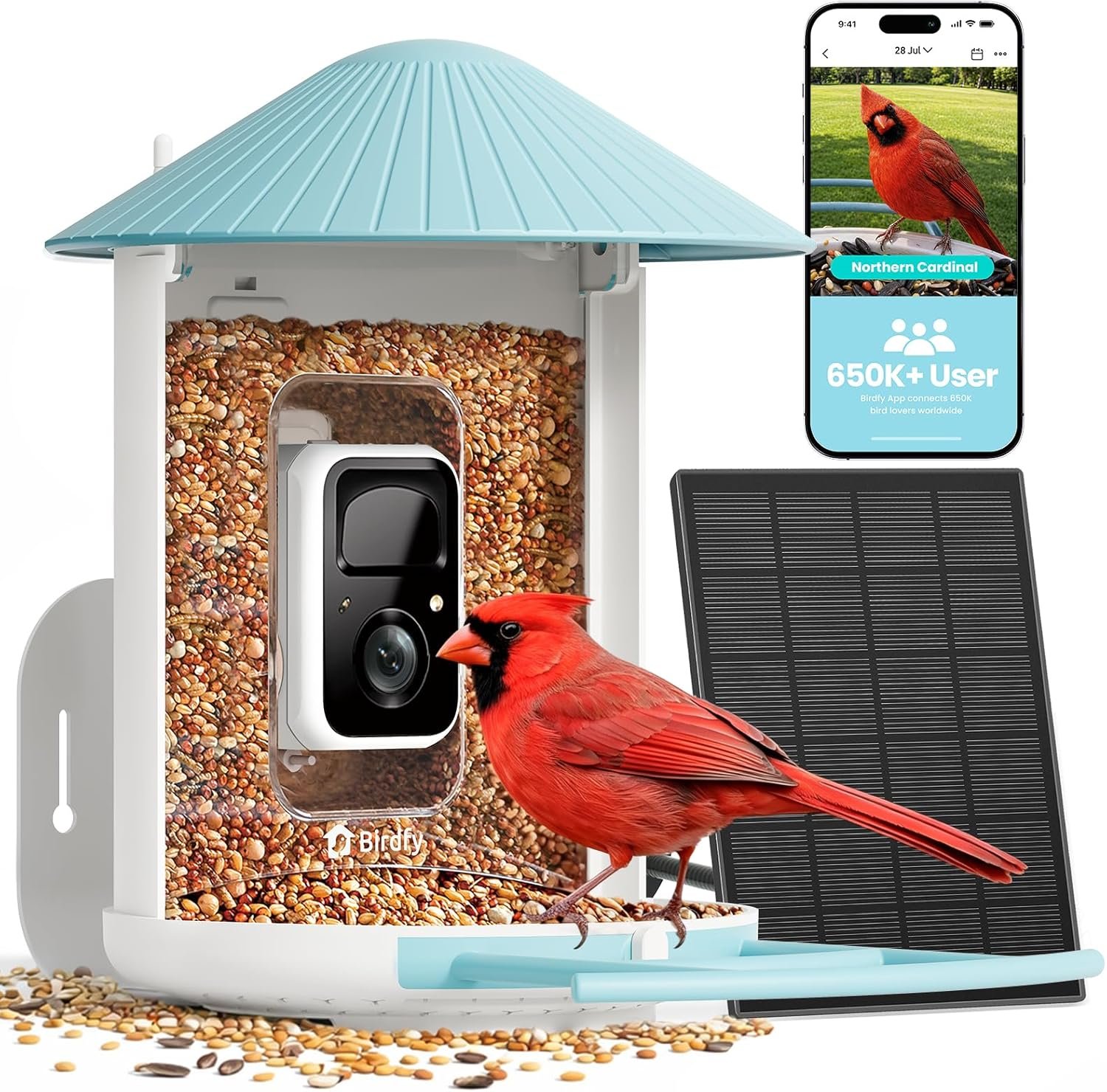
#1 – NETVUE by Birdfy 2K HD AI Camera Feeder
Why Birdfy earns the overall spot
Birdfy wins by being the easiest recommendation to explain without depending on one headline specification. Its listed 2K camera is a meaningful step above basic 1080p models, color night vision expands usefulness around dawn and dim weather, and the 5200mAh battery with a solar panel addresses the recurring inconvenience of taking a camera indoors for charging. The housing is described as weather and UV resistant, which matters for a feeder expected to remain outside. None of those features proves that every alert will be perfect, but together they create a more complete everyday package than a resolution number alone.
The buyer evidence is also broader than it is for Camojojo. At the verification snapshot, Birdfy showed a 4.4 rating from 1,493 reviews. Ratings can move and should not be treated as laboratory evidence, yet a four-figure review base gives shoppers more owner experiences to inspect for app behavior, cleaning, mounting, and notification patterns. The HEAPETS count is close, but Birdfy combines that level of market history with a more established camera-feeder ecosystem and an official product page beyond the marketplace listing.
Storage and subscription reality
The phrase no subscription needs careful treatment here. Birdfy lists free cloud clip storage, so a buyer can receive useful captured clips without immediately paying for advanced AI. That is a legitimate no-required-plan benefit for core viewing. It does not mean all species identification is free forever. The listing explicitly separates advanced AI as a subscription feature. If automatic labels are central to your purchase, check the current trial, plan price, supported species, clip limits, household sharing rules, and cancellation terms in the app before the return window closes.
Cloud clips can be convenient because there is no card to remove, but they also make the app and service policy part of ownership. Ask how long clips remain available, whether exports keep their original quality, and what happens if the service terms change. Buyers who want a more explicit local-storage path may prefer HEAPETS or Camojojo. Birdfy is the better fit for someone who values a smoother cloud-first experience and accepts that advanced identification sits behind an optional paid layer.
Practical limitations before ordering
Birdfy uses 2.4GHz Wi-Fi. That band often reaches farther outdoors than 5GHz, but setup can still fail if the phone, router, or app handles band steering poorly. Test the intended feeder location with your phone before mounting anything. A strong signal at the window does not guarantee a strong signal several yards into the garden, especially through brick, metal screens, coated glass, or dense landscaping. Solar charging also depends on panel orientation, shade, season, alert frequency, and temperature. It reduces charging work; it does not create unlimited power under every condition.
Maintenance remains non-negotiable. Seed dust, hulls, rain, and droppings can accumulate around a camera feeder just as they do around a conventional feeder. A convenient app should not encourage owners to leave food out indefinitely. Follow the removable-part instructions, keep liquid away from electronics unless the manual permits it, let cleaned food-contact parts dry completely, and pause feeding if local disease guidance recommends it. Birdfy is the overall winner because it balances the buying variables, not because it removes the responsibilities of wildlife-safe feeding.
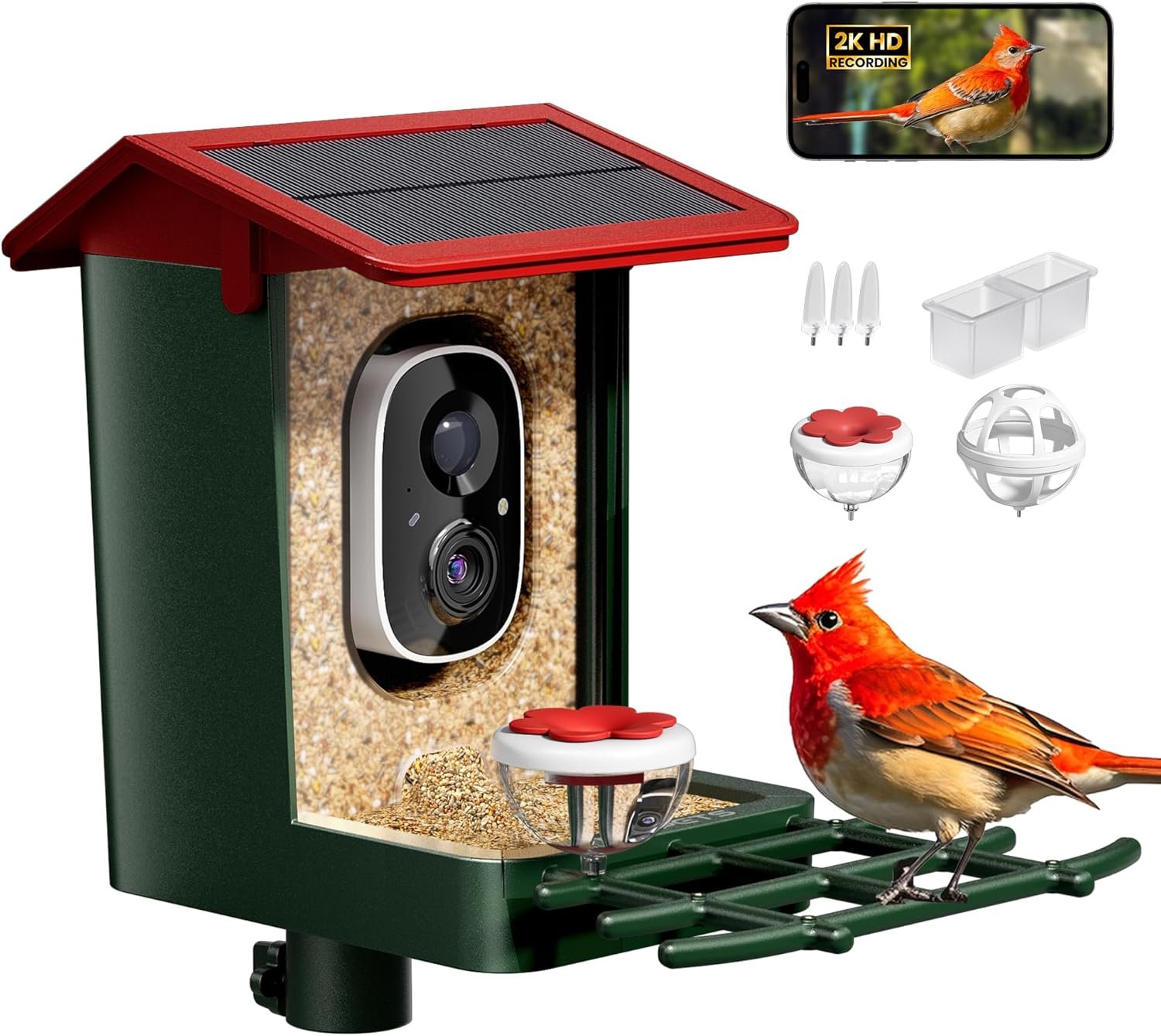
#2 – HEAPETS Q02 Smart Bird Feeder with 2K Camera
Why HEAPETS is the value leader
HEAPETS has the clearest price argument. At the verification snapshot, the Q02 showed a $59.99 Prime price and a $79.99 regular price, putting it well below Birdfy and Camojojo while retaining a listed 2K camera and solar power. That combination matters because a low sticker price is not truly economical if it forces the buyer to accept basic video, constant manual charging, or a mandatory service plan. HEAPETS presents a stronger starting package than its budget label might suggest.
The visible buyer base is substantial at 1,386 reviews and a 4.3 rating at the time checked. Again, ratings are not controlled tests. They are useful as a map for further reading. Sort recent reviews and search for app, connection, card, alert, clean, and solar. Pay attention to whether a complaint reflects the product, a weak backyard signal, a full memory card, or an expectation that every AI label would remain free. The more specific an owner report is about setup conditions, the more useful it is than a one-line score.
What free core use includes
HEAPETS is one of the easiest models here to discuss honestly under a no-subscription search. The supplied product information says core live view, alerts, playback, and local storage are free. It also lists a three-day rolling cloud option and microSD support up to 128GB. That gives the buyer two practical ways to retrieve recent activity without treating a paid plan as the entry ticket to the camera. A card is not listed as included, so budget for a compatible card if local history is important and confirm current format requirements before purchase.
AI identification is a separate question. The product information describes it as optional after a one-month trial. That is not the same as free lifetime AI. A buyer can decline the paid identification layer and keep core viewing and storage, based on the supplied terms, but should expect species labels or expanded AI services to change after the trial. Capture screenshots of the current plan screen and read the renewal details during setup. App plans can change more quickly than feeder hardware.
Where the budget tradeoffs appear
The main tradeoff is not the listed resolution. It is confidence in the wider ecosystem and the precision of the available documentation. Birdfy has a dedicated official product destination and a mature name in camera feeders, while the HEAPETS official URL in the brief points to Amazon. Marketplace-first support can still be responsive, but shoppers should verify how warranty claims, replacement parts, account deletion, and app support are handled. The comparison brief does not provide a warranty duration, so we will not invent one.
Like Birdfy, HEAPETS uses 2.4GHz Wi-Fi. That can suit outdoor reach, yet it still depends on router placement and interference. Solar performance will also vary with sun exposure and alert volume. A busy feeder can generate far more clips than a quiet yard, increasing power and storage demands. A 128GB maximum does not guarantee the same number of days for every owner because clip length, compression, resolution, and event frequency affect retention. Treat the capacity as an upper card limit, not a promised history duration.
HEAPETS is the sensible pick for a first camera feeder, a gift with a controlled upfront budget, or a second feeder position where premium pricing is hard to justify. It is less compelling for a buyer who wants dual-band Wi-Fi, included local storage, or the strongest documented service ecosystem. Its best feature is not a single spec; it is the amount of useful core functionality offered before an optional AI fee is considered.
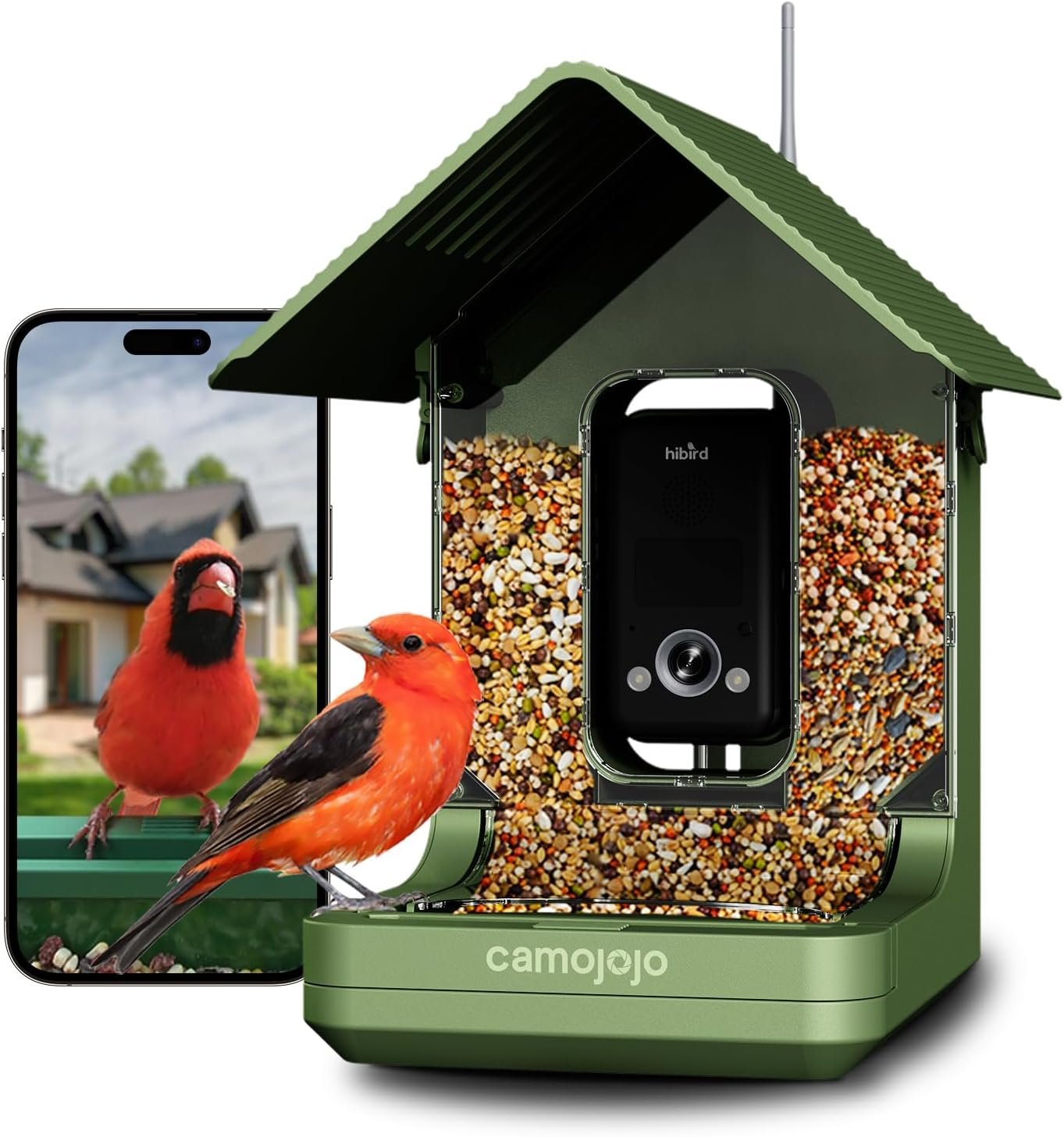
#3 – Camojojo HiBird 4K HD Smart Bird Feeder
Why Camojojo is the image-quality pick
Camojojo is the most specialized option. Its HiBird specification separates it from the two 2K picks with 4K local recording and 32MP still images. That extra capture detail can matter when the goal is more than receiving a visitor alert. Buyers who crop a frame to inspect plumage, archive clips, or share higher-resolution recordings have a stronger reason to pay for it. The key qualifier is local. The supplied specification lists the remote live function at 1080p, so shoppers should not assume that every view inside the app arrives in 4K.
The Wi-Fi specification is another real differentiator. HiBird supports both 2.4GHz and 5GHz networks. Dual-band support gives a buyer more setup flexibility, but it does not make 5GHz the automatic outdoor choice. The faster band usually has shorter range and weaker penetration through exterior walls. A nearby access point may make it useful; a distant router may still work better on 2.4GHz. The benefit is choice, not guaranteed speed at every feeder location.
The strongest local-storage bundle
Camojojo supplies the clearest ready-to-record local package because a 32GB microSD card is included. The feeder supports expansion to 128GB, and the brief also lists seven-day 1080p cloud storage. A buyer can use core recording, live view, alerts, and local storage without a required subscription. Extended cloud service and unlimited AI are optional. That distinction makes Camojojo the least ambiguous choice for someone who wants the camera to remain useful without ongoing payment while still having the option to add services later.
No subscription still does not mean every feature is permanently free. The word unlimited is specifically tied to optional AI, and extended cloud history is also optional. Terms can change, so verify the current app screen. Local storage reduces dependence on a cloud plan but creates its own maintenance. Cards can fill, corrupt, or wear out. Confirm whether the app can format the card, whether old clips overwrite automatically, how exports work, and whether removing the card requires powering down the camera. A local-first design transfers some control to the owner and some responsibility with it.
Price, review depth, and weather context
At $142.87 when checked, HiBird costs slightly more than Birdfy and far more than the HEAPETS Prime price. Its 4.5 rating is the highest of this group, but the 324-review base is much smaller. A higher average from fewer ratings should not automatically outrank a slightly lower average from more than a thousand. Read recent, detailed reports and look for consistency across firmware versions. Camera products can change materially through app updates even when the outdoor shell remains the same.
The IP66 listing is useful context for dust and water resistance, but it should not be read as permission to pressure-wash the feeder or immerse electronic parts. Weather resistance also does not prevent seed from becoming wet or moldy. Position the feeder so that the solar panel receives useful light without directing the camera into harsh glare. Keep drainage paths open, clean food-contact surfaces regularly, and inspect seals and cable points after severe weather. The best image sensor cannot compensate for a dirty lens or unsafe food.
Camojojo is the right choice when detailed local media is the priority and the higher purchase price is acceptable. It is not automatically the best choice for someone who mainly wants a phone notification and a quick look at visitors. For that buyer, Birdfy offers a more balanced ecosystem, while HEAPETS preserves more of the budget. Choose HiBird because you have a use for 4K local clips, an included card, and dual-band setup flexibility, not because 4K is a universally better label.
Why you can use this comparison with confidence
The value of this guide is traceability, not a fictional testing story. Product names, ASINs, prices, ratings, review counts, storage terms, and camera specifications come from the dated cluster brief and linked product records. The article names where advanced AI is paid, optional, or trial-limited instead of turning no subscription into a blanket promise. It also states when the brief does not provide dimensions or warranty duration, so a missing fact is not replaced with an estimate.
Maya Bennett evaluated the products with a decision rubric covering core no-plan usefulness, storage control, camera and stream resolution, connectivity, power, weather information, price, and buyer evidence. The rankings are editorial judgments based on that documentation. They are not claims of side-by-side installation, bird-identification accuracy testing, battery runtime measurement, or long-term weather exposure. Use the dated links and current Amazon pages to verify any term that could change before purchase.
What no subscription should mean before you order
Core access is more important than an AI headline
A useful no-subscription feeder should let you do something meaningful after you decline a plan. That could mean viewing live video, receiving motion alerts, playing recent clips, saving to a microSD card, or using included cloud history. The exact bundle differs here. Birdfy offers free cloud clips while advanced AI is paid. HEAPETS lists free live view, alerts, playback, and local storage, with optional AI after a one-month trial. Camojojo lists free core recording, live view, alerts, and local storage, with extended cloud and unlimited AI optional. Those are three distinct models, not interchangeable versions of free.
Before creating an account, record what the listing promised on the purchase date. Then compare it with the in-app plan screen. Look for clip length, history duration, download limits, number of cameras, household sharing, notification types, AI quotas, automatic renewal, and whether a trial requires payment details. A feeder may satisfy a no-subscription need even if premium AI exists, but only if its unpaid functions cover the reason you bought it.
Free lifetime AI is not part of this verdict
None of these recommendations should be read as a promise of free lifetime access to every identification tool. Birdfy explicitly places advanced AI behind a subscription. HEAPETS describes AI as optional after a trial. Camojojo describes unlimited AI as optional. Software plans can change, species databases can be revised, and usage limits can be introduced. The durable comparison is therefore based on what the camera can still do at the core level, along with storage and connectivity, rather than an assumption that a promotional AI feature will never change.
Smart bird feeder camera buyer guide
A camera feeder combines four systems that are often sold as one simple gadget: a wildlife feeder, an outdoor camera, a Wi-Fi device, and an app service. The best purchase is the model whose weakest system you can live with. A sharp camera will still frustrate you if the signal is unstable. Free storage will not help if the feeder is difficult to clean. Excellent AI labels will not create safe placement. Work through the decisions below in order, beginning with your yard and ending with premium features.
1. Test the intended Wi-Fi location first
Stand where the feeder will hang and check whether your phone can maintain a stable connection to the home network. Repeat the check with doors and windows closed because exterior materials affect signal strength. Do not rely only on the number of Wi-Fi bars; open a live video or run a simple connection test. If the location is marginal, moving the feeder several feet, relocating an access point, or using a mesh node may matter more than choosing 2K instead of 4K.
Birdfy and HEAPETS use 2.4GHz Wi-Fi, which is commonly chosen for longer reach. Camojojo supports both 2.4GHz and 5GHz. Dual-band support is helpful when the feeder is near an access point and the 5GHz channel is clean, but 2.4GHz may still be the reliable outdoor connection. If your router combines both bands under one name, check whether the app offers clear setup steps. Some smart-home pairing problems come from band steering rather than defective hardware.
2. Decide where video should live
Cloud storage is convenient because recent clips can appear in the app without removing a card. Local storage gives the owner more direct control and can reduce dependence on a plan. Neither is automatically superior. Cloud history depends on service terms, account access, and internet connectivity. Local cards depend on card health, capacity, formatting, overwrite behavior, and physical access to the feeder. The right choice is the failure mode you are prepared to manage.
Birdfy is the cloud-first choice in this group because it lists free clip storage. HEAPETS combines a three-day rolling cloud option with microSD support up to 128GB. Camojojo includes a 32GB card, supports expansion to 128GB, and lists seven-day 1080p cloud storage. If you want the product to be ready for local recording on day one, Camojojo has the clearest bundle. If you do not want to handle a card, Birdfy may be easier. Confirm all retention periods and export rules in the current app.
3. Compare recorded resolution, live resolution, and useful detail
Resolution labels are easy to compare and easy to overvalue. Birdfy and HEAPETS list 2K video. Camojojo lists 4K local recording and 32MP stills, but its remote live function is listed at 1080p. A buyer who mainly opens alerts on a phone may see less practical difference than a buyer who downloads and crops local clips. Compression, focus distance, shutter behavior, lens cleanliness, glare, and subject motion also shape usable detail.
Ask what you will do with the footage. For casual identification and sharing, 2K can be sufficient. For archival clips, feather-detail crops, or larger displays, 4K local files have a stronger argument. Do not pay for a resolution number if your yard has weak Wi-Fi, deep shade, or a feeder position that points into the sun. Improve the scene first. A stable, well-positioned 2K camera can be more useful than an unstable 4K camera.
4. Treat solar as support, not a perpetual-power promise
All three selections incorporate solar power in their buyer-facing information, and Birdfy also specifies a 5200mAh battery. Solar can extend time between manual charges, but results depend on panel angle, direct sun, tree cover, latitude, season, temperature, event frequency, recording length, and live-view use. A feeder visited hundreds of times per day will consume more energy than one in a quiet yard. Winter performance can differ sharply from summer performance.
Choose a mounting position that gives the panel useful light while preserving safe bird placement and a good camera angle. Check the battery trend during the return period. If charge declines over several clear days, adjust the panel or reduce high-drain settings before assuming the battery is defective. Keep a realistic plan for occasional USB charging if the product supports it. Solar is an ownership convenience, not freedom from power management.
5. Make cleaning part of the buying decision
A camera adds seams, a lens, charging components, and sometimes a fixed housing to a product that still holds food outdoors. Review the manual or listing images for removable trays, drainage, access to corners, and whether the camera module separates from washable parts. If a feeder requires a complicated disassembly every week, the inconvenience may reduce how often it is cleaned. Ease of maintenance is therefore a performance feature, even though it is not represented by megapixels.
Project FeederWatch advises cleaning seed or suet feeders every week or two, more often during heavy use or wet weather, and allowing them to dry completely before refilling. Local conditions may justify a different schedule. Remove old or wet food, wear appropriate protection, follow current wildlife-health guidance, and avoid getting electronics wet unless the manufacturer specifically allows it. Stop feeding temporarily if authorities recommend it during a disease event.
6. Choose placement for birds, not only for the camera
The most cinematic angle is not necessarily the safest placement. Consider window collision risk, predator access, falling seed, squirrel traffic, weather exposure, and whether you can reach the feeder for cleaning. The National Audubon Society source linked above provides window-safety context. Reflective glass can remain hazardous even when a feeder looks far enough away to a person. Use current expert guidance for your home layout rather than relying on a universal distance claim.
Camera framing improves when the feeder is stable, the lens is not aimed directly into strong backlight, and the perch area sits within the stated focus zone. Avoid a position where branches constantly trigger motion or block the solar panel. Check local rules if you live in a multifamily property or community with restrictions. Also consider privacy: aim the camera at the feeder and your own property, not a neighbor’s windows or private space.
7. Read AI identification as assistance, not certainty
Automated identification can make a busy clip library easier to explore, but labels may be affected by angle, lighting, partial views, juvenile plumage, similar species, and the quality of the reference database. A product page may advertise a large species count without explaining how accuracy varies by region or image quality. Use AI as a starting point and compare uncertain labels with a field guide or a trusted birding resource.
Plan terms matter because AI is where these three products draw their clearest paid-service boundaries. If you will not subscribe, judge the feeder by its alerts, video, and storage first. If you will subscribe, compare the current annual cost with the hardware price and think about several years of ownership. A lower-priced feeder plus a recurring plan can cost more than a higher-priced local-storage model over time.
8. Verify support, warranty, and app permissions
The supplied brief does not include warranty duration for any of the three models, so the comparison table tells buyers to confirm current seller terms. Do that before checkout. Look for who handles claims, whether return shipping is covered, what proof of purchase is required, and whether the feeder, camera, battery, and solar panel share the same coverage. Save a copy of the terms that applied on the purchase date.
Review app permissions during setup. A camera feeder needs network access and notifications, but it may request additional permissions for saving media or sharing clips. Use a unique password, enable stronger account protection if offered, update firmware from official sources, and remove access before transferring or disposing of the device. Check whether household sharing uses separate accounts or one shared login. Software stewardship is part of owning any connected outdoor camera.
9. Calculate the full first-year cost
Start with the verified hardware price, then add any card, mount, extension, replacement seed tray, optional plan, or mesh-network upgrade you expect to use. HEAPETS has the lowest hardware entry point, but a buyer who wants a 128GB card should include it. Camojojo includes a 32GB card, which narrows part of the accessory gap. Birdfy includes solar support and offers free cloud clips, but a buyer who wants advanced AI should price the current subscription.
Do not treat a temporary Prime price as permanent. The July 23 snapshot showed HEAPETS at $59.99 for Prime and $79.99 regular, Birdfy at $129.99, and Camojojo at $142.87. Availability and coupons change. Compare the final checkout price and seller, then decide whether the feature difference still justifies the ranking for you. Our overall pick is based on the documented balance, not a guarantee that its price will remain fixed.
Which one should YOU buy?
Buy Birdfy if…
You want the strongest all-round balance of 2K video, solar support, free cloud clips, and a mature camera-feeder ecosystem.
Buy HEAPETS if…
You want a lower-cost 2K solar feeder with free core viewing and microSD support, and optional AI is enough.
Buy Camojojo if…
You prioritize 4K local clips, included storage, dual-band Wi-Fi, and core recording without a required plan.
Frequently Asked Questions
What is the best smart bird feeder with camera? +
Birdfy is the best overall choice for most buyers
Birdfy takes the overall position because its documented package is balanced: 2K HD video, color night vision, a 5200mAh battery, solar charging, free cloud clip storage, weather and UV resistance, and a large buyer-review base. It is not the least expensive and it does not provide advanced AI for free. HEAPETS is better for a tight hardware budget, while Camojojo is better for 4K local recording and included microSD storage. The best model therefore depends on whether you prioritize ecosystem balance, cost, or local image quality.
Which option has the lowest subscription burden? +
Camojojo is the clearest local-first option
Camojojo includes a 32GB microSD card and lists core recording, live view, alerts, and local storage as free, while extended cloud and unlimited AI are optional. HEAPETS also has a low burden because core viewing, alerts, playback, and local storage are listed as free, with optional AI after a one-month trial. Birdfy offers free cloud clips but charges for advanced AI. No option here should be described as including every AI feature free forever. Confirm current app terms because plan prices, quotas, and retention periods can change.
Is 4K video worth paying more for? +
It is worth it for detailed local clips, not every use case
Camojojo’s 4K local recording and 32MP stills can justify the higher price if you crop frames, archive footage, or care about feather detail. Its remote live function is listed at 1080p, so buyers should not expect a 4K live stream in every situation. Resolution also cannot repair weak Wi-Fi, motion blur, glare, a dirty lens, or poor placement. If your main goal is an alert followed by a quick phone view, a stable 2K system such as Birdfy or HEAPETS may be the better value.
How often should a camera bird feeder be cleaned? +
Use current wildlife guidance and clean more often when conditions demand it
Project FeederWatch advises cleaning seed or suet feeders every week or two and more often during heavy use or wet weather, then allowing them to dry completely before refilling. Follow the manufacturer’s instructions for separating electronic and washable parts. Remove wet or spoiled food, keep drainage clear, and pause feeding if local authorities advise it during a disease event. A camera feeder needs the same responsible food management as a conventional feeder, plus care around the lens, seals, battery, and charging hardware.
NETVUE by Birdfy 2K HD AI Camera Feeder
Birdfy wins for the strongest overall balance of 2K capture, solar support, free cloud clips, weather-focused construction, and a broad buyer base. Choose it for the complete core package, while remembering that advanced AI remains an optional subscription feature.
As an Amazon Associate, I earn from qualifying purchases. Prices, ratings, availability, app terms, and plan features accurate as of July 23, 2026 and subject to change.