


Disclosure: I did not enroll in, purchase, complete, or test the Fear Free Groomer Certification Program. ReviewGuid has no relationship with Fear Free, and this independent analysis contains no enrollment affiliate link.
Short answer: a professional behavior framework, not a technical grooming school
The Fear Free Groomer Certification Program is a $229 annual professional membership that includes an online course about reducing fear, anxiety, and stress during grooming. Its public curriculum is unusually relevant to the problem behind this cluster: a quiet grooming vacuum does not help if a dog is rushed, restrained past its tolerance, or given no way to opt out. Fear Free teaches body-language reading, gradual desensitization, counterconditioning, cooperation, salon setup, communication, and record keeping.
That focus also defines the program’s limit. It is not presented as a complete technical grooming school. The public outline does not promise breed-pattern instruction, scissoring mastery, clipper-blade technique, business licensing, supervised practice, or a job-placement credential. A groomer who needs hands-on coat and cutting skills would still need appropriate technical education and supervised experience.
Our source-based verdict is conditional. The membership can make sense for a working salon or mobile groomer who wants a structured emotional-welfare framework and will maintain the credential. It is a weak purchase for a pet owner who only wants to introduce one dog to a grooming vacuum, because excellent cooperative-care guidance is available free from veterinary and training authorities.
The verified public facts as of July 26, 2026
The official Fear Free program page lists $229 per person for one member, $219 per person for groups of two to nine, and $209 per person for groups of 10 to 29. Organizations with 30 or more people must request a quote. The listed annual renewal is $59 per person. An individual with an existing active Fear Free membership can add another pet-professional membership for $119.
Pricing is tied to membership, not a one-time lifetime course purchase. Fear Free says certification requires an active membership, so buyers should evaluate the first-year fee and the ongoing renewal together. The program page also says members must pass each online module with a score of at least 80% and sign the Fear Free Pledge.
The course is described for grooming professionals working in salon and mobile settings. The public page does not state a prerequisite degree, government license, or minimum number of professional years. That does not mean an online certificate alone establishes complete grooming competence. Local business rules, animal-welfare requirements, insurance conditions, employer standards, and hands-on skill expectations remain separate questions.
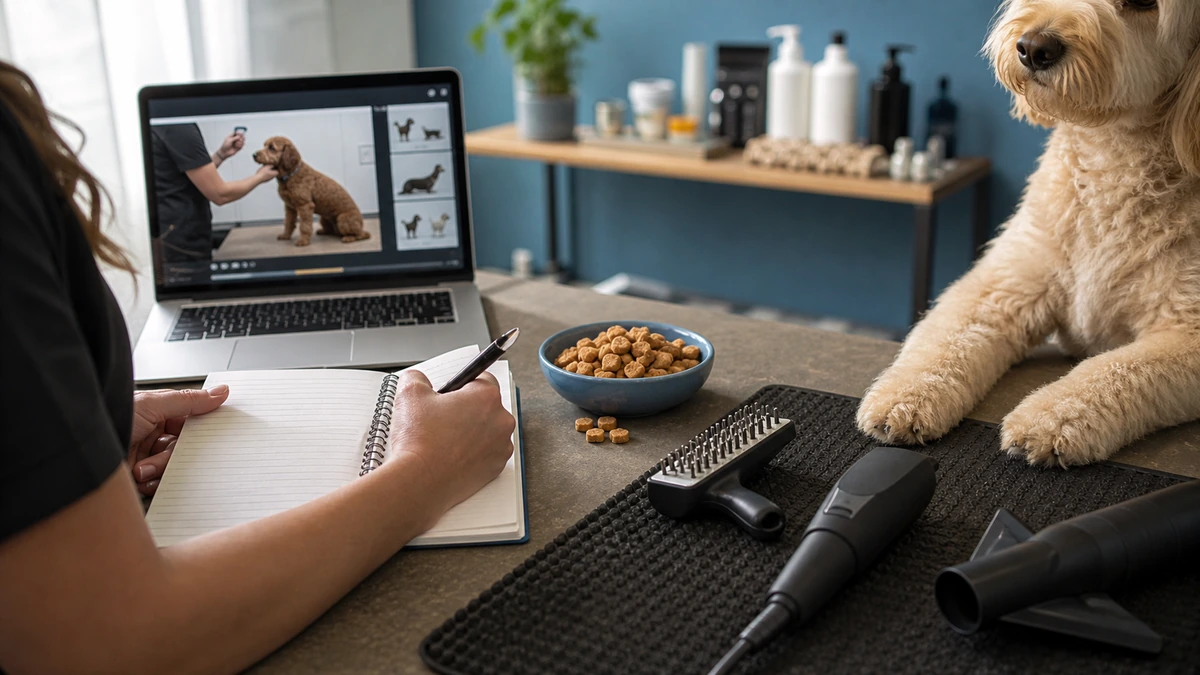
What the four-module curriculum actually covers
| Module | Publicly listed emphasis | Practical value | What it does not prove |
|---|---|---|---|
| 1. Core concepts | Fear Free principles, behavioral documentation, fear-anxiety-stress scale, conditioned emotional response, desensitization, counterconditioning, collaboration versus coercion. | Creates a shared vocabulary for recognizing and changing an animal’s response to tools, people, sounds, and the salon. | It does not prove that a graduate can execute every breed trim or safely repair severe matting. |
| 2. Body language | Head-to-tail observation, subtle stress and relaxation signals, communication, triggers, and responses to fear, anxiety, and stress. | Helps a groomer notice when a session should slow down, change, pause, or stop. | It is not a veterinary diagnosis and does not authorize medical treatment. |
| 3. Salon setup | Cooperation, choice, Meet and Treat, introductions to the salon and equipment, environment design, behavior records, and caregiver education. | Connects behavior principles with the room, workflow, arrival process, tools, and client communication. | A course outline cannot show how well every learner applies these ideas under real salon pressure. |
| 4. Communication and future behavior | Verbal communication, documentation, record keeping, caregiver collaboration, and planning for future visits. | Supports continuity instead of treating every appointment as a new encounter. | Certification is not a guarantee that every dog will accept grooming or that every procedure can be completed. |
The course author is Terrie Hayward, M.Ed., KPA Faculty Member, CPDT-KA, CSAT, and co-author of Grooming Without Stress. Fear Free says the course uses step-by-step video clips and slides, including introductions to grooming tables, clippers, bathtubs, dryers, shears, and groomer’s loops. The page lists approval for five Professional Animal Care Certification Council continuing-education units.
This structure is more specific than a short webinar about calming products or generic customer service. It also stays within a clear lane: emotional experience and humane process. A careful buyer should value it for that lane rather than inflate the credential into technical mastery, veterinary behavior qualification, or a universal safety guarantee.
Why the concepts matter beyond the program’s own marketing
Independent veterinary guidance supports the program’s central direction. In a February 2026 article, Cornell University’s Riney Canine Health Center describes cooperative grooming as voluntary participation built through gradual exposure, choice, predictability, and rewards. The guidance emphasizes ending a session before the dog’s stress threshold is exceeded. That principle matters more than a vacuum’s advertised decibel number.
A dog may react not only to loudness but also to frequency, vibration, airflow, movement, handling, distance, novelty, and earlier experiences. A manufacturer can publish a low-mode sound claim, yet the dog may still freeze, pull away, lick its lips, yawn when not tired, or show the whites of its eyes. A humane workflow treats those signs as information rather than disobedience.
A 2023 evidence review indexed by PubMed supports environmental management, incentives, counterconditioning, relaxation work, and gradual desensitization for canine noise fears. This does not validate every Fear Free lesson or prove a certification outcome. It does show that the broad behavior principles are consistent with evidence-based approaches rather than depending only on a brand claim.
AAHA’s overview of cooperative care also describes voluntary participation and positive reinforcement as ways to reduce stress and fear during handling and procedures. A salon is not a veterinary clinic, but the shared challenge is clear: an animal cannot understand the business pressure to finish on schedule.
“Teach your dog that vacuums are safe and fun” – Jessica Gore, CPDT-KA, quoted by the American Kennel Club.
The quote is simple, but it points to an operational test. Does the course help a professional create predictable, positive introductions and adjust when the animal says no? The published curriculum suggests that it addresses those decisions directly. Only independent outcome research or transparent salon audits could show how consistently graduates apply them.
Is $229 good value?
Value depends on the buyer’s work, not the size of the lesson list. For a professional groomer, one retained client, one avoided escalation, or a better repeat-visit plan may be economically meaningful. The member benefits also include additional courses, educational and marketing resources, an optional directory listing, a member community, product discounts, and eligibility to order a certification kit. Those benefits have value only if the member uses them.
The first-year cost is not the whole calculation. Add the $59 renewal, time spent completing modules, any future continuing education, workflow changes, record keeping, and staff coordination. Group pricing lowers the per-person fee but raises the implementation question: will the salon create one consistent approach, or will a few individuals hold certificates while the daily process remains unchanged?
There is also a signaling benefit. A directory listing and certificate may help clients identify professionals who have chosen a fear-reduction framework. Consumers should still ask how the groomer handles a dog that freezes, growls, cannot tolerate a dryer, or needs a procedure beyond the salon’s safe limit. A badge is the beginning of that conversation, not the answer.
For an ordinary dog owner, $229 plus renewal is difficult to justify solely to learn one home routine. The owner can begin with free guidance from Cornell, AAHA, AKC, a veterinarian, or a qualified reward-based trainer. The professional program becomes more plausible when the learner handles many animals, needs structured documentation, and wants an industry-facing credential.
Who should consider it, and who should skip it?
Before buying, a professional should review the public lesson list and ask three questions. First, which current client or animal problems would the material help address? Second, what salon policy will change after the course? Third, who will check whether the new practice survives during busy days? If the answers are vague, the membership risks becoming a logo rather than a process.
Pet owners selecting a groomer can use the curriculum as an interview guide even without buying anything. Ask whether the dog can take breaks, whether caregivers receive behavior notes, how the team introduces noisy equipment, what signs cause a session to stop, and when the salon refers a case to a veterinarian or behavior professional.
Alternatives and complementary education
The first alternative is free cooperative-care education. Cornell’s current grooming article explains voluntary participation and stress thresholds. AKC guidance explains gradual vacuum exposure and pairing the sound with valuable rewards. AAHA discusses cooperative-care applications and when a veterinary behavior team may be needed. These sources can help an owner start slowly without purchasing a professional credential.
For salon safety rather than fear-specific depth, the AKC S.A.F.E. Dog Grooming Program centers on Safety in the Salon, accident avoidance, sanitation, special cases, and a groomer or salon oath. It is a different emphasis, not a direct substitute. A professional may find both emotional-welfare and physical-safety education relevant.
For technical coat work, seek programs with supervised practical instruction, transparent instructor credentials, clear skill assessments, and experience across coat types. An online behavior course should complement, not replace, safe clipper handling, blade-temperature awareness, mat assessment, sanitation, first aid, and professional referral judgment.
For severe fear, aggression, pain, skin disease, bald patches, lesions, or sudden grooming intolerance, education is not a substitute for veterinary evaluation. A dog’s refusal may communicate a medical or behavioral problem that cannot be solved by a quieter vacuum or a longer appointment.
Our decision framework
Consider the membership when all five conditions are true: you work professionally with grooming animals, fear and stress are recurring operational concerns, you want structured online learning, you will apply the documentation and communication practices, and the ongoing cost fits your business. Compare alternatives when your primary gap is technical grooming, salon safety, first aid, or local compliance.
ReviewGuid’s evidence supports the listed price, group tiers, renewal price, four modules, 13 public lessons, five PACCC CEUs, 80% pass requirement, pledge, and active-membership condition as of July 26, 2026. It does not support a claim about personal course quality, completion difficulty, platform accessibility, learner outcomes, or return on investment because we did not enroll.
The program’s strongest idea is larger than the certificate: better grooming starts with the animal’s experience. That idea should influence how a buyer chooses and introduces a grooming vacuum, how a professional plans a session, and how quickly either person stops when the dog is no longer comfortable.
Frequently asked questions
How much does Fear Free Groomer Certification cost?
The official price checked July 26, 2026 was $229 for one person, with group tiers of $219 and $209 per person. The listed annual renewal was $59 per person. Verify the current checkout terms before purchase.
What does the course include?
The public outline lists four modules and 13 lessons covering core Fear Free concepts, conditioned emotional response, collaboration, body language, reducing fear-anxiety-stress, salon setup, Meet and Treat, documentation, communication, and caregiver education.
Is it a complete dog-grooming qualification?
No. The public program focuses on emotional welfare and behavior during grooming. It should not be treated as proof of complete breed-specific clipping, scissoring, mat removal, medical, or salon-management competence.
What is required to become and remain certified?
Fear Free says members must score at least 80% on each module, sign and uphold the Fear Free Pledge, and keep an active membership. The public course page references additional continuing education but does not state a precise annual hour count.
Did ReviewGuid take the program?
No. This is an independent analysis of public official information and related authority guidance. ReviewGuid did not buy, enroll in, complete, test, or receive access to the program.
Choosing a grooming vacuum for a shedding dog?
Compare oneisall, Afloia, and FurMe for price, bin capacity, attachment coverage, noise claims, and realistic fit for cautious dogs.