

Disclosure: As an Amazon Associate, I earn from qualifying purchases. – Maya Bennett
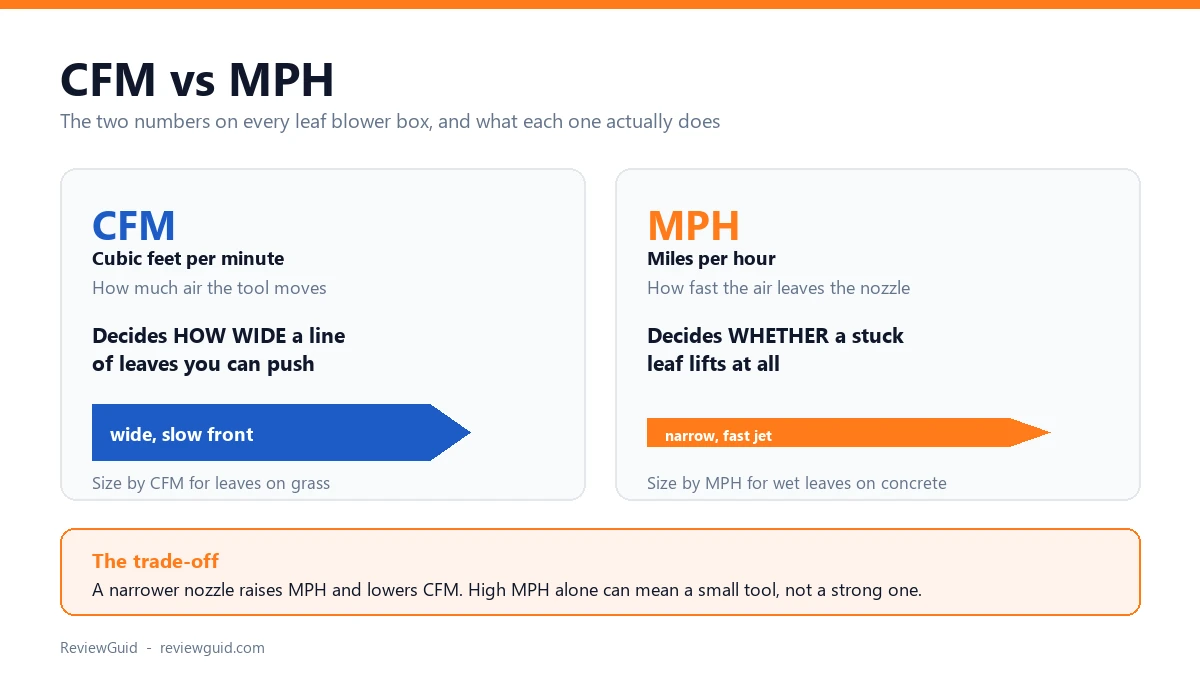
CFM is the volume of air a blower moves and it decides how wide a line of leaves you can push. MPH is how fast that air travels and it decides whether a stuck leaf lifts at all. For leaves on grass, size by CFM. For wet leaves on concrete, you need both. Match the CFM figure to the surface area you actually clear, not to the size of the lot.
What CFM actually does
Cubic feet per minute measures volume: how much air passes the nozzle in a minute. Think of it as the width of the broom. A tool moving 700 CFM sweeps a wide, deep front of leaves ahead of it, so a single pass across a lawn clears a broad strip and the job needs fewer passes. A tool moving 350 CFM sweeps half that width, which does not make it useless, it makes it slower over a large area.
This is why CFM is the right primary number for anyone clearing grass. Leaves on a lawn are not stuck to anything; they are loose material sitting on an uneven surface, and moving loose material is a volume problem. It is also why airflow is the figure that separates the tools that finish a half acre from the ones that do not.
What MPH actually does
Miles per hour measures the velocity of the air leaving the nozzle. Velocity is what breaks the bond between a leaf and the surface underneath it. A dry leaf on a driveway barely holds on and lifts at low speed. A leaf that has been rained on and pressed against concrete is genuinely adhered, and only fast-moving air will get underneath it.
That distinction explains almost every complaint people have about underpowered blowers. A tool that clears the lawn beautifully in October can look useless in November, and nothing about the tool changed. The leaves got wet.
Why you cannot simply maximise both
CFM and MPH trade against each other through the nozzle. For a given motor and fan, narrowing the outlet raises air speed and lowers volume; widening it does the reverse. This is why a specification sheet claiming a very high MPH number alongside a modest CFM number often describes a small tool with a restrictive nozzle rather than a powerful one.
Genuinely powerful tools raise both figures together by moving more air in the first place, and that requires a bigger motor and a bigger battery, which is where the weight and the price come from. When a manufacturer publishes 765 CFM and 200 MPH from the same tool, that is a real capability claim. When one publishes 280 MPH next to 650 CFM at a very low price, read it sceptically.
Translating a yard into an airflow target
The area that matters is the surface you actually clear each time, not the total lot. A half-acre property where only the driveway and a front path get cleared is a small-blower job.
| What you clear | Area | Airflow target | Constraint that bites first |
|---|---|---|---|
| Deck, patio or 2-car driveway | under 1,000 sq ft | 300-400 CFM | Weight matters more than airflow. |
| Small city lot | 1,000-4,000 sq ft | 400-500 CFM | Grass needs volume, not just speed. |
| Typical suburban lot | 1/8 to 1/4 acre | 500-600 CFM | Fine on the 2.5Ah pack if leaves are dry. |
| Large lot with mature trees | 1/4 to 1/2 acre | 600-750 CFM | Battery capacity binds before airflow. |
| Half acre and up, or wet leaves | over 1/2 acre | 750 CFM and above | One 5.0Ah pack will not finish in one pass. |
Two adjustments apply on top of the table. Add roughly 100 CFM if the leaves are routinely wet before you reach them, and add battery capacity rather than airflow if the problem is that the job is not finished when the pack runs out.
The nozzle is the free adjustment most owners never use
Most handhelds ship with more than one nozzle, and swapping them is the only way to change the CFM and MPH balance after purchase. The wide nozzle lowers air speed and widens the working line, which is what you want for a dry lawn. The concentrator raises speed and narrows the line, which is what you want for a wet patch of driveway or for lifting debris out of a gravel edge.
Using one nozzle for every job is the most common reason a competent blower feels underpowered. If a tool struggles on stuck leaves, try the concentrator before concluding the tool is too small.
Technique changes the effective airflow more than 100 CFM does
Three habits get more out of any blower than upgrading it. Work with the wind rather than across it, because a crosswind undoes a third of every pass. Move leaves in one continuous direction toward a single collection point instead of consolidating several small piles, since every pile you build twice is airflow spent for nothing. And hold the nozzle at a shallow angle a few inches off the surface rather than pointing it down, because air aimed straight at the ground scatters material outward instead of pushing it forward.
On a wet lawn a fourth habit matters: clear in the afternoon rather than the morning. A few hours of sun reduces how firmly leaves are bonded to the surface, and that changes the MPH requirement more than any nozzle swap can.
One safety figure worth reading before the spec sheet
Airflow and noise rise together. The loudest current handhelds publish figures where the National Institute on Deafness and Other Communication Disorders describes noise-induced hearing loss as a real risk for sustained exposure, and clearing a yard is sustained exposure. Hearing protection costs a fraction of the tool.
Extension services also publish practical seasonal guidance worth reading alongside the specs: Purdue Yard and Garden and Rutgers leaf composting fact sheet FS117 both cover what to do with the leaves once they are gathered, which is the half of the job the spec sheet does not address.
Frequently asked questions
What does CFM mean on a leaf blower? +
CFM is cubic feet per minute, the volume of air the tool moves. Volume is what pushes a wide line of leaves forward, so CFM is the figure that decides how fast a lawn gets cleared.
What does MPH mean on a leaf blower? +
MPH is the speed of the air at the nozzle. Speed is what breaks a leaf loose from a surface it is stuck to, which is why wet leaves on concrete need high MPH as well as high CFM.
How many CFM do I need for a quarter acre? +
Target 600 to 750 CFM for a quarter to a half acre with mature trees. Below that you will finish the job, but you will make more passes and use more battery doing it.
Does a higher MPH number mean a more powerful blower? +
No. A narrow nozzle raises MPH while lowering CFM, so a high MPH figure on its own can indicate a small tool with a restricted outlet rather than a powerful one. Read both numbers together.
Can I add CFM to a blower I already own? +
No, but you can change the nozzle. A wide nozzle trades MPH for a broader working line, and a concentrator nozzle trades working width for the speed needed to lift stuck debris.
Now apply it to real tools
Three current cordless handhelds at 360, 500 and 765 CFM, compared on the numbers above.
The highest-airflow tool in that comparison is reviewed in full in the EGO POWER+ LB7654 review.