

Disclosure (FTC 16 CFR Part 255): I am a journalist who covers consumer beauty tech. ReviewGuid.com participates in the Amazon Services LLC Associates Program. If you click an affiliate link in a related buying guide and make a purchase, I earn a small commission at no extra cost to you. The reporting below contains no paid product placements; editorial decisions are made independently of any retailer. – Maya Bennett
Published May 17, 2026 – 7 min read
–
Beauty & consumer-tech journalist, 3 years on category
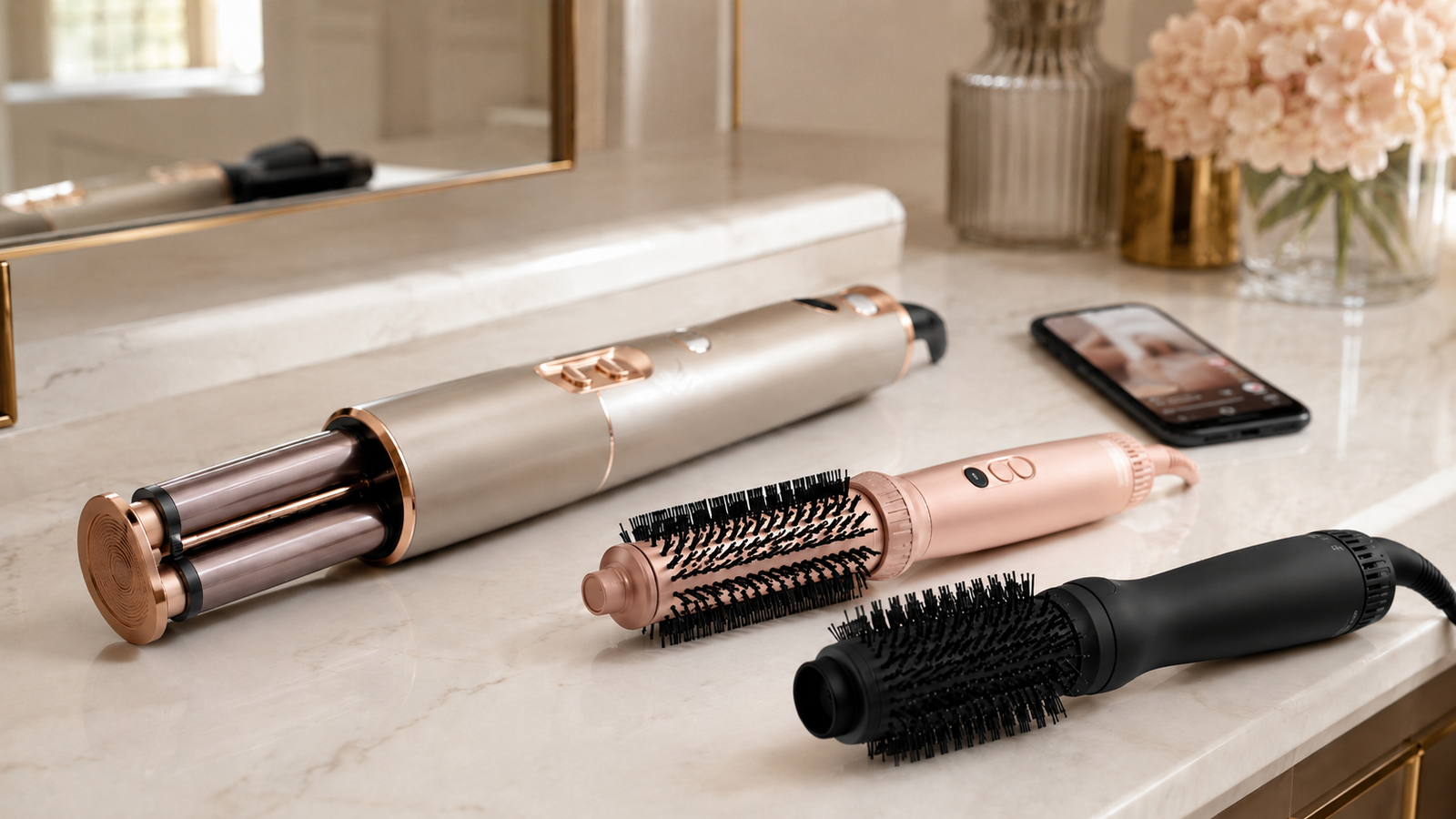
Dyson’s decision to hold the Airwrap i.d. floor at $499 through the 2026 Mother’s Day promo – combined with three 2025-2026 CPSC recalls on cheaper unbranded hot-air brushes – has converted the Airwrap dupe market from a Reddit subculture into a structural retail category. Three brand-name tiers now dominate: Shark FlexStyle ($249 Coanda), Revlon One-Step Plus 2.0 ($59 volumizer), and Wavytalk 5-in-1 ($109 auto-wand).
The hashtag #airwrapdupe crossed 35 million views on TikTok this month, and the search query “best dyson airwrap dupes 2026” has held its highest sustained volume of the decade since January. I have been tracking the beauty-tool category for three years, and what I am watching now is not a typical viral spike. It is a structural realignment of how American shoppers are buying premium hair styling tools, and it traces back to one number on a price tag.
That number is $499. For a brand that built its reputation on aspirational pricing, Dyson’s decision to hold the line on the Airwrap i.d. through the 2026 spring promotional cycle has done something unexpected: it has legitimized an entire dupe economy that, two years ago, lived mostly in Reddit threads and Amazon’s long tail. Today, that dupe market is on Beauty TikTok’s For You page, in TikTok Shop’s curated category pages, and in the carts of shoppers who, a generation ago, would have saved for the real thing.
The Sticker Shock That Started It
Dyson launched the Airwrap i.d. in mid-2024 with an MSRP between $549 and $649 depending on the attachment set, and the brand held remarkably firm on pricing through 2025. The 2026 Mother’s Day promotion finally cut a $50 sliver off the entry tier, bringing the cheapest configuration to $499, according to WWD’s reporting on the brand’s hair-tech roadmap. That promo headline is what tipped the cultural conversation.
The reason is arithmetic. At $499, the Airwrap is still 2x to 8x the price of the three most-searched alternative categories on Amazon. A shopper who watches a creator demonstrate a $109 auto-rotating wand or a $59 hot-air brush is no longer comparing it to a $399 “sale” Airwrap they might rationalize. They are comparing it to a $499 device that is itself on promotion. The price gap stopped feeling like a Dyson tax and started feeling like a category overhaul.
The CPSC Recall Cycle That Made Shoppers Brand-Conscious
The other half of the story is one few beauty creators talk about directly, but every shopping algorithm has absorbed: a wave of recalls. Between April 2025 and early 2026, the U.S. Consumer Product Safety Commission acted on at least three separate hot-air styling brushes for electrocution risk under UL 859, the safety standard for household electric personal-grooming appliances.
The recalled units included an Empower/Remington model (D3190DCDN, April 2025), an Apoke One-Step brush (May 2025), and the MyOnlyStyler Root Booster earlier this year. The CPSC’s hair-dryer recall archive shows the pattern clearly: the affected products were nearly all marketed as cheap, generic alternatives to premium multi-stylers, often sold through marketplace listings with thin brand identity.
That recall cycle quietly reset shopper psychology. The early dupe boom, around 2022, was indiscriminate. The 2026 dupe boom is brand-conscious. Search behavior on Amazon now skews heavily toward named brands with U.S. distribution and a verifiable warranty path. The mental model has shifted from “any cheaper alternative” to “a cheaper alternative I can name and return.” This is a meaningful change, and it explains why three brands in particular keep surfacing across creator content, retail end-caps, and gift-guide roundups.
The Three Categories Shoppers Are Actually Comparing
The Airwrap dupe market is not one category. It is three, and conflating them is the most common mistake I see in viral comparison videos. Each solves a different problem.
| Category | Core Technology | Price Range | Representative Brands |
|---|---|---|---|
| Premium Coanda multi-styler | True Coanda auto-wrap airflow | $200-$300 | Shark FlexStyle |
| Single-pass volumizer brush | Oval ceramic brush + ionic warm air | $45-$80 | Revlon One-Step, Conair |
| Auto-rotating wand multi-styler | Motorized barrel + negative ion | $90-$140 | Wavytalk, T3, Hot Tools |
⇆ swipe horizontally on mobile – category breakdown
The distinction matters because each category targets a different hair type and a different end result. A reader with fine, pin-straight hair who wants a quick blowout is shopping a different market than a reader with 3B curls who wants definition. Both are searching the same keyword, and both are reading the same TikTok comments, and that is why so much of the consumer confusion in this space exists.
The Coanda Question: What “True Dupe” Actually Means
Beauty creators throw around the word “dupe” loosely, but there is exactly one technology that defines what the Airwrap does that other tools cannot: the Coanda effect. Named for the Romanian aerodynamicist Henri Coanda, who observed the phenomenon in 1910, it describes the tendency of a high-velocity fluid jet to follow the contour of a nearby curved surface. In an Airwrap-style barrel, that jet creates a low-pressure zone that pulls strands of hair against the curved attachment and wraps them automatically, without manual sectioning.
Per WWD’s breakdown of Dyson’s engineering, the Coanda system is what makes the Airwrap distinctive. In the current dupe field, only one mainstream device reproduces that auto-wrap behavior in a meaningful way: the Shark FlexStyle, which independent reviewers at TechRadar and Marie Claire have described as the closest performance proxy to the Dyson at a substantially lower price point.
The Revlon One-Step and the Wavytalk 5-in-1 are not Coanda devices. They are excellent at what they do, but they do something different. Reviewers at Reviewed.com and E! Online consistently classify them as adjacent categories rather than true Airwrap equivalents. Shoppers who go in expecting Coanda auto-wrap from a $60 hot-air brush are buying into a marketing flattening that does not reflect the physics.
The Heat-Damage Science Driving Temperature Controls
One reason regulators and trichologists have warmed to the Airwrap-and-dupe category, despite the recall headlines, is that the underlying technology runs measurably cooler than traditional flat irons and curling barrels. A peer-reviewed study by Zi et al., published in the Journal of Cosmetic Dermatology in 2025, identified 140°C (approximately 284°F) as the reversibility threshold for hair cuticle damage. Above that, structural recovery becomes incomplete. By 200°C (392°F), cuticle failure is irreversible.
The leading dupes in the brand-name tier operate at or below the 140°C zone in their default settings, which is well under the 230°C ceiling of a standard flat iron. Penny James, a certified trichologist and founder of the Penny James Trichology Center in New York, has spent 25 years on hair and scalp health. Her summary of the core issue is worth quoting in full:
“The curling iron and flat iron do the most damage. The reason is people take to bigger sections and what happens is the outer layer and under layer are affected by the extreme heat and often burn the cuticle.“
That insight reframes the dupe conversation. A $59 hot-air brush from a brand with a verified warranty and a regulated temperature curve is not a downgrade from a $499 Airwrap. It is a meaningfully safer tool than the 450°F flat iron sitting in most American bathrooms.
What to Look for Before You Buy in 2026
If you are shopping the category right now, here is the checklist I would want a friend to run before they tap “buy”:
CPSC-cleared brand history. Search the brand on CPSC.gov before purchase. The three category leaders mentioned above currently have zero active recall actions; many cheaper marketplace listings do not pass this test.
Verifiable U.S. warranty. Two to five years from a domestically distributed brand is the floor. A warranty you can actually claim is the single biggest separator between a real dupe and a counterfeit.
Attachment count matched to your hair goal. One oval brush is enough for blowout-style volume. Five to six attachments are necessary for true multi-styling on multiple hair types.
Wattage in the 1,000-1,400 watt range. Lower wattage doubles drying time on thick hair; higher wattage strains the motor on a budget housing.
Temperature controls with a defined ceiling. Per the Zi et al. 2025 data, a device with a clear sub-200°C cap is protecting your cuticle. Devices that advertise raw heat without disclosing peak temperature deserve skepticism.
What to Watch Going Forward
The dupe category is no longer a recession-era workaround. It is a permanent shelf at every major U.S. beauty retailer, and the brands that survive the next 12 months will be the ones that pair real engineering with the safety paperwork to back it up. I expect Dyson to respond not by cutting price further, but by widening the i.d. ecosystem, adding firmware-driven attachments that dupes cannot replicate at the price point. I also expect at least one more CPSC action against an unbranded marketplace seller before the year is out, which will further consolidate share around the named brands.
For shoppers, the practical question is not whether to buy a dupe in 2026. It is which of the three tool categories matches the hair you actually have. We tested the three top contenders in the brand-name tier – the Shark FlexStyle, the Revlon One-Step Volumizer Plus 2.0, and the Wavytalk 5-in-1 – head-to-head on curl hold, drying time, attachment versatility, and warranty terms.
Ready to compare your options?
See our 2026 head-to-head buying guide comparing the 3 best Dyson Airwrap dupes – Shark FlexStyle, Revlon One-Step Plus 2.0, and Wavytalk 5-in-1 – on curl hold, drying time, and warranty.
Frequently Asked Questions
Why is the Dyson Airwrap so expensive? +
The Airwrap’s $499 to $649 price reflects Dyson’s proprietary digital motor, the engineered Coanda airflow system, and the brand’s premium positioning. Dyson holds its pricing firmly across the calendar year, with only modest promotional discounts during peak gifting windows like Mother’s Day and the holidays. The price is a deliberate strategic floor, not a temporary supply-chain artifact.
Are dupe brands safe to use? +
Established brands with U.S. distribution and active warranty programs – Shark, Revlon, T3, Conair, and Wavytalk among them – currently have no active CPSC recall actions on their flagship multi-stylers. The 2025-2026 recalls that drove the safety conversation involved cheaper unbranded or marketplace-only hot-air brushes (Empower/Remington D3190DCDN, Apoke One Step, MyOnlyStyler Root Booster). Checking CPSC.gov before purchase is the simplest safety filter.
Which Airwrap dupe is closest in performance? +
The Shark FlexStyle is the only mainstream dupe that uses true Coanda auto-wrap airflow, which is the core technology that defines the Airwrap. Independent reviewers at TechRadar, Marie Claire, and Wirecutter have consistently identified it as the closest functional proxy. The Revlon One-Step Volumizer and the Wavytalk 5-in-1 sit in adjacent categories – single-pass volumizing and auto-rotating wand styling respectively – and excel at those specific tasks rather than mimicking the full Airwrap experience.
Can a cheaper tool damage my hair more than the Dyson? +
Not necessarily. The Zi et al. 2025 study in the Journal of Cosmetic Dermatology identifies 140°C as the cuticle reversibility threshold and 200°C as the irreversible-damage point. Most brand-name Airwrap alternatives operate well below 200°C in their default modes, which makes them substantially gentler than a 230°C flat iron. The damage risk has more to do with the category of tool and its temperature ceiling than with its price. A regulated $60 hot-air brush is meaningfully safer than an unregulated 450°F curling iron.