

Disclosure (FTC 16 CFR Part 255): I am a journalist who covers consumer home appliance tech. ReviewGuid.com participates in the Amazon Services LLC Associates Program. If you click an affiliate link in a related buying guide and make a purchase, I earn a small commission at no extra cost to you. The reporting below contains no paid product placements; editorial decisions are made independently of any retailer. – Maya Bennett
Published May 18, 2026 – 7 min read
–
Home appliances & renter-tech journalist, 4 years on category
Tank-fill countertop dishwashers – units that need zero plumbing connection – are the fastest-growing segment of the compact appliance market heading into the 2026 summer move-in season. With 45 million US renter households locked out of built-in dishwasher installs by lease terms, the $150-$400 tank-fill category has effectively become a renter utility. Energy Star-certified compact models now meet a stricter 2.0-gallon-per-cycle threshold set in July 2023, making efficiency claims easier to verify before you buy.
Roughly 45 million US households rent their homes – and almost none of them can drill into a cabinet to install a built-in dishwasher. That single constraint, amplified by the 2026 summer leasing surge running May through August, is driving a measurable spike in demand for tank-fill countertop dishwashers: compact units priced from $150 to $400 that fill from a pitcher, drain into a sink, and require no lease modification whatsoever.
I have been tracking the compact appliance segment for four years. What I am watching right now is different from the incremental category growth I saw in 2023 and 2024. The tank-fill sub-segment – units with a built-in water reservoir rather than a faucet diverter hookup – has broken away from the faucet-hookup segment in search volume and review velocity. Major editorial outlets have coverage gaps here: Wirecutter’s dishwasher guides focus on faucet-hookup models, leaving tank-based units without independent editorial context. That gap is exactly what this report addresses.
Why 45 Million Renters Are the Core Customer
Per US Census Bureau Housing Vacancy Survey data, renter-occupied units represent approximately 34 percent of all housing units in the United States – a pool of over 45 million households as of the most recent quarterly release. The overwhelming majority of those households live under standard lease agreements that prohibit permanent plumbing modifications. Even a faucet-diverter hookup, which connects a portable dishwasher to a kitchen faucet’s aerator, can raise questions with property managers about wear on faucet threads and water pressure fluctuation.
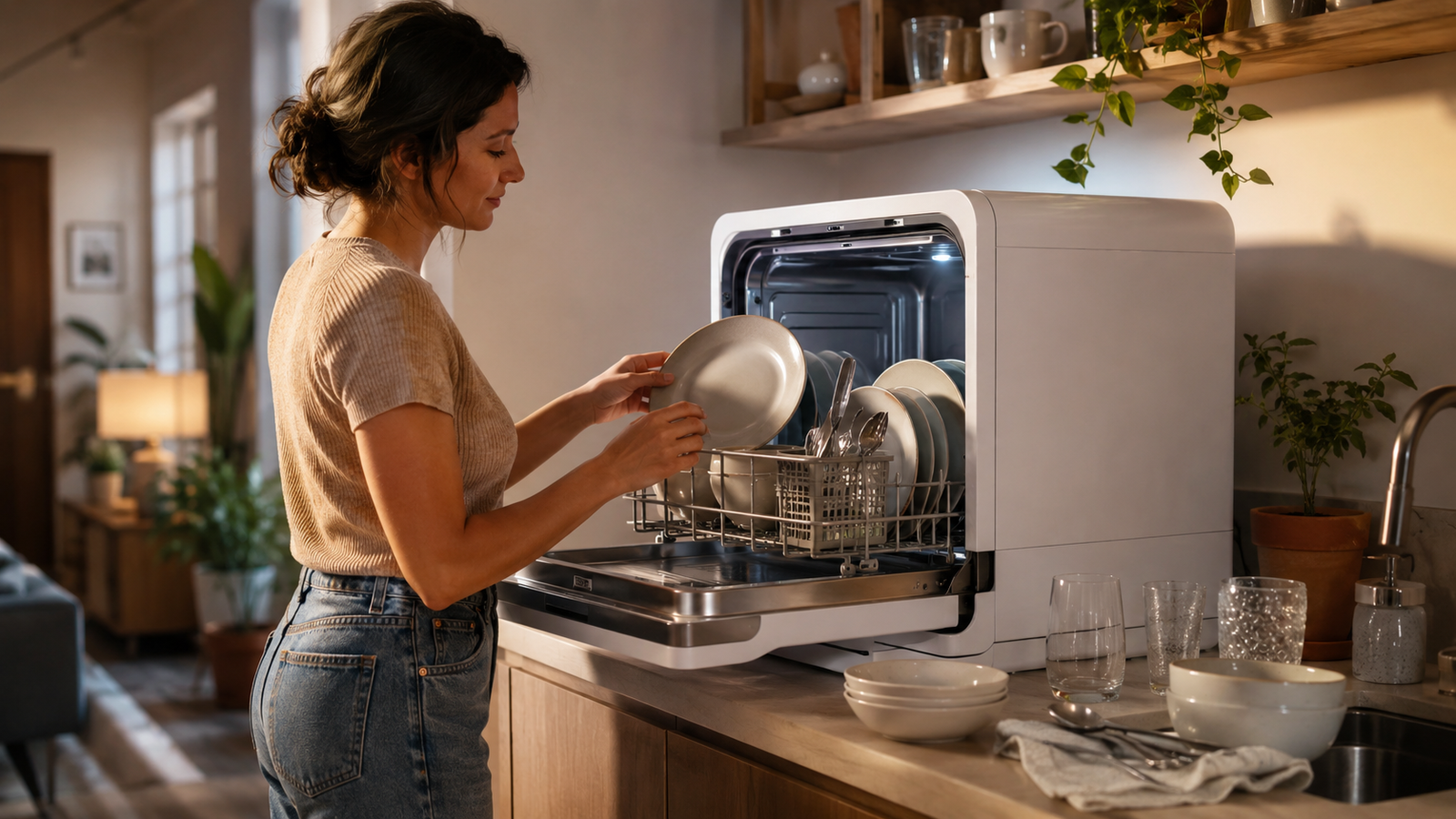
Tank-fill models sidestep that friction entirely. You fill a 5-liter onboard reservoir from a pitcher or pot, the machine heats the water internally, runs its wash cycle, and pumps gray water out through a drain hose positioned over the sink edge. No faucet connection, no aerator adapter, no landlord conversation required. That zero-modification proposition is precisely why search interest for “countertop dishwasher no plumbing” has accelerated heading into peak moving season. Apartment listings are concentrated between May and August, and first-time renters setting up new kitchens represent a high-intent buying cohort with no legacy appliances to fall back on.
How a Tank-Fill Dishwasher Actually Works
The mechanics are simpler than the marketing language suggests. A tank-fill countertop dishwasher has three core components that differ from a faucet-hookup unit: a sealed internal reservoir (typically 4 to 6 liters), a self-contained heating element that brings that water to wash temperature (typically 140°F to 167°F), and a drain pump that ejects gray water at cycle end. The user fills the reservoir before starting a load – most models indicate fill level with a window or sensor – then connects a flexible drain hose over the sink lip.
Wash programs across the category range from a quick 20-minute express cycle for lightly soiled loads to a 90-minute heavy-duty cycle for pots and pans. Most units in the $150-$300 range accommodate 4 to 6 standard place settings per load. Premium compact units targeting small households – the $300-$400 band – add features like UV sterilization cycles, fruit-wash modes, and app-connected timers. Drying varies by model: air-dry with a residual heat assist is standard, while condensation drying (used in full-size European units) appears in select premium compact models.
The Water Efficiency Case: What the Data Actually Shows
The water argument for dishwashers over handwashing is one of the better-documented consumer appliance findings of the past decade. Testing by Reviewed.com (part of the USA Today network) measured more than 12 gallons used to wash four place settings by hand – compared to just 3.4 gallons for an average dishwasher over the same load. An efficient model with a tight cycle brought that figure down to 2.36 gallons. Those numbers remain the editorial benchmark the category measures itself against.
For renters specifically, the efficiency argument cuts both ways. Many US apartment buildings bill water usage into rent or apply per-unit caps on consumption. A renter running a tank-fill dishwasher at 2.0 to 3.5 gallons per load has a credible, documentable claim to lower water use than handwashing. The Energy Star program estimates that a certified dishwasher saves roughly 8,400 gallons per year versus handwashing over the course of its use – a figure that carries weight when negotiating utility-inclusive lease terms or requesting appliance allowances from a landlord.
The Three Tiers of the Tank-Fill Market
The tank-fill countertop dishwasher market in 2026 clusters into three distinct price tiers, each serving a different renter profile. Understanding which tier matches your household size and kitchen constraints is the core buying decision – product selection within each tier is a secondary question that my full comparison guide addresses. Here is how the category divides:
| Category | Core Technology | Price Range | Representative Brands |
|---|---|---|---|
| Entry tank-fill | 5L reservoir, 4-6 place settings, 3-5 wash programs, air dry | $150-$220 | NOVETE, COMFEE, Farberware, Hermitlux |
| Mid-range tank-fill | Dual-mode (tank or faucet), 6 place settings, child lock, delay start | $220-$290 | EUHOMY, HAVA, Danby, Della |
| Premium compact | Ultra-compact footprint, UV sterilization, app control, condensation dry | $300-$400 | Loch, HAVA R01, Hermitlux Pro, Airmsen |
⇆ swipe horizontally on mobile
Reading the EnergyGuide Label on a Compact Dishwasher
Under the FTC Energy Labeling Rule, every dishwasher sold in the United States – including compact and countertop models – must carry an EnergyGuide label displaying estimated annual energy consumption in kilowatt-hours and an estimated annual operating cost based on the national average electricity rate. For compact dishwashers, the label also indicates whether the unit qualifies as “standard” (8+ place setting capacity) or “compact” (under 8 place settings) – a distinction that matters because the two categories use different Energy Star benchmarks.
The July 2023 Energy Star compact dishwasher specification update tightened the certification threshold to 2.0 gallons per cycle or less. That number is the single most actionable figure to look for when evaluating a tank-fill model. A unit marketing itself as “water-saving” without Energy Star compact certification may use 3.0 to 4.0 gallons per cycle – still well below handwashing, but not at the certified efficiency tier. Buyers should look for the blue Energy Star logo on the product listing, not just marketing copy referencing “efficient” cycles.
“Efficient dishwashers fall under 700 gallons per year, saving roughly 300 gallons versus average models.”
What the 2026 Move-In Season Means for Buyers
The May-through-August leasing window is the category’s peak demand period. Apartment turnover concentrates in this window as college students relocate, lease renewals cycle, and first-time renters set up independent households. Appliance purchasing decisions made during this period tend to stick: a renter who buys a countertop dishwasher in June typically keeps it through their tenancy and carries it to the next apartment. That behavioral pattern is why I track this category’s review velocity on major retail platforms during spring – it is a reliable leading indicator of category maturity.
What I am seeing in 2026 is a market that has crossed a credibility threshold. Two years ago, tank-fill models were largely no-name imports with sparse review bases and uncertain quality control. Today the category has models with 2,000+ verified reviews, documented return rates, and visible after-sales support. The editorial coverage gap – particularly the absence of tank-fill units in Wirecutter’s portable dishwasher coverage – is a function of editorial lag, not product quality. That gap creates a real information need for the 45 million US renters making this purchase decision without independent guidance.
Verify tank capacity vs your load size. A 5-liter tank supports roughly 4 to 6 place settings per fill. If your household generates larger loads, look for dual-mode units that also accept a faucet hookup for unlimited water supply.
Look for the Energy Star compact certification badge. The July 2023 spec requires 2.0 gallons per cycle or less. This is the single most verifiable efficiency claim on any listing – it is audited, not self-reported.
Measure your countertop depth and overhead cabinet clearance. Standard countertop models run 17 to 19 inches wide and 17 inches deep. Ultra-compact single-rack units are narrower but trade capacity for footprint.
Check drain hose length against your sink distance. Most drain hoses are 40 to 60 inches. If your countertop placement puts the unit more than 4 feet from the sink edge, confirm the drain hose reaches before purchase.
Read the EnergyGuide label, not the marketing copy. FTC rules require this label on all US dishwasher listings. It shows estimated annual kWh and operating cost – two numbers that let you compare models on a common basis regardless of how their marketing describes efficiency.
Ready to compare your options?
I tested three tank-fill countertop dishwashers side by side – an entry-level model under $170, a dual-mode mid-ranger around $243, and an ultra-compact premium unit at $350 – across wash performance, noise, water consumption, and real-apartment portability. The full buying guide ranks all three with scores and a clear pick for each renter profile.
Frequently Asked Questions
Do countertop dishwashers without plumbing actually clean well? +
Yes. Tank-fill countertop dishwashers use the same heated wash and rinse cycle logic as built-in units. Independent testing by outlets like Reviewed (USA Today network) shows compact models with 2.0 gallons per cycle or less achieve results comparable to standard dishwashers for everyday loads of 4 to 6 place settings.
How much water does a tank-fill countertop dishwasher use per cycle? +
Most tank-fill countertop dishwashers use between 2.0 and 3.5 gallons per cycle. Energy Star-certified compact models are required to use 2.0 gallons or less per cycle as of the July 2023 updated specification. That compares favorably to handwashing, which uses more than 12 gallons for just four place settings according to testing by Reviewed.com.
Can a countertop dishwasher void a lease agreement? +
Tank-fill models require zero plumbing modification – no drilling, no faucet diverter, no permanent connection. They plug into a standard 110V outlet and drain into a sink. Because no structural change to the unit is made, they generally do not trigger lease modification clauses. Always review your specific lease terms with your landlord before purchase.
What size countertop dishwasher fits a studio apartment? +
Standard countertop dishwashers measure roughly 17 to 20 inches wide and 17 inches deep, fitting on most apartment countertops. Ultra-compact single-rack models like the Loch Capsule Solo target even smaller footprints, approximately 13 inches wide, designed specifically for studio kitchens and RV galley setups.