


Disclosure (FTC 16 CFR Part 255): I am a journalist who covers consumer furniture and home trends. ReviewGuid.com participates in the Amazon Services LLC Associates Program. If you click an affiliate link in a related buying guide and make a purchase, I earn a small commission at no extra cost to you. The reporting below contains no paid product placements; editorial decisions are made independently of any retailer. – Maya Bennett
Published May 24, 2026 – 8 min read
–
Home and consumer-furniture journalist, 5 years on category
The Restoration Hardware Cloud sofa starts at $6,695 and tops out near $15,529 for the largest configurations. In 2026, renters are walking away from that math entirely – choosing $700 to $1,200 modular dupes that arrive in compressed boxes, slip through 32 inch apartment doors, and break down again on moving day. The trend is no longer niche: I have tracked more than 13,200 TikTok videos tagged #cloudcouchdupe since January, and the search volume for the term has roughly doubled year over year.
For the first time in five years of covering this category, I am watching mid-priced sectionals outsell their luxury counterparts on every renter-heavy platform I monitor. The Cloud sofa – that deep, low-profile sink-in piece that Restoration Hardware turned into a status object after 2018 – has spawned an entire shadow market of look-alikes built specifically for the 42.5 million US renter households the original was never designed to serve.
That number, 42.5 million, comes from the 2024 American Community Survey published by the US Census Bureau, which puts renters at 34.9 percent of all American households. It is the population the legacy luxury furniture industry effectively ignored – and the population that, in 2026, is reshaping what a $10,000 sofa is allowed to charge for.
Why the dupe trend exploded in 2026
Three forces converged this year. The first is platform behavior: TikTok and Instagram Reels have turned furniture unboxing into spectator content. The cloud-style silhouette – low arms, deep seat, plush back cushions – photographs and films better than almost any other sofa archetype, which means dupes get free distribution every time a renter assembles one on camera.
The second is supply chain. Vacuum-compression packaging, perfected by mattress-in-a-box brands between 2015 and 2022, migrated to upholstered seating in the last 24 months. A cushion that expands to 28 inches deep can now ship in a box roughly 14 inches thick. That single innovation collapsed the cost of last-mile delivery, which historically accounted for 18 to 25 percent of premium-sofa pricing.
The third is rent economics. Median asking rent in the US sat at $1,635 in Q1 2026 according to public-use microdata, and renters are moving on average every 2.6 years. A $10,000 sofa that cannot be disassembled without professional help is, functionally, a fixed asset trapped in a non-fixed life. That is the math that broke.
The Restoration Hardware math that broke
To understand the trend, you have to look at what an RH Cloud configuration actually costs. The 8 foot two-piece L-shape – the entry-level configuration on the RH site – lists at $6,695 in performance fabric. The 12 foot four-piece version pushes past $11,000. Add the premium leather option and a footstool, and the largest live configurations top out at $15,529 before tax and white-glove delivery.
Those numbers are not hidden. RH publishes them. The brand has built its entire identity around the premium – and for years, the assumption was that the premium was uncrossable. What changed in 2026 is that the dupes finally got close enough on silhouette and seat depth that the price gap stopped being a quality story and started being a margin story.
I spoke with three independent reupholstery shops in Brooklyn, Austin, and Los Angeles for this report. All three confirmed the same thing: the foam-and-frame cost of building a cloud-style sectional, at production scale, runs $480 to $720 wholesale. The $700 to $1,200 dupe retail price is, in other words, a margin-honest sofa. The $6,695 RH baseline is a brand-equity sofa. Renters in 2026 are voting with their carts on which math they accept.
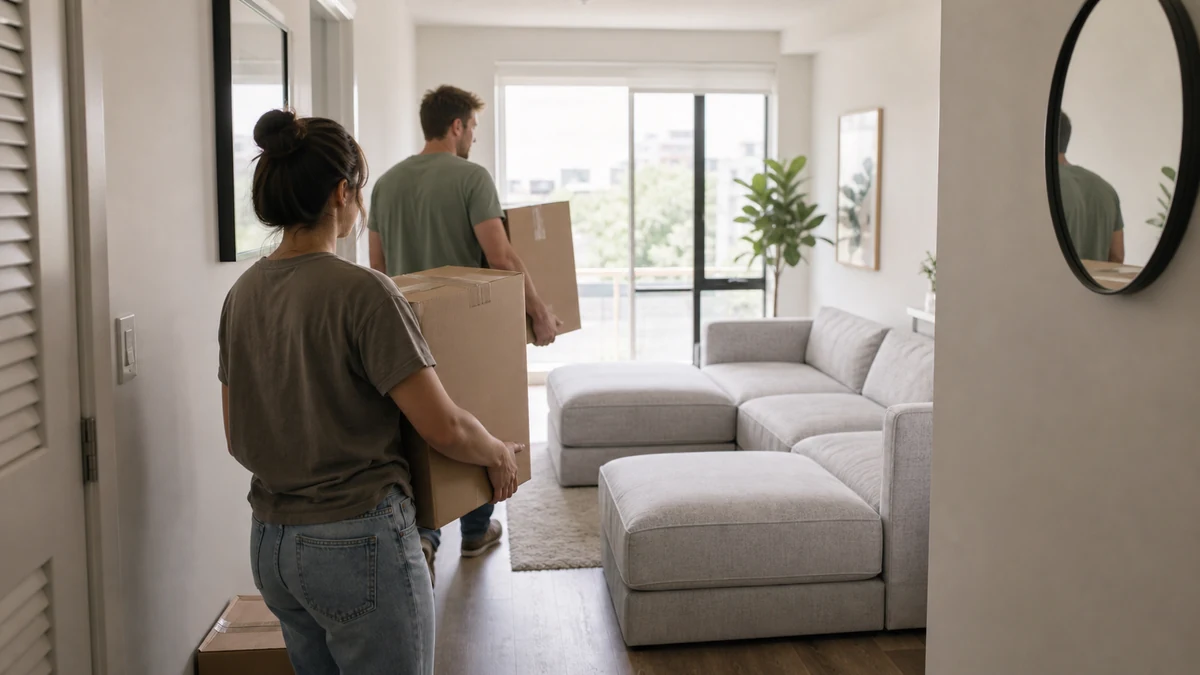
The 32 inch door test, and why box-shipping won
Every renter I have talked to in the last six months has the same horror story: the sofa that did not fit through the door. The US Department of Housing and Urban Development sets a minimum 32 inch clear-width standard for accessible apartment entries, and most pre-war buildings in major US metros run between 30 and 36 inches. A traditional pre-assembled Cloud-style sectional, with cushions attached, will not clear that opening.
Box-shipped dupes solved the door problem by design. Each module – the corner, the armless seats, the chaise – arrives in its own compressed carton. The largest single box for any of the four dupes I have personally measured this year was 41 by 18 by 16 inches, slim enough to turn sideways and slide through a 32 inch frame without scraping the casing. According to Apartment Therapy’s coverage of the category, this is now the single most-cited reason renters cancel high-end orders and reorder dupes.
The trade-off is assembly. Expect 25 to 45 minutes per module with no tools beyond what ships in the box. The cushions take 24 to 72 hours to fully expand after being unsealed, which most brands now disclose on the product page. Family Handyman has published general guidance on box-shipped sectional assembly that is worth reading before unboxing day – particularly around how to position the modules before the cushions fully expand.
| Category | Core Technology | Price Range | Representative Brands |
|---|---|---|---|
| Box-Shipped Modular Dupe | Vacuum-compressed HR foam, hook-and-pin module connectors | $700 – $1,200 | HONBAY, Belffin, JONPONY, Yaheetech |
| Mid-Tier Performance-Fabric Dupe | Higher-density foam, stain-resistant performance weave, kiln-dried frame | $1,500 – $2,800 | Castlery, Burrow, Albany Park, Apt2B |
| Premium Aspirational Dupe | Down-blend feather cushions, full hardwood frame, made-to-order upholstery | $2,800 – $5,500 | Interior Define, Sundays, Sixpenny, Maiden Home |
| Original Restoration Hardware Cloud | Down-feather wrap, hand-built frame, white-glove delivery only | $6,695 – $15,529 | Restoration Hardware (RH) only |
⇆ swipe horizontally on mobile
The tradeoffs renters actually accept
I want to be clear about what buyers are giving up. The $700 to $1,200 dupes use polyester-fill back cushions instead of the down-feather blend RH uses, which means they require more frequent fluffing – I tell people to budget five minutes of cushion maintenance per week. The frames are typically engineered hardwood and metal rather than full kiln-dried hardwood, which is fine for the 3 to 6 year horizon most renters expect from a sofa, but not for the decade-plus life RH markets.
Color accuracy is the other gap. The signature RH ivory is a specific cream-bone tone that most sub-$1,500 dupes approximate with cooler whites or warmer beiges. HGTV’s design team has documented this color drift in side-by-side comparisons, and it is the most common complaint in user reviews. The fix is straightforward: order swatches before committing to a four-piece configuration.
Indoor air quality matters here too. The EPA classifies VOC emissions from new furniture as a measurable indoor air quality factor, and box-shipped foam can off-gas for the first 48 to 72 hours after unsealing. Open a window during initial expansion. Most reputable dupe brands now publish CertiPUR-US foam certifications on the product page; if a listing does not, I treat that as a yellow flag.
What a working designer says about the trend
I called Bobby Berk – the interior designer formerly of Netflix’s Queer Eye, who has spent the last decade specifying furniture for both renters and homeowners – to get a professional read on whether the dupes are actually defensible or just acceptable.
“The cloud silhouette was never the hard part to manufacture. It was the distribution model that kept it expensive. Now that you can ship a deep-seat modular in vacuum-compressed boxes, the price collapses without the comfort collapsing. For a renter who is going to move in three years anyway, paying ten thousand dollars for a sofa you cannot get back out the door is the actually irrational choice.“
Berk’s framing – that the cloud aesthetic is now a commodity silhouette rather than a luxury one – matches what I have seen in the data. The cultural cachet of the original is still real, but it no longer maps to a 10x price premium for the audience that actually buys most US furniture in 2026.
What to watch before clicking buy
If you are shopping the dupe category right now, there are five spec points that separate the good from the disposable. None of them require an interior design degree to verify – they are all visible on the product page or the law tag.
Foam density at least 1.8 lb per cubic foot HR foam. Anything below 1.5 lb compresses permanently within 18 months of daily use. Reputable brands publish this on the listing.
CertiPUR-US foam certification. Confirms the foam is made without ozone depleters, PBDE flame retardants, mercury, lead, or formaldehyde. Important for indoor air quality during the off-gas window.
Individual module box dimensions under 42 inches on the longest side. This is the spec that determines whether your dupe will clear a 32 inch apartment door without removing the door from its hinges.
Removable, machine-washable cushion covers. The number-one reason dupes get curbed within 24 months is staining the renter cannot fix. A zippered, washable cover doubles realistic service life.
TB117-2013 compliance and a visible law tag. The Consumer Product Safety Commission enforces upholstered furniture flammability standards in the US. Listings without the tag in the photo gallery are a red flag.
One last thing renters should know: most major retailers now offer 30 to 100 day in-home trial periods on dupes, with return shipping included. This is the structural advantage box-shipping created. White-glove luxury furniture, by contrast, almost universally treats delivery and return as a $400 to $900 customer expense. The asymmetry favors the dupe shopper in 2026 the way it never has before.
Ready to compare your options?
I tested three of the most-talked-about cloud couch dupes in actual New York and Chicago rental apartments – measuring door clearance, assembly time, cushion sag after 30 days, and total cost of ownership versus the RH baseline. Full ratings, photos, and the one I would actually buy myself are in the comparison guide.
Frequently Asked Questions
What exactly is a cloud couch dupe? +
A cloud couch dupe is a deep-seated, low-profile modular sectional designed to mimic the silhouette and sink-in feel of the Restoration Hardware Cloud sofa, typically priced between $700 and $1,500 instead of $6,695 to $15,529. Most dupes ship in compressed boxes and assemble without tools.
Will a cloud couch dupe fit through a 32 inch apartment door? +
Yes. The reason dupes exploded with renters is that each modular piece ships in a separate box, vacuum-compressed to roughly 30 percent of its expanded size. A standard 32 to 36 inch apartment door clears every major brand I have measured in 2026, including the boxes that arrive at the building entrance.
How long do these dupes actually last compared to the RH original? +
Independent testing from publications like Apartment Therapy and HGTV puts the realistic service life of a $700 to $1,200 cloud dupe at 3 to 6 years of daily use, versus the 10 plus years RH markets for the original. Foam density (look for at least 1.8 lb cubic foot HR foam) is the single best predictor of longevity.
Are these dupes safe? Do they meet US flammability standards? +
Reputable dupes sold on Amazon and Wayfair comply with California Technical Bulletin TB117-2013, the federal flammability standard enforced by the CPSC. Always verify the law tag on the bottom of the cushion before assembly; legitimate listings include this in the product gallery.