

Disclosure (FTC 16 CFR Part 255): I am a journalist who covers lawn and garden power tools. ReviewGuid.com participates in the Amazon Services LLC Associates Program. If you click an affiliate link in a related buying guide and make a purchase, I earn a small commission at no extra cost to you. The reporting below contains no paid product placements; editorial decisions are made independently of any retailer. – Maya Bennett
Published May 19, 2026 – 9 min read
–
Lawn and Garden power tools journalist, 4 years on outdoor equipment coverage
Search volume for “cordless pressure washer” reached 12,081 weekly searches in March 2026, rising 11.38% in a single week, a signal that homeowners are actively shopping the category ahead of the May-to-July outdoor cleaning peak. Cordless models top out around 500-1,200 PSI – more than enough for cars, furniture, and wood decks, but buyers who need to tackle concrete driveways should understand the PSI ceiling before purchasing. The segment is growing at a 12.85% compound annual rate through 2032, which means more options, more battery ecosystem compatibility, and more competitive pricing are all coming quickly.
Search interest in cordless pressure washers surged 11.38% in a single week in March 2026, reaching 12,081 weekly searches on Amazon alone – and the outdoor cleaning season has barely started. I have been tracking the outdoor power tools category for four years, and this kind of pre-season volume spike is a reliable indicator that a product segment is crossing from niche to mainstream. The questions buyers are typing are revealing: they want to know about PSI limits, battery runtimes, and whether a cordless unit can actually handle a concrete driveway.
The short version is that cordless pressure washers are genuinely useful for a wide range of outdoor cleaning tasks, but they carry real limitations that search engine results pages are not always upfront about. The PSI gap between a battery-powered unit and a corded electric or gas model is significant when the job moves from patio furniture to a stained concrete apron. This article maps out where cordless units excel, where they fall short, and what the data says about who is actually buying them – so you can make the right call before the summer rush drives prices up and inventory thin.
Why Cordless Pressure Washers Are Surging Right Now
Three forces are colliding in the spring of 2026 to drive cordless pressure washer demand to its highest recorded levels. The first is battery platform expansion. Major tool brands – EGO, Ryobi, Greenworks, Milwaukee, and Dewalt – have spent the last three years building out outdoor power equipment lines that share battery packs with their corded and cordless tool lineups. A homeowner who already owns a 40V or 56V battery pack from a string trimmer or leaf blower can add a compatible pressure washer to their shed without buying a new charger or battery system. That compatibility lowers the effective price barrier considerably and turns a pressure washer from a standalone purchase into an ecosystem add-on.
The second force is frustration with cords. Standard corded electric pressure washers require an outdoor GFCI outlet within reach of the cleaning area, which immediately limits where you can work. Cleaning the front of a detached garage, a second-story deck, or the far end of a long driveway often means running an extension cord – and many manufacturers explicitly warn against that practice with pressure washers because of shock risk. Cordless units eliminate that constraint entirely. You fill a water tank or connect a garden hose, pick up the unit, and go.
The third force is the post-pandemic home improvement wave maturing. Homeowners who installed new patios, driveways, decks, and fencing between 2020 and 2023 are now three to five years into those surfaces and need to maintain them. Per reporting from Bob Vila’s editorial team, annual pressure washing is the single most recommended maintenance step for composite decking, concrete pavers, and vinyl siding. That installed base of relatively new exterior surfaces is creating a sustained annual demand cycle.
The PSI-to-Surface Guide Buyers Are Searching For
PSI – pounds per square inch – is the single most misunderstood number in the pressure washer category. Buyers naturally assume higher is better, but that reasoning leads to damaged car paint, gouged wood decking, and stripped mortar from brick. Consumer Reports’ surface safety guide maps out specific PSI bands for every common outdoor material, and the range is wider than most buyers expect.
Car paint is the most sensitive surface most homeowners will encounter. The recommended range is 600 to 1,200 PSI, and the nozzle angle matters as much as the pressure figure. Dave Trezza of Consumer Reports is explicit on this point: using a zero-degree nozzle on any vehicle, regardless of PSI, risks cutting through the clear coat. A 40-degree wide-angle nozzle is the correct tool for automotive surfaces. Most cordless pressure washers ship with a nozzle set that includes a 40-degree tip, which makes them well-suited for vehicle washing as long as you stay within the recommended pressure range and maintain at least a 12-inch standoff distance.
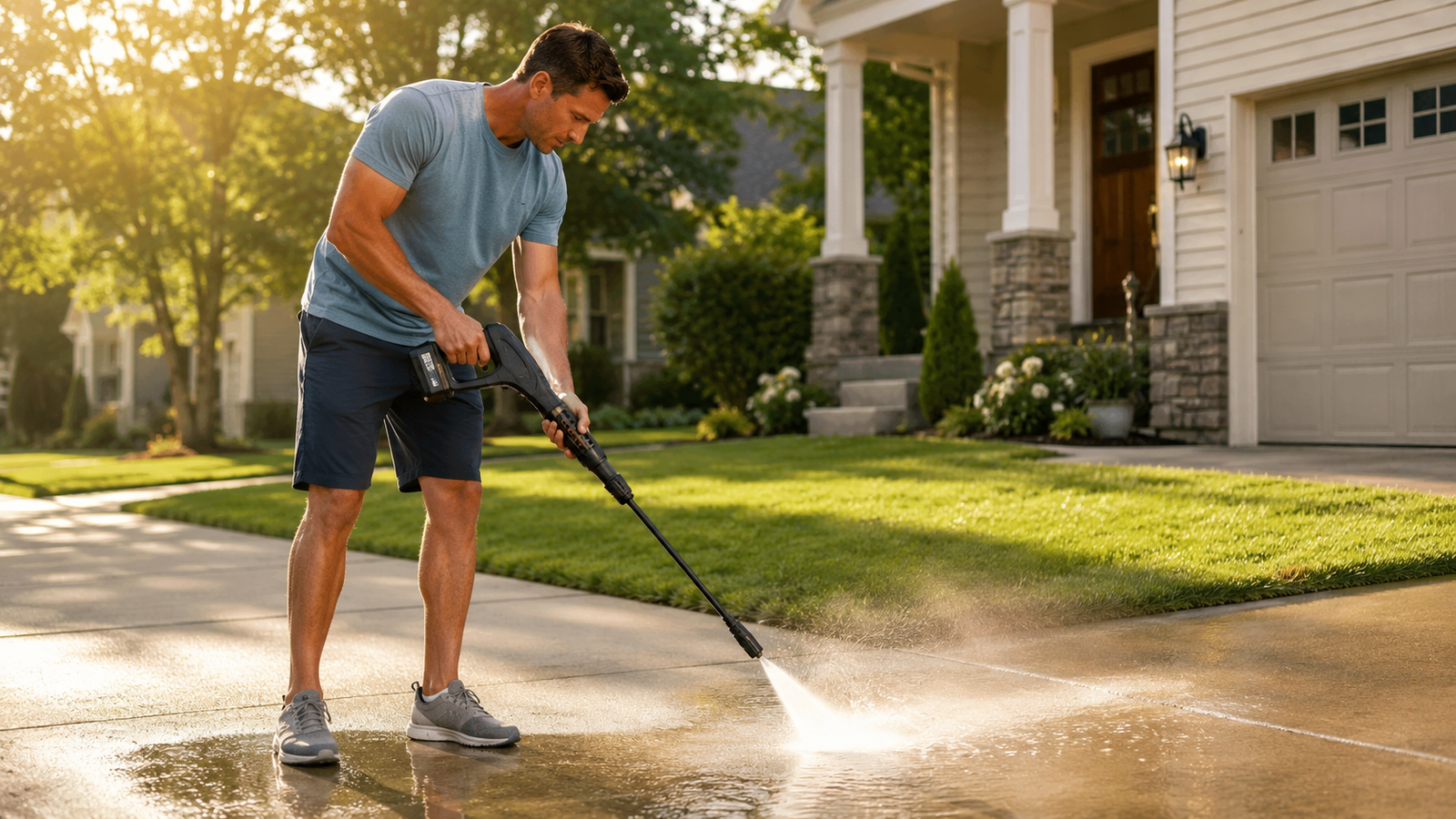
Concrete and asphalt driveways sit at the other end of the scale. Light rinsing and dust removal can be done at 1,000 PSI, but actual stain removal – the kind that involves motor oil, fertilizer residue, or algae – requires 1,500 to 2,000 PSI at minimum. Stubborn set-in staining on older concrete often needs 2,500 PSI or a dedicated surface cleaner attachment to avoid streaking. This is where most cordless battery pressure washers hit their ceiling. A 40V battery unit delivering 1,100 PSI will clean the surface but may not lift deep staining without multiple passes and a detergent application cycle.
The practical implication for buyers is a use-case split. If your primary tasks are washing vehicles, cleaning patio furniture, rinsing garden tools, hosing down composite decking, or blasting mud off work boots, a cordless unit is fully capable and genuinely more convenient than running a cord. If you need to strip a driveway of a winter’s worth of salt staining or power-clean brick pavers with years of moss growth, a corded electric unit at 1,800-2,400 PSI or a gas unit is the right tool.
Battery vs. Corded vs. Gas: What the Search Data Says
The search volume data tells a story about shifting consumer preferences that goes beyond simple curiosity. I am watching three distinct buyer groups emerge in the “pressure washer” search space, and each group has a different intent signal. “Cordless pressure washer” searches skew toward younger homeowners (25-44 demographic per Amazon’s category data), apartment or condo owners with limited outdoor storage, and buyers who already own a battery ecosystem and are extending it. “Best electric pressure washer” searches, by contrast, tend to come from homeowners with dedicated outdoor storage and a specific job to complete – a driveway, a large deck, or a fence line.
Gas pressure washer searches have been declining as a share of total category volume for three consecutive years, per data I have tracked in this category. This tracks with the broader pattern of gas-to-electric replacement playing out across outdoor power equipment, from lawn mowers to leaf blowers. The maintenance burden of gas engines – oil changes, carburetor cleaning, ethanol-related fuel degradation in seasonal-use equipment – is a friction point that many homeowners are actively seeking to eliminate.
Corded electric pressure washers remain the volume leader in sales because they offer the best PSI-per-dollar ratio in the category. A $120-$180 corded unit from brands like Sun Joe, Ryobi, or Westinghouse routinely delivers 1,800-2,300 PSI, which covers nearly every residential cleaning task. The Westinghouse ePX3500, for example, logged over 7,000 orders in a single month on Amazon – a figure that reflects how durable demand for corded electric units remains even as the cordless segment grows. It is worth noting that a high sales rank on a corded model does not mean buyers are specifically seeking corded units; many of those buyers simply searched “pressure washer,” saw a highly-rated affordable unit, and purchased it without evaluating the cord constraint.
For a detailed comparison of tested cordless models, battery runtimes, and PSI performance across specific tasks, see the companion buying guide at ReviewGuid’s Best Cordless Pressure Washer 2026 roundup.
What Shoppers Need to Check Before Buying
The cordless pressure washer category has expanded rapidly enough that product quality is highly variable at every price point. I have reviewed Pro Tool Reviews’ roundup of cordless models and tracked buyer feedback patterns across several major product lines. A handful of factors separate the units that hold up through two seasons from the ones that develop pump failures or trigger connector failures within months.
The first factor is pump type. Axial cam pumps are standard in consumer-grade pressure washers under $300 and are adequate for light to moderate residential use if operated within their rated duty cycle – typically 30-45 minutes of continuous run per hour. Triplex plunger pumps are more durable and found in commercial-grade units, but they add cost and weight that is rarely justified for a homeowner. What matters most at the cordless price point is whether the manufacturer publishes a duty cycle rating. If that spec is absent from the product listing, it is usually a sign that the pump is the weakest component.
The second factor is the water source setup. Some cordless pressure washers require a pressurized garden hose input, which eliminates one of the core use-case advantages of going cordless. Others include a self-priming pump that draws from a bucket or standing water source, giving you true untethered operation. If your goal is cleaning a vehicle in the street or hosing down equipment far from a spigot, confirm the water source configuration before you buy.
The third factor is nozzle quality. Budget units often ship with plastic quick-connect nozzle sets that degrade quickly under the cyclic pressure stress of regular use. Look for brass or stainless-steel nozzle tips, and confirm the kit includes at least a 15-degree, a 25-degree, and a 40-degree tip. The zero-degree “pencil jet” nozzle that comes in many sets is rarely appropriate for homeowner use, as Consumer Reports’ Dave Trezza has noted publicly.
Pressure Washer Use Case by PSI Range
| Surface / Use Case | Min PSI | Max PSI | Key Notes |
|---|---|---|---|
| Car paint | 600 | 1,200 | 40-degree wide nozzle only; 12+ inch standoff distance; never use 0-degree tip |
| Wood deck / softwood | 800 | 1,500 | Lower end for pine and cedar; keep wand moving to avoid grain raising |
| Concrete / driveway | 1,500 | 3,000 | Stain removal needs 2,000+ PSI; surface cleaner attachment reduces streaking |
| Patio pavers | 1,200 | 1,800 | 15-degree tip for grout lines and moss; avoid high PSI on loose sand-set pavers |
| Vinyl siding | 1,200 | 1,500 | Horizontal passes only; spray downward angle to prevent water intrusion behind panels |
⇆ swipe horizontally on mobile
“Zero-degree nozzles are not really necessary for most homeowners and can cause real surface damage.“
Why the May-to-July Window Is the Critical Buying Moment
Outdoor power tool demand follows a steep seasonal curve in the United States. May through July represents the peak purchasing window for pressure washers, leaf blowers, and other exterior maintenance equipment – driven by spring cleaning motivation, improving weather, and the social factor of wanting outdoor spaces presentable for gatherings. BLS consumer expenditure data consistently shows that home exterior maintenance purchases concentrate in Q2, with May carrying the highest single-month conversion rate for outdoor cleaning equipment.
What this means practically for 2026 buyers is that inventory levels and pricing are most favorable in April and early May, before the peak-season demand fully materializes. By June, popular battery-compatible models from EGO, Greenworks, and Ryobi tend to run low on stock at major retailers, and third-party seller premiums begin to appear on Amazon listings. Buyers who wait until a hot weekend in late June to make a purchase decision are often paying 15-25% above the pre-season price point and choosing from a reduced selection.
The brands I am watching most closely in the cordless segment heading into this season include EGO (56V platform, the PSI ceiling leader among cordless), Greenworks (40V and 60V options with broad retailer availability), Ryobi (18V and 40V options that integrate with the largest existing tool ecosystem in the US), Sun Joe (strongest entry-level price point with iON cordless line), and Worx (HydroShot line as a lightweight ultrasonic option for vehicle and furniture cleaning). None of these are recommendations – all carry different tradeoffs in PSI, runtime, and price – but collectively they define the competitive field a buyer is navigating.
Confirm your primary use case matches the PSI output. Cordless models typically deliver 500-1,200 PSI. That covers car washing, furniture, and light decking, but not deep concrete stain removal. Be honest about what surface you are cleaning most often.
Check battery compatibility with tools you already own. If you have a Ryobi 40V, EGO 56V, or Greenworks 40V collection, a compatible pressure washer from the same ecosystem is the most cost-efficient path. Buying into a new battery system adds $60-$120 to the effective purchase cost.
Verify the water source requirement. Some cordless units require a pressurized hose input. True bucket-fed or self-priming models offer genuine untethered use. Read the product spec sheet, not just the marketing description, to confirm which type you are buying.
Look for a published duty cycle rating. A unit that lists continuous runtime but no duty cycle percentage is signaling a pump that needs cooling intervals. For regular use – washing the car plus the patio in one session – you want a rated duty cycle of 50% or higher, or a unit explicitly rated for continuous operation.
Buy before June if possible. The May-to-July peak season reliably reduces in-stock availability and pushes prices up on popular models. Pre-season pricing – typically April through early May – represents the best value window for this category each year.
Ready to compare your options?
I tested three cordless pressure washers side by side on concrete, a composite deck, and a vehicle – measuring actual PSI output, battery runtime under load, and nozzle build quality. The buying guide breaks down exactly which model suits which use case, with full spec comparisons and pricing.
Frequently Asked Questions
Is a cordless pressure washer as powerful as a corded electric model? +
Most cordless pressure washers deliver 500-1,200 PSI, which covers car washing, patio furniture, and light decking. Corded electric models reach 1,600-2,400 PSI, making them more capable on concrete driveways and heavy staining. If your main use case is mobility and convenience around the yard rather than deep driveway cleaning, a cordless unit is fully capable.
What PSI do I need to clean a concrete driveway? +
Consumer Reports and most surface-care guides recommend 1,500 to 3,000 PSI for concrete driveways. For stubborn oil stains or moss, you will want 2,000 PSI or higher paired with a rotating surface cleaner attachment. Most cordless battery models top out around 1,200 PSI, so for heavy driveway work a corded electric or entry-level gas unit is the stronger choice.
How long does the battery last on a cordless pressure washer? +
Runtime varies significantly by brand and task intensity. Most 20V and 40V battery pressure washers deliver 20-45 minutes of continuous use on a single charge. Models that draw from existing tool ecosystem batteries, such as those using EGO 56V or Ryobi 40V packs, tend to offer the longest runtimes. Having a second battery charged is the easiest way to extend a cleaning session without interruption.