

Disclosure (FTC 16 CFR Part 255): I am a journalist who covers consumer home-and-garden gear. ReviewGuid.com participates in the Amazon Services LLC Associates Program. If you click an affiliate link in a related buying guide and make a purchase, I earn a small commission at no extra cost to you. The reporting below contains no paid product placements; editorial decisions are made independently of any retailer. – Maya Bennett
Published May 20, 2026 – 8 min read
–
Consumer and home-and-garden journalist, 6 years on the category
Searches for drip irrigation kits are up an estimated 125 percent year over year and raised-bed interest is up 83 percent as gardeners head into the May-to-June planting peak. The driver is simple: raised beds dry out fast, summer travel makes daily hand-watering impossible, and extension research shows drip cuts water use by 20 to 75 percent versus sprinklers. The hot product is a DIY kit a gardener installs in under an hour without a landscaper.
Heading into the 2026 planting peak, drip irrigation for raised beds has become one of the fastest-climbing categories in home gardening, with kit searches up an estimated 125 percent year over year and raised-bed interest up 83 percent – a surge timed almost exactly to the May-and-June window when North American vegetable gardeners set out tomatoes, peppers and squash.
I have been tracking garden-gear search behavior for several seasons, and the pattern this spring is unusually sharp. The interest is not in expensive in-ground sprinkler systems or professional installs. It is concentrated on self-contained kits that thread onto an outdoor hose spigot and snap together by hand. Three forces are pushing it: persistent drought messaging from water utilities, the rise of the travel-proof garden, and a wave of extension-backed data showing just how much water the old overhead method wastes.
Why drip irrigation is surging right now
The timing is the story. Raised-bed gardening exploded during the pandemic and has stayed elevated, but the watering problem is seasonal. From roughly mid-May through July, daytime temperatures and wind strip moisture out of raised beds far faster than spring rains can replace it. That is exactly when gardeners start searching for a fix, and 2026 is no exception.
What changed is the answer they are searching for. Instead of “how often to water tomatoes,” the queries now skew toward “drip irrigation kit for raised beds” and “automatic watering while on vacation.” The U.S. Environmental Protection Agency’s WaterSense program reports that efficient irrigation can save a household up to 30,000 gallons of water a year, a figure that lands harder when many Western and Southern utilities are still under voluntary or mandatory conservation rules this spring.
There is also a travel angle that did not exist at the same scale a few years ago. Gardeners who invested in raised beds now want them to survive a long weekend or a two-week trip. A drip line paired with a battery-powered faucet timer turns a daily chore into a set-and-forget system, and that promise is doing a lot of the search lifting.
Why raised beds change the watering equation
Raised beds are not just in-ground gardens on a pedestal. The same loose, well-draining soil mix that makes them great for root growth also makes them dry out quickly. University of Minnesota Extension notes that raised beds drain faster and need more frequent irrigation than conventional ground-level plots, which is precisely why a hand-watering schedule that worked in April starts failing in June.
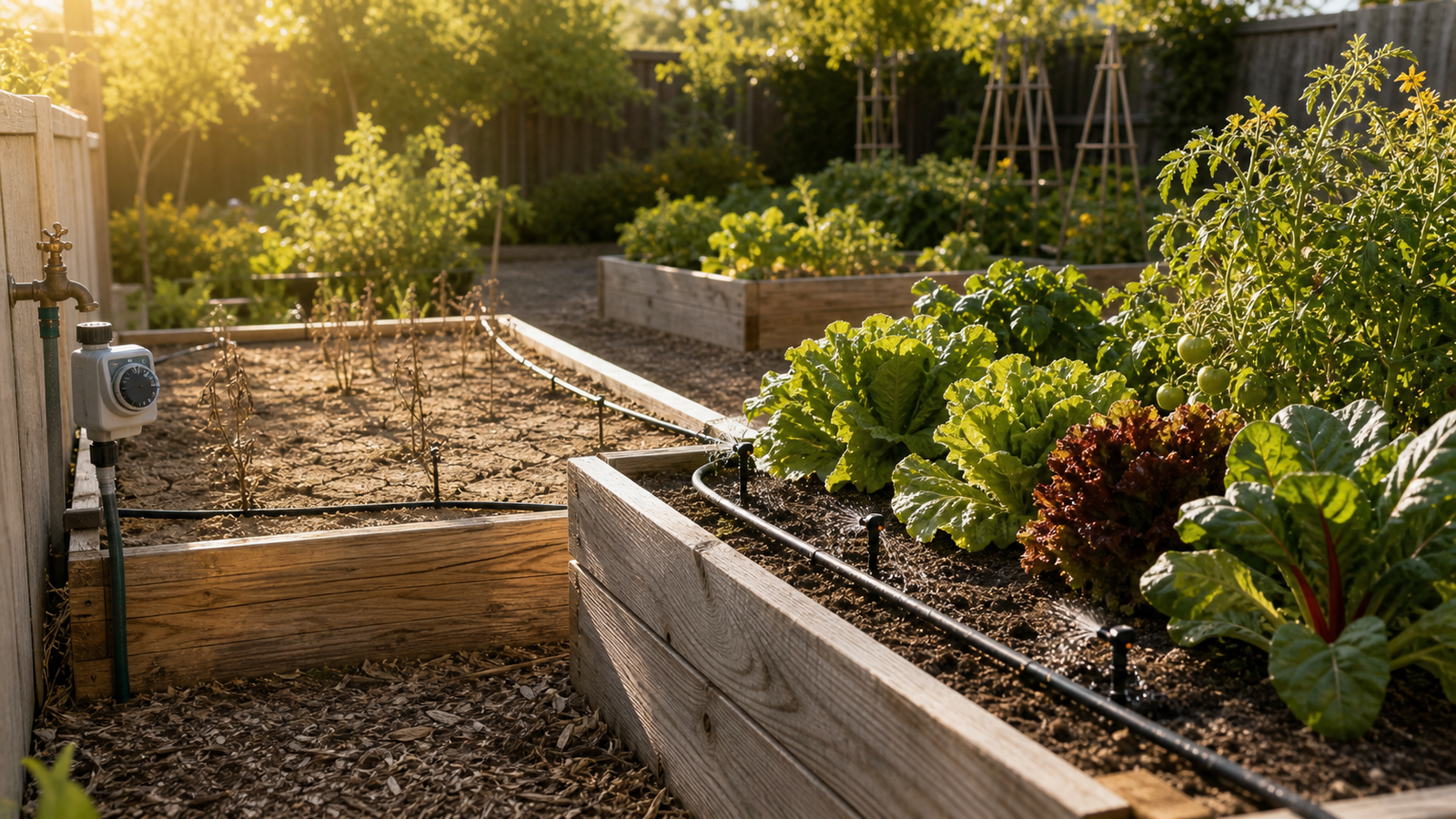
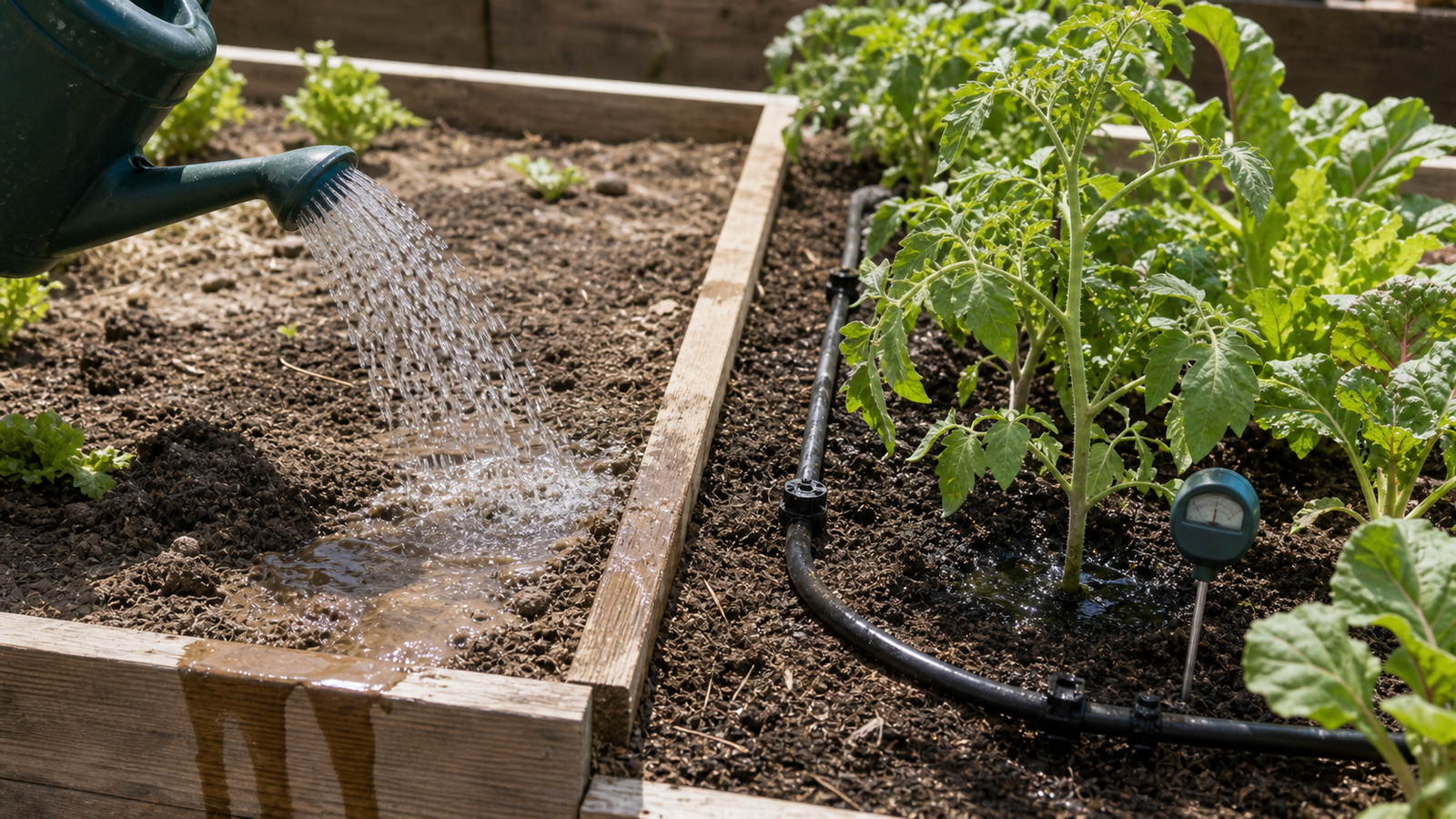
The trap most new raised-bed owners fall into is overcorrection. When plants wilt in the heat, the instinct is to drench the surface with a hose or sprinkler. That wets the top inch, runs off the sides and evaporates before it reaches the roots, while leaving the deeper soil dry. Drip flips the model: it releases water slowly and directly at the root zone, so the bed stays evenly moist without the boom-and-bust cycle that stresses vegetables.
This is also where the “losing plants while traveling” pain shows up most acutely. A raised bed can go from healthy to heat-stressed in two unattended days during a July heat wave. A consistent, low-volume drip schedule is far more forgiving of an absent gardener than a soak-and-hope routine.
The water math behind the trend
The numbers driving this trend come straight from land-grant university extension research, and they are striking. Colorado State University Extension reports that drip irrigation can exceed 90 percent water efficiency, compared with 50 to 70 percent for sprinkler systems, because almost none of the water is lost to wind, evaporation or runoff.
Clemson University’s Home and Garden Information Center goes further, calling drip the best method to conserve water in the vegetable garden in its guidance on watering vegetables. The reasoning is the same across institutions: water that lands on leaves and pathways is wasted, while water delivered at the soil line is used. For a gardener watching a utility bill or living under conservation rules, that efficiency is the entire pitch.
Stacked together, the figures explain the search spike. When the EPA says efficient irrigation saves up to 30,000 gallons a year, and three separate university programs independently confirm drip cuts use by anywhere from 20 to 75 percent, the case for switching off the sprinkler stops being a hunch and starts looking like settled guidance.
| Category | Core Technology | Price Range | Representative Brands |
|---|---|---|---|
| Tubing + emitter kits | Mainline tubing plus individually placed drippers you customize per plant | $25 – $70 | Rain Bird, DIG, Orbit, Raindrip |
| Quick-connect kits | Push-fit fittings and pre-set drippers for tool-free assembly | $30 – $90 | Gardena, Raindrip, Flantor, MIXC |
| Pre-assembled grids | Bed-sized mat or grid sized to standard 4×4 and 4×8 beds, drop-in ready | $40 – $120 | Garden In Minutes, Raised Bed Irrigation, Rain Bird |
⇆ swipe horizontally on mobile
The three kit categories gardeners are choosing between
The market sorts into three buckets, and the right one depends on how much customization a gardener wants versus how fast they want to be done. Tubing-and-emitter kits give the most control: you run a mainline along the bed and place a dripper at each plant, dialing in flow for thirsty tomatoes versus light-drinking herbs. They are the cheapest per bed but take the longest to lay out.
Quick-connect kits trade some of that flexibility for speed. Push-fit fittings click together without clamps or tools, and the drippers come pre-set, so a first-timer can assemble a bed in well under an hour. Pre-assembled grids go furthest toward plug-and-play: they are sized to standard 4-by-4 and 4-by-8 raised beds and essentially drop in as a unit, which is why they are popular with gardeners who want zero fiddling.
None of these is automatically the best choice, and that is the point of a comparison rather than a single recommendation. The deciding factors are bed size, how many beds you are running off one spigot, and whether you would rather save money up front or save time on install day.
What the extension experts say
The strongest endorsement of the trend comes not from retailers but from horticulturists. Bob Westerfield, a senior public service associate and consumer horticulturist with the University of Georgia Cooperative Extension, has been blunt about the efficiency gap between drip and the overhead methods most home gardeners grew up with.
“Drip irrigation uses 75% less water than using an overhead system.“
That 75 percent figure is the high end of the savings range, and it captures why extension offices across the country now lead with drip in their vegetable-garden guidance. The takeaway for shoppers is that the trend is not a marketing invention – it is consumer demand finally catching up to advice agronomists have given for years.
What to check before you buy a kit
Because the category has filled up fast, not every kit on a marketplace listing is built for a raised bed specifically. A handful of details separate a system that works for years from one that clogs or leaks by midsummer. Here is the shortlist I would run through before committing.
Pressure regulator and filter included. Home spigots run too high for drip tubing; a regulator and mesh filter prevent blowouts and clogging.
Bed coverage matches your footprint. Confirm the kit covers your total square footage and number of beds before assuming one kit does it all.
Timer compatibility. A standard hose-thread connection lets you add a battery faucet timer, which is what makes the system travel-proof.
Pressure-compensating emitters. These keep flow even across the whole bed, so the far end gets as much water as the spigot end.
Expandable fittings. If you may add beds later, pick a kit whose tubing and connectors you can extend instead of replacing.
Run through those five points and most of the buyer’s remorse around drip kits disappears. The remaining decision – which of the three categories fits your beds best – is what a head-to-head comparison is for.
Ready to compare your options?
We put three DIY drip irrigation kits for raised beds through a hands-on test – a customizable tubing-and-emitter system, a tool-free quick-connect kit and a drop-in pre-assembled grid – and scored them on install time, even coverage and travel-proof timer support.
Frequently Asked Questions
Is a drip irrigation kit worth it for a raised bed garden? +
For most raised-bed vegetable gardeners, yes. Raised beds drain faster than in-ground soil and need more frequent watering, per University of Minnesota Extension. A drip kit delivers water slowly at the root zone, which extension trials show uses 20 to 50 percent less water than overhead sprinklers while keeping moisture steady during May to July heat.
Can I install a drip irrigation kit myself without a plumber? +
Yes. The category surging in 2026 is built around DIY install. Most kits connect to an outdoor hose spigot with a pressure regulator and filter, then push-fit tubing into the bed. No trenching, no in-ground sprinkler lines and no landscaper are required. A typical single raised bed takes about 30 to 60 minutes to set up.
Will drip irrigation keep my garden alive while I travel? +
That is one of the main reasons searches are climbing. Pairing a drip kit with a battery hose-faucet timer lets the system water on a fixed schedule whether you are home or not, removing the daily hand-watering window that strands travelers in summer.
How much water does drip irrigation actually save? +
EPA WaterSense reports efficient irrigation can save a household up to 30,000 gallons a year, and drip systems use 20 to 50 percent less water than pop-up sprinklers. Colorado State University Extension puts drip efficiency above 90 percent versus 50 to 70 percent for sprinklers, and University of Georgia Extension reports up to 75 percent savings over overhead watering.