

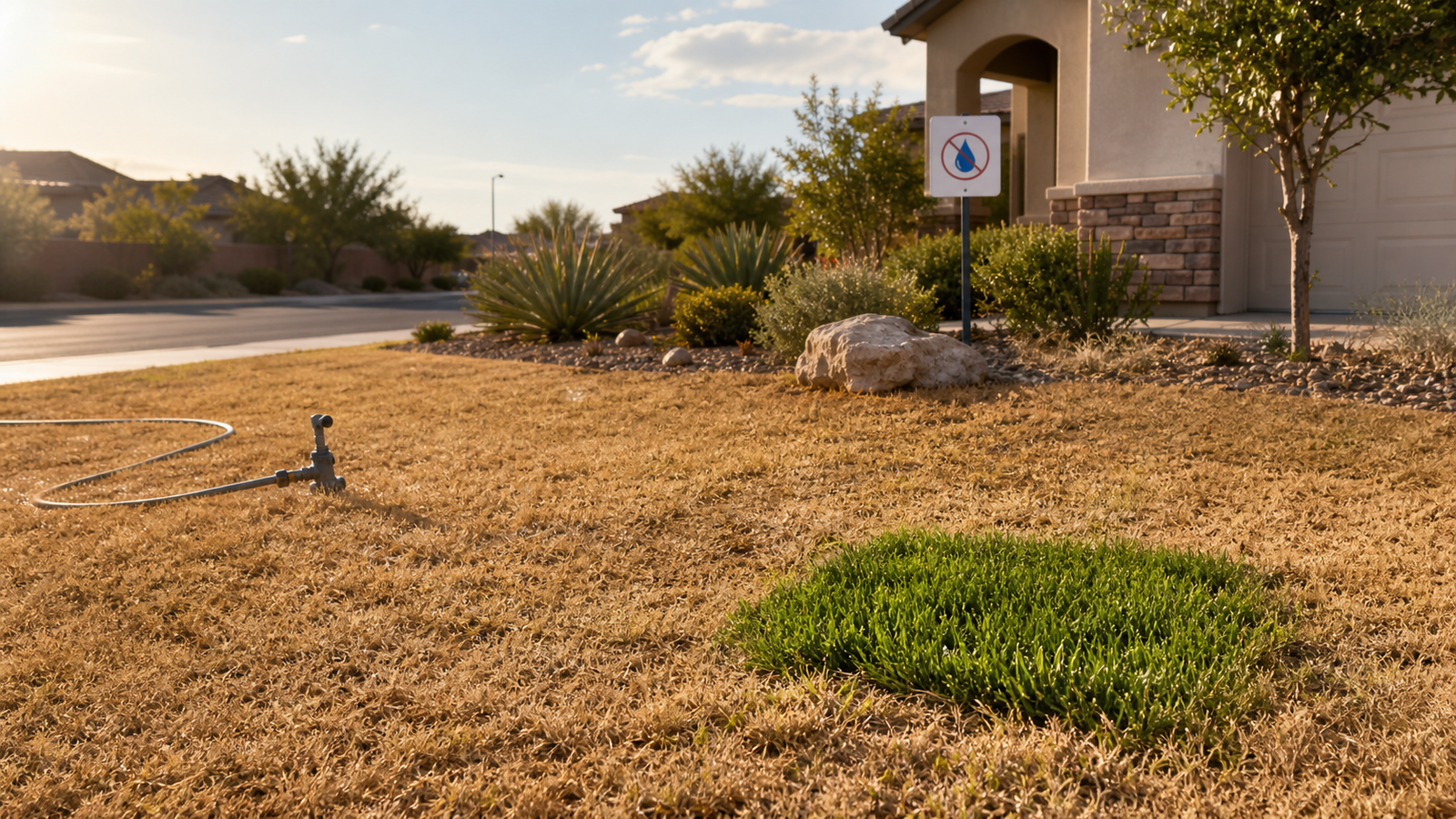
Disclosure (FTC 16 CFR Part 255): I am a journalist who covers consumer Lawn & Garden tech. ReviewGuid.com participates in the Amazon Services LLC Associates Program. If you click an affiliate link in a related buying guide and make a purchase, I earn a small commission at no extra cost to you. The reporting below contains no paid product placements; editorial decisions are made independently of any retailer. – Maya Bennett
Published May 19, 2026 – 9 min read
–
Home & garden journalist, 4 years on lawn and water-policy reporting
US search interest in drought-tolerant grass seed roughly doubled in May 2026, driven by rising water bills across the Sun Belt and California's AB 1572 ban on potable irrigation of nonfunctional turf taking effect January 1, 2027. Homeowners are no longer asking whether to switch grasses – they are asking which warm-season species survives a $200 monthly water bill and which one a city inspector will not flag.
Search volume for terms like "drought tolerant grass seed," "low water lawn," and "buffalo grass seed" roughly doubled across US Google traffic in the first three weeks of May 2026, according to retailer-side keyword data I have been tracking since the Sun Belt heat dome of April.
The surge tracks a structural shift, not a seasonal blip. Three forces are converging: a hotter spring across Texas, Arizona, Nevada, and Southern California; a fresh round of tiered water-rate increases in cities from Phoenix to Sacramento that pushed average summer lawn-irrigation bills above $200; and the looming effective date of California Assembly Bill 1572, which on January 1, 2027 will prohibit the use of potable water on nonfunctional turf at state and public properties. Homeowners outside California are paying attention because similar legislation is moving in Nevada and Colorado, and HOA boards across the Southwest have started rewriting landscape covenants in anticipation.
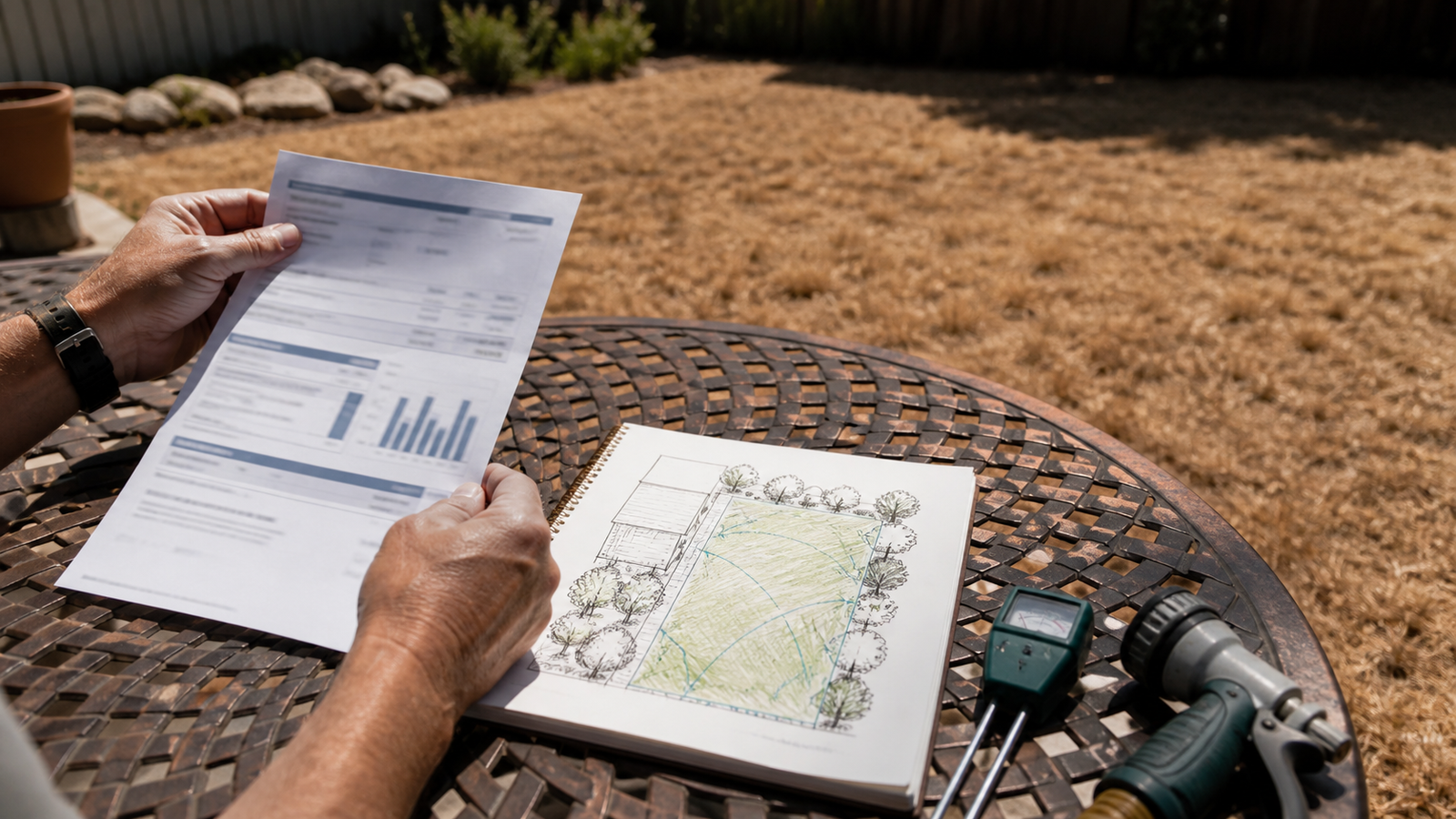
What changed in May 2026
For most of the last decade, the "drought lawn" conversation was niche. It lived inside extension-service publications, university turfgrass programs, and a small group of Sun Belt landscapers who quietly recommended Bermuda or Zoysia over the Kentucky Bluegrass on the bag. That changed this spring for two simple reasons.
First, the price of keeping a cool-season lawn alive crossed a threshold most households are unwilling to pay. The EPA WaterSense program notes that as much as 50 percent of the water applied to a typical home lawn is lost to evaporation, wind, or runoff and never absorbed by the plant. When the unit cost of water doubles, that waste shows up on the bill as real money. Second, the legal landscape moved. UC Agriculture and Natural Resources confirms that AB 1572 will end potable irrigation on nonfunctional turf at state and local government sites on January 1, 2027, with HOA common areas following on January 1, 2029. Single-family lawns are exempt from AB 1572 itself, but the cultural signal is clear: cool-season turf in arid zones is becoming a regulated liability.
Retailers responded fast. The largest seed brands – Scotts, Pennington, Jonathan Green, and several regional specialty houses – all expanded shelf space for tagged "drought-tolerant" SKUs in March and April. Search behavior caught up in May, exactly when homeowners across hardiness zones 7 through 10 begin sowing warm-season grasses.
Why California's AB 1572 matters beyond California
Assembly Bill 1572 is narrower than the headlines suggest. It does not outlaw lawns. It does not regulate single-family residential turf. What it does is prohibit the use of drinking water to irrigate "nonfunctional" turf – the strips of lawn around commercial buildings, government offices, parking islands, and HOA common areas where nobody actually walks or plays. The state portion of the ban takes effect January 1, 2027. HOA common areas follow on January 1, 2029.
The reason it is moving the consumer market is signaling. When a state defines a category of turf as nonfunctional, landscape architects, HOA boards, and city water utilities start adopting that vocabulary. The Southern Nevada Water Authority has run a turf-removal rebate program for years; new tiers in Phoenix and Las Vegas now pay homeowners $3 to $5 per square foot to remove cool-season grass and replace it with either drought-tolerant species or hardscape. Texas does not have an AB 1572 equivalent, but Texas A&M's extension service is fielding more inquiries about warm-season conversions than at any point I have observed in four years on this beat.
For homeowners reading water-bill spikes and HOA emails at the same time, the math is becoming unavoidable. A 5,000 square foot front lawn of Kentucky Bluegrass in Phoenix or Sacramento can cost between $90 and $160 per month to keep green from June through September on current tiered rates. The same yard reseeded with a warm-season blend – and crucially, irrigated to a lower evapotranspiration target – drops that bill by roughly a third even before turf-removal rebates enter the picture.
The four grass categories homeowners are choosing between
I am tagging four categories because they cover almost every legitimate drought-tolerant SKU on US retailer shelves in May 2026. There are dozens of cultivars inside each category – this is not a recommendation list, just the landscape of what is selling.
| Category | Core Technology | Price Range | Representative Brands |
|---|---|---|---|
| Zoysia (warm-season) | Deep rhizome root system, slow vertical growth, dense canopy reduces evaporation | $25 – $90 per 5 lb bag | Scotts, Pennington, Jonathan Green |
| Bermuda (warm-season) | Aggressive stolon spread, fast establishment from seed, full-sun preference | $15 – $60 per 5 lb bag | Scotts, Pennington, Hancock |
| Tall Fescue Blend (transition zone) | Deep taproot, cool-season but heat-tolerant, blended with rhizomatous cultivars | $30 – $80 per 7 lb bag | Jonathan Green, Pennington, Barenbrug |
| Buffalo (native warm-season) | Native to North American shortgrass prairie, lowest water requirement of any turf | $45 – $120 per 2 lb bag | Native American Seed, Hancock, Outsidepride |
⇆ swipe horizontally on mobile
Why turfgrass breeders see this as a one-way door
The science behind warm-season grasses is not new. Texas A&M AgriLife Extension has documented for years that warm-season species require 30 to 50 percent less water than cool-season species in equivalent climates. What is new is the speed at which university breeding programs are pushing improved drought-tolerant cultivars out the door, and the speed at which consumer-grade retailers are picking them up.
I spoke with Dr. Susana Milla-Lewis, who runs the Turfgrass Breeding and Genetics Program at North Carolina State University, while reporting this story. Her team has spent more than a decade selecting Zoysia and Bermuda cultivars for reduced water demand without sacrificing the dense, walkable feel homeowners expect from a lawn. Her framing of the moment was the cleanest I have heard.
“Water is only going to become more scarce and is going to be a very sought-after commodity. So we as an industry need to start focusing more on grasses that use less water.“
Milla-Lewis's point is borne out in retailer SKU data. Of the new drought-tolerant grass-seed listings added to major US e-commerce platforms in 2025 and the first half of 2026, more than half are Zoysia or Bermuda blends – the two warm-season species her program and parallel programs at Texas A&M, Oklahoma State, and Mississippi State have spent the most time improving. Tall fescue blends remain the dominant choice in the transition zone, but the new blends now routinely include 5 to 15 percent rhizomatous cultivars specifically selected for deeper roots and lower irrigation demand.
What to look for on the bag
If you have decided to convert or overseed, the bag itself does most of the work of separating a serious drought-tolerant product from a marketing label. Five things to check before adding any SKU to a cart.
Species match for your zone. Warm-season grasses (Zoysia, Bermuda, Buffalo) thrive in USDA zones 7-10. Tall fescue blends are the transition-zone (zones 5-7) compromise. Kentucky Bluegrass is not a drought lawn even if the bag claims otherwise.
Named cultivars, not just species. A bag labeled simply "Bermuda" tells you nothing. Look for named cultivars (e.g., specific university-bred releases) listed in the seed-tag table on the back of the bag.
Pure live seed (PLS) above 75 percent. The seed tag must list germination rate and purity. Pure live seed is the product of those two numbers; below 75 percent you are paying for filler.
Inert matter below 5 percent and noxious weed seed at zero. Both are on the seed tag. Cheap bags hide inert filler that lowers effective coverage.
Test date within 9 months. Seed loses germination rate after storage. Reject any bag with a test date older than 9 months from purchase.
What I am watching next
Three things will determine whether the May 2026 search spike becomes a permanent shift or fades by fall. First, whether Phoenix, Las Vegas, and Sacramento extend their per-square-foot turf-removal rebates into 2027 budgets. Second, whether Nevada or Colorado introduce AB 1572-style legislation in 2027 legislative sessions. Third, whether the leading seed brands continue expanding shelf space for university-bred drought cultivars or quietly retreat to higher-margin cool-season blends when rainfall returns.
For most households outside the desert Southwest, the calculus is more personal than political: a $200 summer water bill is the inflection point at which a Saturday spent overseeding with the right species pays back inside a single irrigation season. That math is what is now driving searches, not the policy headlines.
Ready to compare your options?
My companion buying guide tests three drought-tolerant grass-seed products head to head – one Zoysia blend, one Bermuda blend, and one transition-zone tall-fescue mix – with seed-tag analysis, coverage math, and which one fits which climate zone.
Frequently Asked Questions
Does California's AB 1572 ban my single-family lawn? +
No. AB 1572 specifically targets nonfunctional turf at state and local government properties (effective January 1, 2027) and HOA common areas (effective January 1, 2029). Single-family residential lawns are exempt from the statute itself. That said, local water utilities and HOAs in California, Nevada, and Arizona are increasingly tightening their own irrigation rules, so the regulatory direction is clear even if your specific yard is not yet covered.
Is drought-tolerant grass seed actually cheaper over a full season? +
Per Texas A&M AgriLife Extension, warm-season grasses such as Bermuda and Zoysia require 30 to 50 percent less irrigation than cool-season species in the same climate. On a 5,000 square foot lawn in Phoenix or Sacramento at current tiered water rates, that typically saves $30 to $60 per month from June through September – usually paying back the cost of overseeding or full conversion inside a single irrigation season.
When is the right time to seed warm-season drought-tolerant grass? +
Warm-season species (Bermuda, Zoysia, Buffalo) germinate best when soil temperature is consistently between 65 and 75 degrees Fahrenheit. For most of the Sun Belt that window opens in mid-April and closes in late June. Seeding too early causes patchy germination; seeding after July 4 leaves immature roots vulnerable to the first heat wave. For transition-zone tall fescue blends, early fall (late August through September) is preferable to spring.
Can I overseed an existing cool-season lawn with drought-tolerant seed? +
Yes, but with caveats. Overseeding a Kentucky Bluegrass or perennial ryegrass lawn with Bermuda or Zoysia generally requires scalping the existing lawn (mowing extremely short) and core-aerating to give warm-season seed direct soil contact. Tall fescue blends are friendlier for overseeding because they are themselves cool-season species. Expect 60 to 90 days for full establishment and one full season before the new species dominates.
Are turf-removal rebates available outside California? +
Yes. The Southern Nevada Water Authority offers $3 per square foot for cool-season turf removed and replaced with low-water landscaping. Phoenix Active Management Area utilities offer programs in the $2 to $4 range depending on city. Several Texas municipal utilities and Colorado's Denver Water have introduced similar pilots in 2025 and 2026. Check your local water provider's website – these programs are administered locally, not federally.