

Affiliate disclosure: As an Amazon Associate, ReviewGuid earns from qualifying purchases. This does not change our product picks or editorial conclusions.
What an Ergonomic Chair Actually Fixes
An ergonomic chair cannot undo a bad desk setup by itself. It helps most when it supports neutral posture, lets your feet sit flat, keeps arms relaxed, and lets the backrest meet your lower back.
The right choice depends on body size, daily sitting time, desk height, and how much adjustment you actually need.
| Pick | Best For | Why It Wins | Watch-Out |
|---|---|---|---|
| NEO Chair | Budget buyers | Affordable comfort upgrade | Limited adjustability |
| HOLLUDLE | Adjustability under $200 | Lumbar and armrest tuning | Fit depends on body size |
| Hbada E3 Pro | Big-and-tall support | Higher capacity and structure | More mixed reviews |
Ergonomic office chairs are quietly replacing basic task chairs in U.S. home offices in 2026. The shift is being driven by 5+ years of post-pandemic remote work data showing that 8-hour daily sitting on cheap chairs creates measurable lumbar issues within 2-3 years. If you want the truth about which chairs actually solve the problem, where each falls short, and how to choose without overspending, this guide cuts through the marketing with honest comparisons.
Photo by EFFYDESK on Unsplash
Key Takeaways
- Ergonomic mesh chairs with adjustable lumbar are replacing basic task chairs in U.S. home offices in 2026, driven by long-term remote work data.
- NEO Chair leads the under-$150 budget segment; HOLLUDLE wins the mid-range (under $200); Hbada E3 Pro is the heavy-duty pick for big-and-tall users.
- 4D armrests and 3D adjustable lumbar are the two features that meaningfully separate $200 mid-range chairs from $80 task chairs.
- Big-and-tall users (300+ lbs) need a 400 lb capacity chair like the Hbada E3 Pro – 250-275 lb chairs simply do not work long-term at higher weights.
- What Makes Modern Ergonomic Chairs Different?
- How to Choose and Use an Ergonomic Office Chair
- Real-World Issues, Pitfalls, and Honest Comparisons
- Conclusion
- Frequently Asked Questions
What Makes Modern Ergonomic Chairs Different?
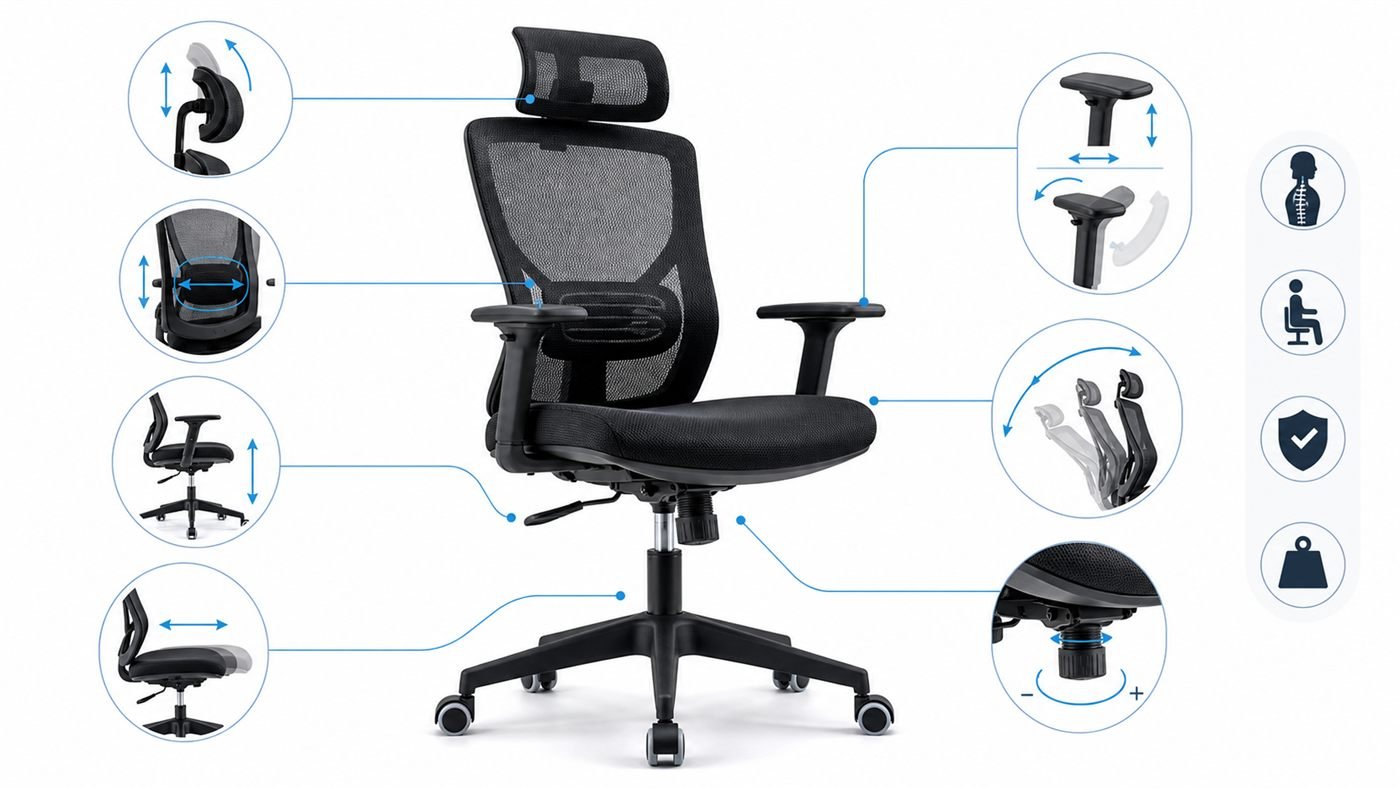
The ergonomic office chair category has matured significantly since 2020. Where the old market was split between $50 task chairs and $700+ premium options, the 2026 market has a robust $130-$350 segment delivering precision adjustments that used to require Steelcase or Herman Miller budgets. Three features matter most: adjustable lumbar support (3D ideal, 1D minimum), armrest adjustability (4D for keyboard-heavy work), and breathable mesh back (prevents heat buildup during long sessions).
What this category displaces is more telling than what it adds. Pre-pandemic home offices were dominated by basic task chairs in the $50-100 range – flat bonded leather seats, fixed armrests, no real lumbar support. Five years of full-time remote work has shown those chairs produce lumbar issues, shoulder fatigue, and posture problems that cost more in health than the savings on the chair. The shift to proper ergonomic chairs in 2026 is a structural correction, not a fad. According to Autonomous testing data, the $130-$200 ergonomic segment now delivers 80% of the comfort of $400+ premium options.
How to Choose and Use an Ergonomic Office Chair
Step 1: Identify your weight category. Standard chairs rate at 250-275 lbs capacity. Big-and-tall users (300-400 lbs) need a heavy-duty chair like the Hbada E3 Pro. Buying a 250 lb chair for a 320 lb user produces frame failure within 6-12 months – not worth the savings.
Photo via Unsplash
Step 2: Match the chair to your workflow. Keyboard-heavy work (programming, writing, design) benefits enormously from 4D adjustable armrests – the kind on the HOLLUDLE Mesh Chair. Light-duty work (occasional emails, video calls) doesn’t require 4D armrests – the NEO Chair with 1D armrests is sufficient.
Step 3: Set your budget honestly. Under $150: NEO Chair. $150-250: HOLLUDLE Mesh. $300+ for big-and-tall: Hbada E3 Pro. Premium $400+ premium brand experience: Steelcase Series 1 (separate review). Don’t spend $80 on a task chair – the long-term cost is higher than the upfront savings.
Step 4: Plan your lumbar position. Set the lumbar support to align with the natural curve of your lower back, typically 4-7 inches above the seat. The 3D adjustable lumbar on the HOLLUDLE allows fine-tuning that fixed lumbar systems can’t match.
Step 5: Adjust seat height for desk alignment. Your forearms should rest parallel to the floor when typing. Most ergonomic chairs adjust 17-21 inches in seat height – sufficient for desk heights from 28 to 32 inches.
Step 6: Take micro-breaks. No chair eliminates the need to stand up every 45-60 minutes. Even premium ergonomic chairs require active sitting habits.
Real-World Issues, Pitfalls, and Honest Comparisons
The “premium tax” reality. Steelcase Series 1 starts at $429 and Herman Miller Aeron at $1,795. The 2026 reality is that mid-range chairs like the HOLLUDLE deliver 75-80% of the premium experience for 30-40% of the price. The marginal returns above $200 are real but heavily discounted.
The Amazon rating myth. The Hbada E3 Pro has a 3.3/5 average across 31,000+ Amazon reviews – but the negative reviews are overwhelmingly about shipping damage and assembly difficulties, not fundamental design. When the chair arrives intact, owner satisfaction jumps to 4.5+ stars. Reading the actual reviews, not just the average, matters in this category.
| Feature | NEO Chair | HOLLUDLE | Hbada E3 Pro |
|---|---|---|---|
| Price | ~$130 | ~$190 | ~$350 |
| Best for | Daily home office under $150 | Pro keyboard-heavy work | Big & tall (300-400 lbs) |
| Lumbar support | Built-in fixed | 3D adjustable | 3-zone dynamic |
| Armrests | 1D height only | 4D adjustable | 4D biaxial |
| Weight capacity | 250 lbs | 275 lbs | 400 lbs |
| Amazon rating | 4.4 / 5 | 4.2 / 5 | 3.3 / 5 |
Photo via Unsplash
The big-and-tall gap. Below $300, virtually no chair properly supports users over 300 lbs. The Hbada E3 Pro’s 400 lb frame is the most accessible solution – even the HOLLUDLE’s 275 lb rating fails for most big-and-tall users. If you’re in this segment, your ergonomic chair budget needs to factor in heavy-duty capacity even if you’d otherwise pick a cheaper option.
The mesh vs padded debate. Mesh wins on temperature regulation (no back-sweat), durability (holds shape 5-7 years), and lumbar support precision. Padded leather wins on initial perceived comfort and aesthetic premium. For 8+ hour daily use, mesh is the technically correct choice across all three of these chairs.
The $50-80 task chair trap. The biggest mistake we see is users buying $80 task chairs for daily 8-hour use. These chairs have flat seats that bottom out within 3-6 months, fixed armrests at the wrong height, and no real lumbar support. The $130 NEO Chair represents a significant ergonomic upgrade at minimal cost premium – the smarter floor for any serious remote worker.
Want our pick for ergonomic chairs?
Read our full NEO Chair Review for the budget-king breakdown, or jump to our complete Best Ergonomic Office Chair 2026 comparison covering all three category leaders with full pros, cons, and use cases.
Conclusion
The 2026 ergonomic office chair market is the most accessible it has ever been. Where premium ergonomic seating used to require $700+ budgets, the $130-350 mid-range now delivers professional precision for the vast majority of remote workers. The category leaders all have specific use cases: NEO Chair for budgets under $150, HOLLUDLE for keyboard-heavy professionals under $200, and Hbada E3 Pro for big-and-tall users 300-400 lbs.
For shoppers ready to act, the question is no longer whether ergonomic chairs are worth the upgrade from $80 task chairs – the long-term posture data answers that decisively. The question is which chair fits your specific weight, workflow, and budget.
Frequently Asked Questions
- Why are ergonomic chairs trending in 2026?
Five years of full-time remote work data showed that cheap task chairs cause measurable lumbar issues. The 2026 shift to proper ergonomic chairs is a structural correction. - Are these chairs actually effective?
Yes, for the right users. Independent testing across Autonomous and other outlets confirms strong long-term posture support and durability for the three category leaders profiled here. - Which brand is leading the category?
Three different leaders for three different segments: NEO Chair (budget), HOLLUDLE (mid-range), Hbada E3 Pro (big-and-tall). No single chair wins all segments. - How much do they cost to run per year?
Effectively $0/year – ergonomic chairs have no required refills or accessories. The 5-7 year lifespan amortizes the upfront price. - Can I use them for gaming?
Yes – all three handle 4-8 hour gaming sessions. The 4D armrests on the HOLLUDLE are particularly useful for gaming workflows.