

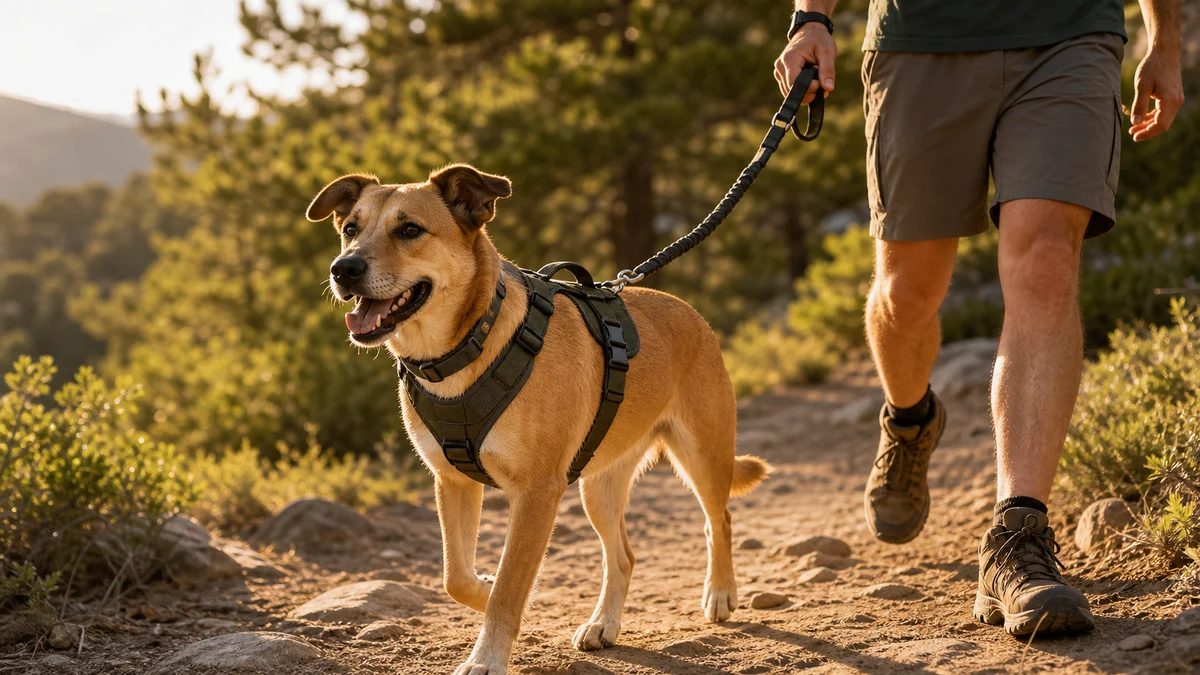
Disclosure: As an Amazon Associate, I earn from qualifying purchases. – Maya Bennett
Disclosure: As an Amazon Associate, I earn from qualifying purchases. – Maya Bennett. I am a journalist who covers consumer pet products. ReviewGuid.com participates in the Amazon Services LLC Associates Program. If you click an affiliate link in a related buying guide and make a purchase, I earn a small commission at no extra cost to you. The reporting below contains no paid placements.
Published June 2, 2026 – 8 min read
–
Consumer pet-products journalist, 4 years on the category
Interest in escape-proof, reflective dog harnesses climbs every summer as walking and travel ramp up, then spikes hard around the July 4th fireworks window when frightened dogs bolt. The shift this year is away from single-strap back-clip harnesses toward multi-strap, low-slack designs that a panicking dog physically cannot reverse out of.
I have been tracking pet-gear search behavior for four years, and the same pattern repeats every late spring: as soon as the weather turns, owners stop shopping for collars and start shopping for harnesses a dog cannot slip out of. Heading into summer 2026, that shift is more pronounced than I have seen it. The phrase “escape proof dog harness” is climbing weeks ahead of its usual July peak, and the products getting the most attention share one trait – they have abandoned the simple single-strap loop in favor of multi-strap closures built specifically to defeat the backward-duck escape.
The driver is not fashion. It is fear of a lost dog. The standard back-clip harness, the one most people already own, leaves a slack loop behind the front legs that a determined or frightened dog can twist and reverse straight out of. Owners who have watched it happen once – usually on a busy street or near a startling noise – rarely buy the same style again.
Why the surge is happening now
Summer compresses two separate risk factors into the same months. The first is simple exposure: warm weather pushes daily walking, weekend hiking, and dog-friendly travel to their annual high from May through September. More time on leash in unfamiliar places means more opportunities for a harness failure to matter.
The second is acoustic. Fireworks, thunderstorms, and the general chaos of summer holidays produce the noise that sets dogs running. The American Kennel Club has long documented that the days surrounding July 4th rank among the busiest of the year for lost-pet reports, and animal-welfare groups echo the warning every season. When a dog hits full panic, the gear it is wearing is the only thing standing between a scary moment and a dog gone over the horizon.
Put those together and the timing of the search spike makes sense. Owners are not buying escape-proof harnesses in June because they are bored – they are buying them because they remember last July, or because a neighbor’s dog got loose, and they want the problem solved before the fireworks start. You can see the same seasonal logic in the AKC’s guidance on harnesses versus collars, which frames secure-fit gear as a safety tool rather than an accessory.
Panic-bolt season is the real catalyst
Talk to anyone who works in animal rescue and they will tell you the escapes that matter most are not slow leaks – they are explosions. A dog that walks calmly on a back-clip harness for two years can shed it in a single second when a firework goes off behind it. The mechanics are unforgiving: the dog drops its head, plants its weight, and shoots backward, and a loose chest loop simply slides over the shoulders.
That is why the gear conversation has moved from “does my dog pull” to “can my dog get out.” Those are different problems. A no-pull harness manages a dog that leans into the leash on a normal walk. An escape-proof harness is designed for the worst-case moment when the dog is no longer thinking at all. Reflective trim has ridden the same wave, because owners who fear a bolt also want a dog that stays visible to drivers and easy to spot if the worst happens. The ASPCA’s walking-gear resources treat visibility and secure fit as a single safety package for exactly this reason.
How an escape-proof harness actually works
The engineering is simpler than the marketing suggests. Every reliable escape-proof design does one thing: it eliminates the slack loop a dog can reverse through. There are a few ways to get there, and they define the categories owners are choosing between this summer.
The most robust approach adds a third strap behind the ribcage. Because the rib cage is wider than the waist, that strap physically blocks the harness from sliding forward over the shoulders, which is what makes the backward duck nearly impossible even on deep-chested breeds. A second approach wraps the whole body in a closed loop with no gap behind the front legs. A third, common at the budget end, uses a step-in cut that keeps the body so snug there is no loose loop to begin with, often paired with a secondary release-button lock that has to be pressed deliberately.
None of this works if the harness is sized loose, which is the single most common mistake I see. Veterinary guidance is consistent on the point – VCA Hospitals’ overview of collar and harness options stresses that a secure, well-fitted harness reduces pressure on the trachea compared with a collar while keeping the dog contained, but only when it is adjusted correctly.
The four categories owners are weighing
If you strip away brand names, the market sorts into four recognizable categories. They differ in how they defeat the escape, what they cost, and which dog they suit. The table below maps the landscape – it is a category guide, not a product recommendation.
| Category | Core Technology | Price Range | Representative Brands |
|---|---|---|---|
| Full-body 3-strap | Neck, chest and belly straps form a closed loop with no slack gap | $25-$35 | rabbitgoo, Kurgo, Voyager |
| Step-in low-slack | Snug step-in cut plus a secondary release-button lock | $18-$28 | ThinkPet, PoyPet, Eagloo |
| Tactical / ribcage 3-point | Third strap behind the ribcage blocks forward slide; lift handle | $45-$70 | RUFFWEAR, OneTigris, Julius-K9 |
| No-pull back-clip | Front D-ring redirects pulling; single chest loop (not escape-proof) | $15-$30 | PetSafe, Chai’s Choice, 2 Hounds |
⇆ swipe horizontally on mobile
Why fit, not brand, decides the outcome
Here is the uncomfortable truth I keep running into when I report on this category: the harness on the box is rarely the problem. The fit is. A premium ribcage harness sized one notch too loose will fail just as surely as a cheap one, and a modest step-in model adjusted snugly will hold a dog that a sloppy expensive one would lose.
That makes measuring the single most important step, and it is the one owners skip most. Chest girth is the number that matters, not weight, because two dogs of the same weight can have very different barrel shapes. Veterinary and breed-club resources both recommend measuring the chest at its widest point and sizing to that figure – PetMD’s guide to measuring a dog walks through the method, and it takes about a minute with a soft tape.
“An incorrectly fit harness can do a lot of damage both physically and behaviorally.“
What I tell owners to look for
When friends ask me what separates a harness that holds from one that fails, I do not point them at a brand. I point them at a short list of features and a fitting habit. The checklist below is what I would want on any dog heading into a summer of walks, trips, and fireworks.
Count the straps. A true escape-proof design uses at least three contact points or a ribcage strap, not a single chest loop.
Measure chest girth first. Size to the widest point of the chest, not body weight, and check the brand’s own size chart before ordering.
Apply the two-finger rule. Two flat fingers under each strap is snug enough to contain a bolt without restricting breathing.
Demand reflective trim. Summer walks slide into dawn and dusk; reflective tape or stitching makes a loose dog far easier to recover.
Check the buckle locks. A secondary release-button or dual-lock buckle resists the accidental pop-open that happens during a panic pull.
The category is not complicated once you know what to ignore. Marketing language about “premium” materials matters far less than strap count, an honest size chart, and the discipline to fit the thing correctly. Get those right and the brand on the label becomes a question of budget and breed shape rather than safety.
Ready to compare your options?
I put three escape-proof harnesses through their paces across the categories above – a full-body three-strap, a budget step-in with a dual-lock buckle, and a ribcage tactical model for strong pullers and hikers. The hands-on comparison breaks down fit, security, and value so you can match one to your dog before the fireworks start.
Frequently Asked Questions
What makes a dog harness escape-proof? +
An escape-proof harness removes the slack loop a dog can reverse out of. Most use a third strap behind the front legs or ribcage, plus a snug step-in or full-body cut, so there is no gap for the dog to back out of when it panics or pulls.
Why are escape-proof harnesses trending in summer 2026? +
Two seasonal forces overlap. Warm-weather walking, hiking, and travel rise from May through September, and the July 4th and summer-storm fireworks window drives a sharp spike in panic-bolt escapes. Owners search for harnesses a frightened dog cannot slip out of before the holiday.
Are reflective harnesses worth it? +
For early-morning and after-dusk summer walks, reflective tape or stitching makes a dog visible to drivers and helps an owner locate a dog at night. It does not prevent an escape, but it shortens recovery time if one happens, which is why reflective trim now appears on most escape-focused models.
How should an escape-proof harness fit? +
Use the two-finger rule: you should be able to slide two fingers flat under any strap, but no more. A harness loose enough for a third finger leaves enough slack for a determined dog to twist free. Measure chest girth before sizing rather than going by weight alone.