

Disclosure: As an Amazon Associate, I earn from qualifying purchases. – Maya Bennett
Published May 22, 2026 – 8 min read
–
Pet health & consumer-products journalist, 5 years covering the pet safety category
An ASPCA Poison Control advisory in September 2025 linked hydrogel cooling pads to pet seizures and deaths, accelerating a consumer pivot toward gel-free, electricity-free alternatives. The breakout options for 2026 use Arc-Chill or ice-silk fabric that absorbs body heat passively – no freezer, no power cord, and no acrylamide. Prices start around $22, making the switch an easy call for most dog owners.
A quiet product category is having its loudest year. Self-cooling dog mats that require no electricity and contain no gel filling have surged in search volume and retail placement in the first half of 2026 – driven largely by a September 2025 ASPCA Poison Control advisory that connected certain hydrogel cooling pads to acrylamide exposure, seizures, and at least several reported pet deaths.
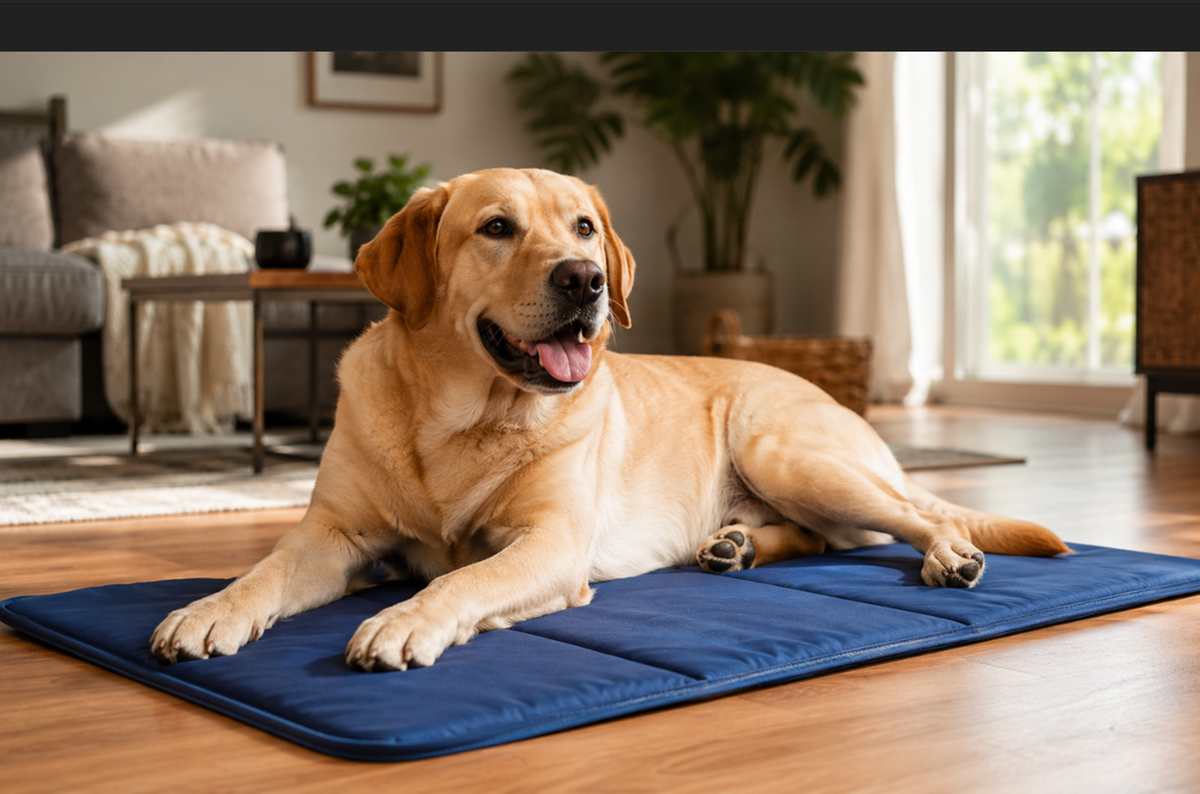
I have been tracking this shift for several months, and the numbers tell a clear story. Retailers from major big-box chains to independent pet boutiques have either pulled gel pad SKUs from endcaps or added explicit safety callouts on packaging. At the same time, a new crop of pressure-activated, fabric-based cooling mats – priced between $22 and $39 – has filled the gap with a straightforward pitch: lay it down, let your dog lie on it, watch the surface temperature drop. No freezer space required. No power outlet. No gel to rupture.
The ASPCA Warning That Changed the Category
In September 2025, the ASPCA Animal Poison Control Center published an advisory flagging acrylamide contamination in a subset of hydrogel cooling pads sold through major online channels. Acrylamide is classified as a probable human carcinogen by the EPA and is known to cause peripheral neuropathy and neurological damage in animals at elevated exposures. The advisory documented cases involving seizures and, in some instances, death following prolonged contact with or chewing of affected gel pads.
The ASPCA did not issue a full product recall – that authority rests with the CPSC and FDA – but the advisory carried enough weight to shift consumer behavior almost immediately. Forum posts, Reddit threads, and veterinary Facebook groups lit up within days. Pet owners began photographing the gel-pad ingredients lists they had previously never read. Many found no toxicology disclosures at all. For a category that had positioned itself on the premise of passive, worry-free pet safety, that was a credibility collapse.
You can read the ASPCA’s broader Hot Weather Safety Tips | ASPCA guidance for context on how the organization frames summer heat risk for pets. The cooling-pad advisory sits within a broader recognition that summer pet products deserve the same scrutiny consumers apply to food and toys.
How Gel-Free Cooling Mats Actually Work
The physics behind gel-free cooling mats are less exotic than the marketing language sometimes suggests. Two main technologies dominate the 2026 market. The first is Arc-Chill fabric – a woven endothermic material that absorbs contact heat at a higher rate than standard cotton or polyester. When a dog lies on it, the fabric draws warmth away from the body surface, creating a sensation of coolness that persists until the fabric reaches thermal equilibrium with the surrounding air. At that point the mat needs a few minutes of ambient air exposure to reset – typically 10 to 20 minutes – before it is cooling again.
The second technology is ice-silk fabric, a slightly different weave with a similar passive heat-transfer mechanism. Both approaches are sometimes marketed under QMAX ratings – a standardized measure of how quickly a surface absorbs heat from skin. A higher QMAX score means faster perceived cooling. Neither technology involves a gel, a phase-change chemical reservoir, or any material that could rupture, leak, or off-gas.
A third category – elevated mesh cots – works differently, relying on airflow underneath the dog rather than surface absorption. These are the oldest technology in the space and do not offer the same contact-cooling intensity, but they remain completely inert from a toxicity standpoint and are often the easiest to clean.
A Breakdown of Every Cooling Mat Type on the Market
Not all cooling mats are equal, and the 2026 landscape now spans five distinct categories with very different risk and performance profiles. The table below is a category explainer – not a product recommendation. It is designed to help you understand what you are looking at before you read any product listing or compare article.
| Mat Type | How It Cools | Needs Power? | Needs Freezing? | Gel / Toxin Risk? | Machine Washable? |
|---|---|---|---|---|---|
| Pressure-activated gel | Absorbs body heat via gel reservoir | No | No | YES – ASPCA warning Sept. 2025 | No |
| Arc-Chill fabric | Endothermic fiber absorbs contact heat | No | No | No | Yes |
| Ice-silk fabric | Passive surface heat transfer via woven fiber | No | No | No | Yes |
| Water-filled | Water thermal mass stays cooler than air | No | No | No | Usually no |
| Elevated mesh cot | Air circulation underneath the dog | No | No | No | Sometimes |
⇆ swipe horizontally on mobile
Why Heatstroke in Dogs Is More Urgent Than Most Owners Realize
I want to spend a moment on the underlying medical reality, because it is easy to treat a cooling mat as a convenience item rather than a safety tool. Canine heatstroke is a genuine medical emergency. According to the Overheating in Dogs | AKC resource, a dog’s normal core temperature sits between 101 and 102.5 degrees F. At 106 degrees F – just 4 degrees above that baseline – heatstroke begins. Organs fail. Neurological damage follows. And per PetMD’s data, roughly 50 percent of dogs that develop heatstroke die even when they receive veterinary treatment.
The risk escalates faster than most people expect. How Hot Is Too Hot for Dogs? | PetMD notes that pavement on a 90-degree day can reach 150 degrees F, and a closed car with windows cracked becomes a lethal environment within 10 minutes. But heatstroke is not just a car problem or a beach problem. It happens at home – on sun-exposed decks, in poorly ventilated rooms, after vigorous midday play. Dogs with flat faces (brachycephalic breeds like pugs, bulldogs, and French bulldogs) are at significantly higher risk because their airway anatomy makes panting – the primary canine cooling mechanism – less efficient.
A cooling mat does not replace shade, fresh water, or veterinary care when a dog is already overheating. But a properly engineered mat – laid in the dog’s resting spot before the hot part of the day – meaningfully reduces the thermal load the dog has to manage through panting alone. That is the actual value proposition, and it is why the category is growing even beyond the ASPCA catalyst.
What the Market Looks Like Right Now
The gel-free, no-electricity segment of the cooling mat market is dominated in 2026 by a small number of fabric technologies and a somewhat larger number of brands deploying them. Arc-Chill fabric mats are sold under several labels including Arf Pets, K9 Ballistics, and various direct-import brands on Amazon and Chewy. Ice-silk variants come from brands including Coohom, Mihachi, and a handful of newer entries. Elevated mesh cots have been around longest and are associated with brands like Coolaroo and Frisco.
Retail price compression has been significant. Eighteen months ago, a quality fabric cooling mat was a $45-to-$55 item. In May 2026, I am seeing the same functional technology – sometimes from the same contract manufacturer – at $22 to $39 for a medium or large size. Part of that is increased supply-chain competition. Part of it is that brands repositioned quickly after the gel-pad controversy, treating the transition as a volume play rather than a premium one.
If you are ready to see how specific options stack up side by side, I have tested the top three gel-free, no-electricity cooling mats in detail. Read the full comparison at best gel-free self-cooling dog mats for 2026 for a ranked breakdown with real-use notes.
“On a hot day, even with windows open, a parked car becomes a furnace quickly.”
What Veterinary Experts Want Dog Owners to Know
The quote above from Dr. Lori Bierbrier, ASPCA’s Senior Medical Director of Community Medicine, was originally made in the context of car safety – but its relevance extends to any enclosed or semi-enclosed space on a hot day. A sunroom. A garage. A back porch with no shade canopy. The physics do not change. Enclosed air heats faster than open air, and a dog resting on a surface that is absorbing radiant heat from a sun-exposed floor or wall faces compounding heat load from below and above.
Veterinary guidance broadly supports the use of passive cooling surfaces as part of a multi-strategy heat management plan. That plan typically includes shade, fresh water available at all times, avoidance of exercise during the hottest hours (generally 10 a.m. to 4 p.m. in summer), and a cool resting surface. A fabric-based cooling mat slots cleanly into that last category without the leakage risks of water mats, the freeze-prep logistics of ice packs, or now – following the ASPCA advisory – the toxicity concerns of some gel pads.
What experts do caution is that cooling mats are not a replacement for air conditioning in extreme heat events. When ambient temperatures exceed 95 degrees F and humidity is high, passive fabric cooling is a supplement, not a solution. Dogs in those conditions need access to air-conditioned spaces. A mat is most valuable in the 75-to-90-degree F range that characterizes the majority of summer days across most of the continental United States.
No gel filling. Avoids the acrylamide risk flagged in the ASPCA’s September 2025 hydrogel advisory. Look for Arc-Chill, ice-silk, or elevated-mesh construction instead.
Machine-washable cover. Dogs shed, drool, and track in dirt. A cover that goes through a standard washing machine cycle is not optional if you plan to use the mat daily.
Works without electricity or refrigeration. Plug-in cooling pads and freeze-overnight inserts both require prep time or infrastructure. Passive fabric mats are ready to use at any time.
Explicit dog weight and size rating. A mat engineered for a 40-lb dog will not perform the same way for an 80-lb dog. Always match the mat’s rated capacity to your dog’s actual weight.
QMAX or cooling performance spec listed. A published QMAX value means the brand has quantified the heat-absorption rate. No spec means no accountability. Higher QMAX = faster surface cooling.
Non-toxic materials verified by brand. Ask for a material safety data sheet or look for brands that explicitly state acrylamide-free and phthalate-free on their product pages.
Ready to find the right mat?
I tested the top 3 gel-free, no-electricity options side by side – measuring actual surface temperature drop, ease of cleaning, and whether each mat holds up to a large-breed dog’s weight over a full summer. See which one earned the top spot.
Frequently Asked Questions
Are gel cooling mats safe for dogs in 2026? +
Not all of them. In September 2025 the ASPCA Poison Control issued an advisory after acrylamide – a neurotoxin – was detected in certain hydrogel cooling pads. Reported cases included seizures and deaths in pets. The ASPCA recommends choosing gel-free alternatives that cool through pressure-activated endothermic fabric or elevated mesh instead. If you already own a gel pad, check the manufacturer’s materials disclosure and contact the ASPCA Animal Poison Control Center (888-426-4435) if your dog has chewed or heavily mouthed the pad.
What is a self-cooling dog mat and how does it work without electricity? +
A self-cooling dog mat uses either pressure-activated endothermic fabric (Arc-Chill or ice-silk) or breathable elevated mesh to draw body heat away from a dog passively – no power cord and no freezing required. The fabric absorbs and disperses heat through a physical process, keeping the surface noticeably cooler than ambient room temperature. Most fabric mats need 10 to 20 minutes of air exposure between long sessions to reset their cooling capacity.
How hot is too hot for a dog to be outside? +
According to PetMD, pavement temperatures above 85°F can burn paw pads in under 60 seconds, and ambient air temperatures above 90°F put most dogs at risk of heat exhaustion – especially brachycephalic breeds. The AKC notes that a dog’s normal body temperature is 101 to 102.5°F; heatstroke begins at 106°F, a rise of only about 4 degrees from baseline. Limit outdoor activity to early morning and evening hours when summer temperatures peak above 85°F.
Do self-cooling dog mats work for large dogs? +
Yes, but sizing matters significantly. Most manufacturers offer sizes from S through XL and specify a maximum dog weight per size. A mat rated for a 50-lb dog will not perform the same way under a 90-lb Labrador. Look for a mat that lists an explicit weight rating and a QMAX cooling performance value – a higher QMAX number means faster surface heat absorption. The compare guide at best gel-free self-cooling dog mats for 2026 includes size charts for all three tested options.