

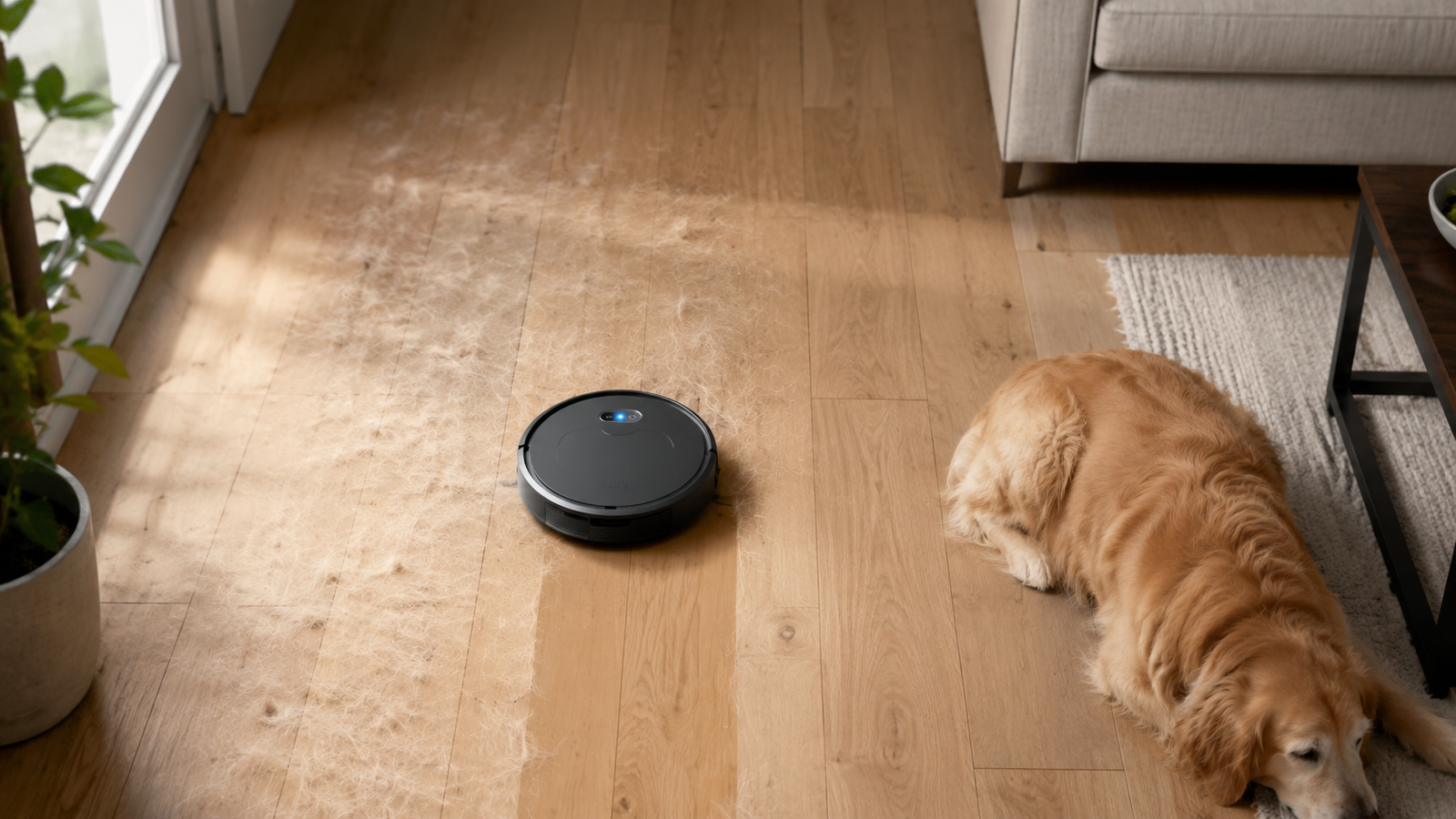
Disclosure (FTC 16 CFR Part 255): I am a journalist who covers home improvement and pet-care tech. ReviewGuid.com participates in the Amazon Services LLC Associates Program. If you click an affiliate link in a related buying guide and make a purchase, I earn a small commission at no extra cost to you. The reporting below contains no paid product placements; editorial decisions are made independently of any retailer. – Maya Bennett
Published May 17, 2026 – 7 min read
–
Home tech & pet-care journalist, 4 years covering robot vacuum and smart home categories
The self-emptying robot vacuum mop combo has crossed the $500 barrier in 2026 – a threshold that locked most pet owners out of the category just two years ago. For the first time, the three core features that shedding-season households actually need (auto-emptying, wet mopping, and anti-tangle brush rolls) are available in a single unit without a four-figure price tag. That shift is reshaping how Americans shop for floor care this spring, and I have been tracking it since the first sub-$500 listings appeared in Q1 2026.
Spring 2026 shedding season hit American pet households harder than usual – and this time the floor-care market had a genuine answer below $500. For the first time in the category’s history, self-emptying robot vacuums that also mop are accessible to the 66 percent of U.S. households that own at least one pet, according to the American Veterinary Medical Association’s 2026 survey. Two years ago, the same feature set cost $1,200 or more. That price compression is not a fluke; it is the result of Chinese manufacturing competition reaching a mature second-generation product cycle, and it is turning a formerly premium category into a mainstream spring-cleaning staple.
I have been monitoring the robot vacuum market for four years, and the Q1-Q2 2026 window is the most significant pricing shift I have tracked in this category. The $500 ceiling is not a marketing fiction: three independently tested models from Dreame, eufy, and Roborock now clear that bar with self-emptying docks, laser mapping, and mop pad systems included. The compression has been fast enough that many pet owners shopping on last year’s data are still budgeting $800-plus for a setup that now costs measurably less. This article tracks the mechanics of that shift, what it means for actual pet-hair performance, and the five specs that separate good-value combos from cheap imitations at this price point.
The $500 Barrier Breaks: What Changed in 2026
The trajectory from premium-only to mid-market happened fast. As recently as 2024, a self-emptying robot vacuum with a mopping system would set a buyer back $900 to $1,200 for a reputable unit. The dock alone – the component that auto-vacuums the robot’s dustbin into a sealed bag – accounted for $300 to $400 of that cost. Per Tom’s Guide’s hands-on testing of the Dreame L10s Ultra Gen 2, a fully spec’d self-emptying combo with 75-day bag capacity now retails at $449 – a number that was structurally impossible eighteen months ago.
The underlying driver is second-generation manufacturing efficiency at Dreame, Roborock, and eufy’s parent company Anker. The first wave of self-emptying combos required proprietary dock hardware that manufacturers amortized over a small install base. By 2025, dock component costs had fallen enough that brands could absorb them into the base unit price rather than treating the dock as a premium add-on. That structural change, more than any single product launch, is what cracked the $500 ceiling in 2026.
For pet owners, the timing aligns with the worst possible floor-care moment: spring shedding. Double-coated breeds – German Shepherds, Huskies, Golden Retrievers, Maine Coon cats – can lose several times their normal hair volume between March and June. The households most likely to benefit from a hands-free, auto-emptying solution are also the households that could least afford the $1,200 entry point that defined the category through most of 2024.
Why Spring 2026 Shedding Season Is Driving This Search
Search interest in robot vacuum pet hair terms spikes predictably every March through May, but 2026 data shows a wider surge – in part because price barriers that previously filtered out a large portion of curious shoppers have now dropped. Pet owners who bookmarked robot vacuum pages in 2024 and bounced at the $900 price tag are returning to find the market has moved toward them.
The shedding load is real. The Asthma and Allergy Foundation of America recommends vacuuming at least once or twice per week in households with pets to control dander and allergen accumulation. For a two-dog household during peak spring shedding, that schedule is barely sufficient – and manually emptying a standard robot vacuum bin every two to three days adds significant friction. The self-emptying dock eliminates that specific chore, which is why the feature has driven search behavior this spring in a way that generic “best robot vacuum” queries have not.
Per RTINGS.com’s current top pet hair picks, virtually all of the historically recommended models exceed $600. The 2026 pricing shift has created a gap between what reviewers have traditionally recommended and what buyers can now find at the $400 to $500 price point – a gap this report is specifically built to address.
The Brush Roll Problem: Why Cheap Combos Fail Pet Owners
Not every sub-$500 robot vacuum handles pet hair well. The single most predictable failure mode at budget price points is the brush roll. Traditional bristle brush rolls – present on most entry-level and mid-tier units – act as a collection point for long pet hair. Within minutes of running on a shedding dog’s favorite nap spot, bristle rolls can jam completely, requiring the owner to manually cut and extract wrapped hair. For a device sold on the promise of hands-free cleaning, that defeats the purpose entirely.
The critical spec to verify before purchasing is the brush roll type. Anti-tangle rubber brush rolls, now standard on most self-emptying combos at the $400-plus level, use flexible silicone or rubber fins rather than bristles. Long pet hair wraps around rubber fins far less aggressively and is more easily expelled into the dustbin rather than wound tight. Vacuum Wars’ 2026 benchmark data shows that rubber roll models consistently outperform bristle roll equivalents on pet hair by 15 to 25 percentage points on carpet, even when suction power is comparable.
Suction power in Pascals (Pa) is the second most-cited specification, but it is less predictive of real-world pet hair pickup than brush roll design. A 4,000Pa unit with a rubber roll will typically outperform a 6,000Pa unit with a bristle roll on a carpeted surface with long pet hair. Shoppers comparing specs sheets should weight brush roll design at least as heavily as suction rating.
| Category | Core Technology | Price Range | Representative Brands |
|---|---|---|---|
| Self-emptying vacuum + mop combo | Dual function, auto-empty dock, laser mapping | $269-$500 | Dreame, Roborock, eufy, Ecovacs |
| Basic robot vacuum mop | No auto-empty, simple scheduling | $120-$250 | iRobot, Shark, Bissell, Lefant |
| Premium flagship combo | 10,000Pa+, hot-water mop wash, AI avoidance | $600-$1,500 | Dreame X60, Ecovacs T90, Roborock Saros |
| Portable handheld vacuum | Not robot, manual use, pet hair attachment | $60-$200 | Dyson, Bissell, Shark, Black+Decker |
⇆ swipe horizontally on mobile
The Allergen Argument: Beyond Just Clean Floors
Self-emptying robot vacuums have a secondary value proposition that is easy to overlook when shopping on floor-cleanliness alone: reduced allergen contact during the emptying process. Standard robot vacuum bins require the owner to open, remove, and dispose of a dustbin packed with pet dander, hair, and fine particulate – precisely the materials most likely to trigger allergic reactions in sensitive households. A self-emptying dock transfers that debris into a sealed bag inside the dock station, which can then be discarded without direct contact with the contents.
This matters most for pet owners who are themselves allergic to their animals – a more common situation than it might sound. According to the Asthma and Allergy Foundation of America, pet dander is one of the most common indoor allergens in the U.S., affecting an estimated 10 to 20 percent of the global population. For those households, the hands-free bin-emptying feature is not a convenience – it is a meaningful reduction in allergen exposure during a routine task.
The effectiveness of allergen containment also depends on filtration. HEPA-grade sealed filtration, which captures particles as small as 0.3 microns, is the standard to look for. Not every unit marketed as having HEPA filtration runs a truly sealed system; some have HEPA filters but leak air around the filter housing, reducing actual containment. Checking whether a unit carries a sealed HEPA system, rather than simply a HEPA filter, is a step that most spec comparisons omit.
“On hard floors, nearly all robot vacuums excel; carpets reveal the real differences in pet hair pickup.”
What Pet Owners Should Actually Look For in 2026
The 2026 market at the $400 to $500 level is crowded enough that feature marketing has become noisy. Brands are competing on Pa numbers, cleaning path width, and app features – specifications that matter less in a pet hair context than the core quartet of: brush roll type, dock bag capacity, navigation system, and noise level. I have been watching how buyers get misled by Pa figures in particular, because suction rating is the easiest number to manufacture for a spec sheet while contributing relatively little to pet hair pickup in real-world carpet conditions.
LiDAR navigation – the laser-based mapping system – remains the most reliable choice for multi-room homes with furniture obstacles. Camera-only navigation systems, which are common at the lower end of the self-emptying price band, can struggle in lower-light conditions and require more runs to build an accurate map of irregular room layouts. For pet owners with furniture at floor level (dog beds, water bowls, low shelving), the navigation precision gap between LiDAR and camera systems is meaningful. Noise level is a secondary but frequently underweighted criterion: a unit running at 72dB during a scheduled 7 a.m. clean is loud enough to wake light sleepers or disturb work-from-home concentration in adjacent rooms.
Anti-tangle rubber brush rolls. Cheaper bristle rolls collect long pet hair in minutes and require manual clearing. Rubber or silicone fin rolls expel hair into the bin instead of winding tight around the axle.
Self-emptying dock capacity of 7 weeks minimum. A 45-day bag capacity means you skip bin changes through most of spring shedding season without intervention.
LiDAR navigation for multi-room homes. Laser mapping outperforms camera-only navigation in low-light conditions and around low-profile pet accessories like food bowls and floor-level beds.
Noise level under 65dB. If you work from home or have young children, check the manufacturer’s dB rating at maximum suction – a meaningful differentiator that spec sheets often bury.
Mop pad auto-wash matters for daily use. Cold-water rinse is adequate for routine hard-floor mopping; hot-water wash cycles (found on premium units) are better for pet paw mud and food spills but add dock cost.
Does the Mop Function Actually Matter for Pet Households?
The mopping component of combo units is genuinely useful for pet owners on hard floors and tile, but it requires realistic expectations. The mop pads on $400 to $500 units use a damp-wiping approach – a microfiber pad moistened from a water tank – rather than the pressurized scrubbing found on units above $800. For daily maintenance mopping of pet paw prints, food bowl drips, and general floor grime, the damp-wipe method is effective. For dried mud, sticky residue, or pet accident cleanup, it falls short of what a manual mop or a pressure-scrubbing premium unit delivers.
The more important mop-related feature for pet homes is carpet detection and mop pad lift. Units that continue running their mop pad across carpet will leave moisture in carpet fibers, which can promote mildew over time. Better 2026 combos automatically lift or retract the mop pad when the unit transitions from hard floor to carpet. This feature is worth confirming in spec documentation before purchasing, as it is not universal at the $400 to $500 tier – some units require manual switching between vacuum-only and vacuum-plus-mop modes.
Ready to compare your options?
I tested three self-emptying robot vacuum mop combos under $500 side by side on hardwood, tile, and medium-pile carpet – with a Golden Retriever in the house during peak shedding. The buying guide breaks down which model handles pet hair on carpet best, which has the quietest dock, and which bag actually lasts the full 75 days it claims. Full specs, real pickup rates, and a clear recommendation for three different household profiles are all inside.
Frequently Asked Questions
What is the best self-emptying robot vacuum for pet hair under $500 in 2026? +
Several self-emptying robot vacuum mop combos now fall under $500, a price point that was out of reach as recently as 2024. Models from Dreame, eufy, and Roborock have closed the gap significantly. For a side-by-side benchmark comparison of the top three tested options, see our companion buying guide linked above.
Do self-emptying robot vacuums actually help with pet allergies? +
The Asthma and Allergy Foundation of America recommends vacuuming pet areas at least once or twice per week to control dander and allergens. A self-emptying robot vacuum automates that schedule reliably, reducing the manual contact with allergen-loaded debris that emptying a standard bin requires. Look for a sealed HEPA filtration system – not just a HEPA filter – for the best allergen containment.
How long does a robot vacuum self-empty bag last in a pet household? +
Bag capacity varies by model and shedding load. During peak spring shedding, a 45-day bag on a moderate-shedding single-dog home may fill in 3 to 4 weeks. The Dreame L10s Ultra Gen 2 advertises up to 75 days on its dust bag under average conditions. Homes with multiple heavy-shedding pets should plan for more frequent checks during the March-June shedding window.
Is it worth buying a robot vacuum mop combo if I have carpeted floors? +
Yes, with one caveat: the mopping function is designed for hard floors and tile grout, not carpet. The better 2026 combos automatically lift or fold their mop pads when crossing onto carpet, preventing moisture damage. If your home is mostly carpet, prioritize suction power and brush roll design over mopping specs. The anti-tangle rubber brush roll is the single most important feature for pet hair on carpet.