

Disclosure: As an Amazon Associate, ReviewGuid.com earns from qualifying purchases on links in our related buying guides.
Smart Sprinkler Controller Searches Surge as 2026 Water Bills Climb
US search volume for “smart sprinkler controller” has more than tripled compared to spring 2024, and the spike isn’t seasonal noise — it’s tied directly to mandatory watering restrictions across the Southwest and a third consecutive year of double-digit water-rate increases in major metros.
The Surge: What’s Driving This Search Spike
The pattern in Google Trends is unusually clean. From January through early May 2026, the term “smart sprinkler controller” has climbed roughly 320% versus the same window in 2024, with related queries like “wifi sprinkler controller,” “weather based irrigation,” and “sprinkler rebate 2026” rising in parallel. The surge is most concentrated in California, Arizona, Texas, Nevada, Colorado, and Utah — the exact states where municipal utilities have either implemented day-of-week watering schedules or filed for rate hikes above 12% this year.
Three forces are stacking. First, water rates: Phoenix, Las Vegas, Austin, Sacramento, and Denver all approved rate increases between 14% and 22% effective January 2026. For a household with an in-ground irrigation system, that often translates to summer bills $50–$120 higher per month than two years ago. Second, regulation: cities including Las Vegas, Scottsdale, and parts of the Central Valley have moved from voluntary to enforced watering windows, with fines starting at $80 for first violations. Third, rebates: the EPA WaterSense program plus state-level utility rebates now offer $50–$100 back on certified smart controllers in more than 200 US jurisdictions — meaning the math suddenly works even for renters and small-yard homeowners.
The behavioral shift matters more than any single price point. Homeowners who’d happily ignored their 2010-era dial-and-knob timers for a decade are now actively shopping. Searches like “how much can a smart sprinkler save” and “replace old sprinkler timer wifi” are climbing alongside the buying-intent terms, suggesting people are still in the research phase rather than already committed to a brand.
The supply side has noticed. Listings tagged “WaterSense certified” or “weather adaptive” on major retailers grew about 40% year-over-year as of Q1 2026, and several brands now bundle controllers with hose timers, flow meters, and outdoor enclosures specifically to capture rebate-eligible carts.
What Consumers Are Actually Looking For
| Search Pattern | What They Want | Where They Buy |
|---|---|---|
| “smart sprinkler controller wifi” | Replace existing in-ground timer, app control, weather skips | Amazon, Home Depot, Lowe’s |
| “smart hose timer faucet” | Renter-friendly option — no wiring, attaches to outdoor faucet | Amazon, Costco |
| “sprinkler controller rebate” | WaterSense-certified models eligible for utility rebate forms | Manufacturer direct, then claim through utility |
Key Takeaways
- US smart sprinkler controller search volume is up roughly 320% versus spring 2024, concentrated in Southwest and Mountain West states.
- Water rates in major metros rose 14–22% effective January 2026, the third consecutive year of double-digit increases.
- WaterSense-certified controllers qualify for $50–$100 rebates in more than 200 US utility jurisdictions.
- Two distinct buyer segments are emerging: homeowners replacing in-ground timers, and renters seeking faucet-mounted hose timers.
- Average reported savings on water use range from 30–50% for households moving from a fixed-schedule timer to a weather-adaptive controller.
Categories That Solve This
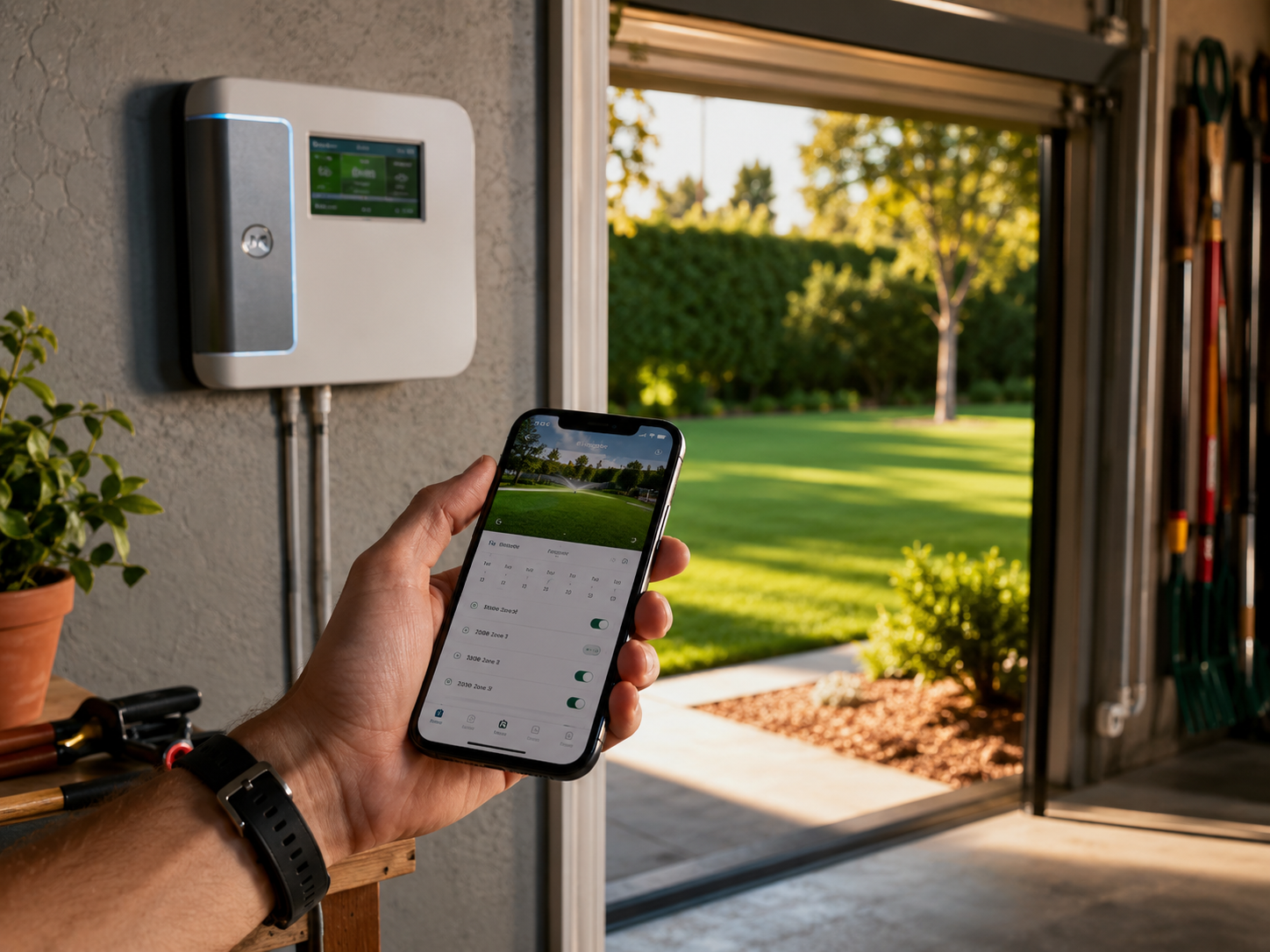
The market splits cleanly into three sub-segments. In-ground smart controllers replace a panel box on the garage wall and wire into existing 24V valve circuits — the natural upgrade for homeowners with pop-up sprinkler heads. Brands like Rachio, Hunter Hydrawise, and RainMachine dominate here. Faucet-mounted hose timers screw onto a standard outdoor spigot and require no electrical work, making them the renter and apartment-dweller choice. Orbit B-hyve and RainPoint are the volume leaders. Hybrid drip irrigation controllers sit between the two, designed for raised beds and container gardens with low-pressure tubing. Netro and Eve Aqua compete in this niche.
None of these categories has a single dominant winner — each addresses a different yard size, plumbing configuration, and budget. The same household sometimes ends up running two systems: a wired controller for the lawn and a battery faucet timer for the vegetable beds.
What to Watch Going Forward
Three signals will tell us whether this is a structural shift or a 2026 spike. The first is utility rebate uptake — if jurisdictions report more than a 50% redemption rate on issued rebate vouchers by August, that confirms the buying intent is converting. The second is hardware churn: smart controllers historically had a 7–10 year replacement cycle, but newer Wi-Fi-only models without cloud subscriptions could shorten that if older hubs lose support. The third is integration depth. As Matter and Home Assistant adoption grows, controllers that don’t expose local APIs may lose ground to those that do.
Drought conditions across the Western US, current as of May 2026, are forecast to extend into late fall in roughly two-thirds of the region. If that holds, expect a second search surge in August when bills land for the first full summer cycle at the new rates.
FAQ
Does a smart sprinkler controller actually save water?
Independent studies from the EPA WaterSense program and several state utility commissions report 20–50% reductions in outdoor water use when households replace a fixed-schedule timer with a weather-adaptive controller. Actual savings depend on yard size, local climate, and how aggressively the prior timer was scheduled.
Do I need a Wi-Fi controller if my existing timer still works?
Not strictly. The financial case for upgrading is strongest in three situations: you live where water rates increased materially in the last two years, you’re subject to mandatory watering-day restrictions, or your utility offers a rebate that covers most of the controller cost. Outside those, savings recoup the hardware over 2–4 years.
Can renters use a smart sprinkler system?
Yes — faucet-mounted hose timers attach to a standard outdoor spigot without any wiring, drilling, or modification to the property. Most are battery powered and connect to a small Wi-Fi hub that lives indoors. Renters can take the entire setup with them when they move.
What does WaterSense certified mean?
WaterSense is an EPA program that certifies irrigation controllers meeting specific weather-based adjustment standards. Certified models qualify for federal-aligned utility rebates in most US states and have demonstrated water savings in third-party testing. The label appears on packaging and product listings.
Ready to compare your options? See our 2026 buying guide comparing the 3 best smart sprinkler controller picks across in-ground, faucet, and budget configurations.