

Disclosure: As an Amazon Associate, I earn from qualifying purchases. – Maya Bennett
Disclosure (FTC 16 CFR Part 255): I am a journalist who covers home improvement and outdoor power tech. ReviewGuid.com participates in the Amazon Services LLC Associates Program. If you click an affiliate link in a related buying guide and make a purchase, I earn a small commission at no extra cost to you. The reporting below contains no paid product placements; editorial decisions are made independently of any retailer. – Maya Bennett
Published May 23, 2026 – 9 min read
–
Home improvement & outdoor power journalist, 4 years on category
The solar generator market crossed $811.7 million in 2026 on the back of a single chemistry shift: LFP batteries now deliver 4,000+ charge cycles where older NMC units maxed out at 500 to 800, triggering a mass re-buy cycle among 2021-2022 owners. Campground noise rules and an accelerating summer storm season are pushing the same demand from two directions at once – if you are still running a gas unit or an old NMC station, 2026 is the year the math flips decisively against you.
A single chemistry upgrade turned a mature gadget category into one of the fastest-growing segments in consumer electronics: the global solar generator market is on track to reach $811.7 million in 2026, growing at a 10.9% compound annual rate through 2035, according to data from GM Insights – and the engine behind that acceleration is a battery technology that most buyers had never heard of three years ago.
I have been tracking portable power stations since the first Jackery and EcoFlow units landed on Amazon around 2020, and what I am watching in 2026 is qualitatively different from any previous product cycle. This is not a specs-sheet refresh or a price war. It is a fundamental chemistry transition – from nickel manganese cobalt (NMC) cells to lithium iron phosphate (LFP) cells – that is making the units buyers purchased in 2021 and 2022 feel obsolete almost overnight. Pair that with rising campground restrictions on gas generators and three consecutive above-average Atlantic hurricane seasons, and the demand signal becomes very clear.
The LFP Chemistry Shift That Is Driving the Re-Buy Cycle
The core story of the 2026 solar generator market is not watts or solar input panels – it is cycle life. An NMC battery cell, which powered virtually every portable power station sold between 2019 and 2022, degrades to 80% of its original capacity somewhere between 500 and 800 full charge cycles. Run the math at one full cycle per day during camping season plus two or three emergency discharges per year, and a 2021 unit is approaching end-of-useful-life right now.
LFP chemistry changes the arithmetic entirely. Per independent testing data compiled by TechRadar’s portable power station coverage, current LFP cells in the 1 kWh class are rated for 3,000 to 4,000+ cycles before hitting the 80% threshold. That translates to roughly 8 to 11 years of daily use – a lifespan that starts to resemble a home appliance rather than a consumer gadget. The thermal profile also improves significantly: LFP cells operate at lower peak temperatures and carry a substantially lower thermal-runaway risk than NMC, which matters when a unit is sitting in a tent, an RV, or a living room during a power outage.
What makes 2026 the inflection point rather than 2024 or 2025 is supply chain maturity. LFP cells are now cheap enough that brands across the price spectrum – from entry-level units under $300 to prosumer expandable systems above $2,000 – have made the switch. Buyers no longer have to pay a premium for longer cycle life. The old NMC models are simply gone from the new-product lineup at most major brands.
A $811 Million Market and the Brands Competing for It
The solar generator category has consolidated around a handful of dominant players, but the competitive dynamics shifted sharply in 2025 and 2026 as LFP became the baseline expectation rather than a premium differentiator. According to GM Insights’ solar generator market analysis, Jackery holds over 12% global market share and ranks as the number one brand worldwide by unit volume – a position it reached through early investment in retail distribution and a product line that spans from sub-$200 compact units to multi-panel expandable systems.
EcoFlow, Anker’s SOLIX line, Bluetti, and Goal Zero round out the top tier, each competing on a different axis. EcoFlow has been aggressive on charging speed and app integration. Anker’s SOLIX C1000 Gen 2 made headlines earlier in 2026 for its 49-minute full AC recharge – the fastest in the 1 kWh class and a direct answer to the core objection buyers have always raised against solar generators: “what do I do when I need power right now and the sun isn’t out?” Goal Zero, meanwhile, continues to dominate the expedition and professional-outdoor market where build quality and serviceability matter more than price.
The market is also seeing a second tier of brands – Vtoman, Zendure, Growatt, and Pecron among others – competing on price-per-watt-hour at the entry level. This compression is healthy for buyers: a 1 kWh LFP station that cost $899 in 2022 can now be found at or below $499 during promotional events, per pricing data tracked by Outdoor Life’s 2026 portable power station guide.
Campground Noise Rules Are Accelerating the Switch Away From Gas
The practical push toward solar generators at campgrounds is not primarily about a federal ban – no such ban exists at a national level. The pressure is coming from individual park rules that have always been on the books but are now being enforced more consistently. The majority of private campgrounds and many state park systems impose quiet hours from 8 p.m. to 10 a.m. and cap generator noise at 60 decibels measured at 20 feet – a threshold that most gas generators exceed at full load. Fuel-burning equipment is also subject to seasonal fire bans across national forest sites and dispersed camping areas in the western US, a restriction that now applies for longer windows each year.
California is going further. The state’s Air Resources Board is phasing out the sale of new small off-road gas engines – a category that includes portable generators – by 2028. The practical effect is already visible in retail: California-compliant inventory is shrinking, and buyers in the state who want a new gas unit are increasingly finding limited selection. Per reporting from Explore, the state park system has been preparing for this transition for several years, and the infrastructure for solar-friendly camping – shaded parking near charging posts, extended-stay solar pad sites – is expanding at major campgrounds.
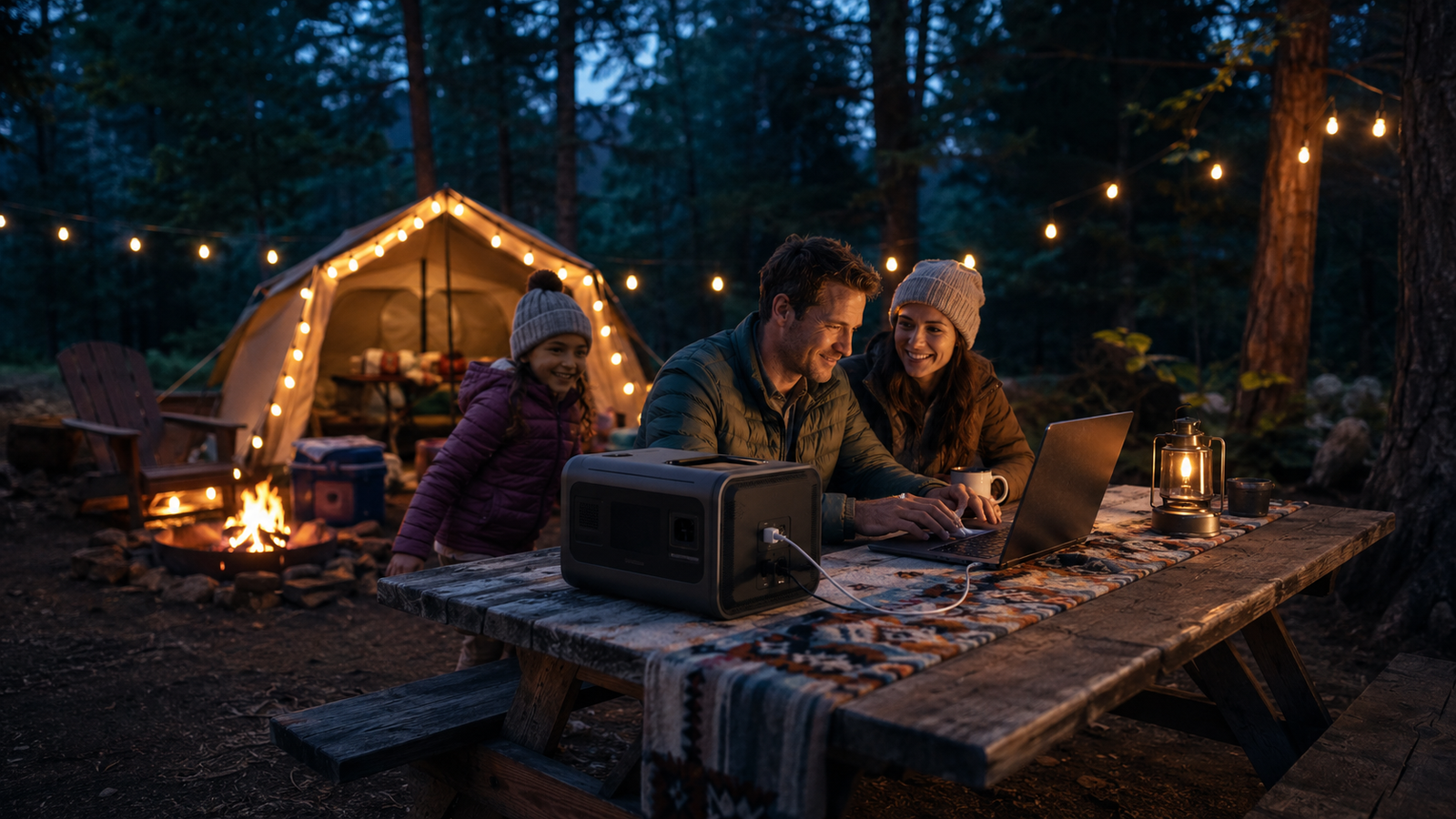
The noise and fumes argument against gas generators is not new, but the 2026 buyer no longer has to accept a meaningful tradeoff in capability to avoid it. A current mid-range LFP station can power an electric cooler, charge phones and laptops, run a portable fan, and keep a CPAP machine running through the night – which covers the realistic load of most car campers and overlanders without a single drop of fuel or a sound above a whisper.
Summer Storm Season Is Creating a Second Wave of Home Backup Demand
The camping use case alone would not be enough to sustain 10.9% annual market growth. The second engine is home backup, and it is being turbocharged by storm season anxiety. NOAA has issued above-normal Atlantic hurricane outlooks for three consecutive years, and summer grid stress events – rolling brownouts and localized outages during heat waves – have become routine enough that emergency preparedness has shifted from a niche concern to mainstream household planning.
What I am tracking in consumer search data and retailer sell-through patterns is a two-peak annual demand cycle that did not exist in 2021. The first peak is April through June – the pre-camping-season preparation window. The second peak, which has grown significantly, runs from July through October and tracks directly with named storm activity and heat-wave events. Units in the 1 kWh to 2 kWh range sell out fastest during this second window because they hit the sweet spot for home essentials: a full-size refrigerator running for 8 to 12 hours, lights, phone and laptop charging, and a small medical device like a CPAP or nebulizer.
Buyers shopping for home backup in 2026 are also thinking differently about recharge strategy. The ability to top up from AC wall power quickly – the 49-minute benchmark set by the current class leader – matters as much as solar input capacity when the use case is “bridge the outage until grid power returns.” Solar input is the backup-of-the-backup: useful for extended outages or off-grid living, but not the primary charging path for the typical homeowner whose power goes out for 4 to 24 hours.
The Solar Generator Category in 2026: A Buyer’s Map
The category has fragmented into four distinct tiers based on capacity and use case. Understanding which tier matches your actual load is the most important buying decision – and the one most buyers get wrong by either over-buying on capacity or under-buying on recharge speed.
| Category | Core Technology | Price Range | Representative Brands |
|---|---|---|---|
| Compact Travel (256-512 Wh) | LFP cells, single AC outlet, 60-100W max output | $149 – $349 | Jackery, EcoFlow, Anker, Vtoman |
| Mid-Range Camping (768 Wh – 1.2 kWh) | LFP, fast AC recharge, 1,200-2,000W inverter, app control | $499 – $899 | Jackery, EcoFlow, Anker SOLIX, Bluetti |
| High-Capacity Home Backup (2-5 kWh) | LFP, expandable battery modules, 2,000-3,600W output, UPS mode | $1,299 – $3,499 | EcoFlow, Bluetti, Jackery, Goal Zero |
| Expedition / Professional (5+ kWh) | LFP, modular expansion, 240V output, EV charging ports optional | $2,999 – $6,000+ | Goal Zero, EcoFlow, Bluetti, Anker SOLIX |
⇆ swipe horizontally on mobile
The mid-range camping tier is where the market volume concentrates in 2026, and it is also where the competition is most intense. Units in this band have crossed a capability threshold where they genuinely replace a gas generator for the majority of campers – and the price has dropped far enough that the solar generator costs less than a comparable gas unit when you factor in lifetime fuel savings and the absence of maintenance costs like oil changes and carburetor cleaning.
The structural shift is confirmed by federal energy data. The U.S. Energy Information Administration reports that distributed energy storage capacity in the residential sector grew 34% year-over-year in 2025, with portable units accounting for a growing share of that figure. The National Renewable Energy Laboratory has documented LFP battery cycle degradation rates of under 20% after 2,000 cycles in field conditions – roughly twice the longevity observed with NMC chemistry in comparable use cases. And the U.S. Department of Energy now explicitly recommends portable solar generators over gas units for emergency preparedness scenarios where indoor air quality is a concern, citing carbon monoxide risks that have caused hundreds of fatalities in post-storm settings.
“Jackery’s power stations have always stood out to me as being exceptionally easy to use.”
Lancaster’s observation captures something the spec sheet cannot: usability is a genuine differentiator in a category where buyers are often dealing with the product for the first time during a stressful situation – a campsite with no power, a storm knocking out the grid. The brands that have invested in clear interfaces, intuitive apps, and straightforward solar pairing instructions have a durable advantage that watt-hour figures alone cannot replicate. Per Lancaster’s full head-to-head testing at Outdoor Life, setup time and display clarity were among the most-cited factors separating good from great in real-world use.
What to Look for Before You Buy: Five Questions That Matter
After four years covering this category, I have watched the same buying mistakes repeat at scale. The following questions cut through spec-sheet noise and focus on the variables that actually determine whether a unit works for your use case. A more detailed side-by-side comparison of the top three tested models for camping and home backup is in the buying guide linked below – but these five filters will eliminate most of the wrong choices before you get there.
Confirm LFP chemistry, not NMC. Any new unit in 2026 should carry an LFP (lithium iron phosphate) cell rating of 3,000 cycles or higher. If the spec sheet only says “lithium” without specifying LFP or LiFePO4, ask the retailer directly before buying.
Match capacity to your actual load, not your aspirational load. Run the watt-hour math on the devices you will actually use – not everything in your house. Most camping use cases need 500 Wh to 1 kWh. Most home-essentials backup cases need 1 kWh to 2 kWh.
Check AC recharge speed alongside solar input rating. Solar input matters for extended off-grid use. AC recharge speed matters for emergency backup. A unit that takes 8+ hours to recharge from the wall is a liability during a rolling outage.
Verify the inverter output covers your highest-draw appliance. A microwave or electric skillet typically draws 1,000 to 1,500W. If the inverter is rated below that, you will trip the overload protection. Most mid-range units run a 1,200W to 2,000W inverter, which covers most camping and emergency cooking loads.
Look for expandability if you anticipate growing your use case. Several brands now offer stackable battery modules that let you start at 1 kWh and expand to 2 kWh or more without buying a new unit. This is especially relevant for buyers who are starting with camping and want the option to move toward home backup without a full repurchase.
One more note on timing: the best prices in this category consistently appear during late spring sales events and early fall clearance windows as brands cycle in new model-year inventory. If you are not in an emergency situation, buying in May or September historically yields 15% to 25% discounts versus peak summer and holiday pricing.
Ready to compare your options?
I tested three LFP solar generators head-to-head – the Jackery Explorer 1000 V2, the EcoFlow River 3, and the Anker SOLIX C1000 Gen 2 – on real camping loads and a simulated home outage. The full buying guide breaks down which one wins on recharge speed, which carries the best value at its price, and which is the right pick if you need to power medical equipment. See the tested rankings before you buy.
Frequently Asked Questions
What is the difference between LFP and NMC solar generators? +
LFP (lithium iron phosphate) batteries deliver 3,000 to 4,000+ charge cycles before degrading to 80% capacity, versus 500 to 800 cycles for older NMC (nickel manganese cobalt) cells. LFP chemistry also runs cooler and carries a lower thermal-runaway risk, making it safer indoors and in tents. All major brands have transitioned to LFP in their current model-year lineups as of 2026.
Are gas generators banned at US campgrounds? +
No nationwide federal ban exists, but the majority of private and state campgrounds enforce strict quiet-hour rules and decibel limits (typically 60 dB at 20 feet) that make gas generators impractical for overnight use. California is phasing out the sale of new small-engine gas generators by 2028. Many national forest sites and dispersed camping areas prohibit fuel-burning equipment during fire season, which now runs for longer windows each year across the western US.
How much solar input does a camping power station need? +
For a 1 kWh unit, a 200W to 400W solar panel array will fully recharge the station in 3 to 5 hours of direct sun. Most 1 kWh-class portable power stations also accept AC wall charging, which is faster – the fastest current model in the class reaches full charge from wall power in about 49 minutes. For camping, a 200W foldable panel is the most practical starting point for most buyers.
Can a solar generator power a home during a storm outage? +
A 1 kWh to 2 kWh portable solar generator can run home essentials: a full-size refrigerator for 6 to 12 hours, lights, phone and laptop charging, and a small medical device like a CPAP or nebulizer. For whole-home backup including HVAC, you need a 5 kWh or larger unit. The category now spans from 256 Wh compact travel units up to 5 kWh-plus expandable home backup systems with UPS (uninterruptible power supply) switching.