

Disclosure (FTC 16 CFR Part 255): As an Amazon Associate, I earn from qualifying purchases. I am a journalist who covers consumer home-office gear. ReviewGuid.com participates in the Amazon Services LLC Associates Program. If you click an affiliate link in a related buying guide and make a purchase, I earn a small commission at no extra cost to you. The reporting below contains no paid placements. – Maya Bennett
Published May 30, 2026 – 8 min read
–
Consumer home-office and furniture journalist, 6 years on category
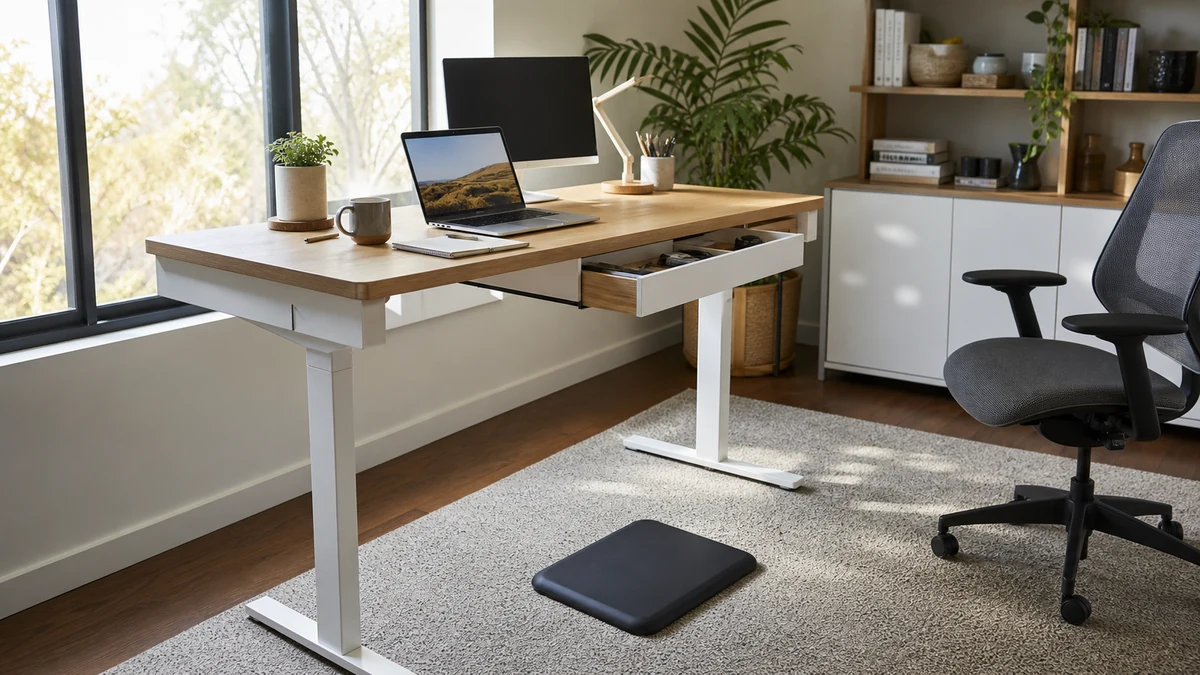
Standing desks that bundle drawers and shelving into the same footprint have moved from a niche feature to a mainstream buying filter. The shift is driven by small-apartment hybrid workers who have nowhere to put a separate filing cabinet, and “drawers standing desks” is now its own shopping category on major retailers. The catch: storage adds weight and steals knee room, so frame strength and drawer placement matter more than the marketing photos suggest.
A standing desk used to be one flat surface that went up and down. In 2026 it is increasingly a piece of storage furniture that also happens to lift, and the data behind that shift is hard to miss: industry trackers and retailer category pages show built-in-storage models climbing from roughly 30 percent of the standing-desk market in 2020 to somewhere between 45 and 50 percent today.
I have been tracking the home-office furniture category since the pandemic-era buying boom, and the through-line this spring is space, not posture. The people emailing me are not asking whether standing is healthy. They are asking where the filing cabinet is supposed to go in a 400-square-foot apartment when the desk already eats one wall. Manufacturers heard the same thing, and the answer arriving on shelves is a sit-stand frame with drawers, cubbies, or a side cabinet folded into the design.
Why the storage-desk surge is happening now
The timing is not an accident. Hybrid work settled into a permanent pattern over the last two years, which means millions of people who once treated a home desk as a temporary setup now need it to be a real, full-time workstation – including the paperwork, cables, and supplies that a real office quietly absorbs. In a dedicated office you stash all of that in a cabinet down the hall. In a studio apartment there is no hall.
Retailers have responded by carving out dedicated shelf space. Wayfair now runs a standalone “drawers standing desks” filter, and a wave of fresh May 2026 buyer guides from outlets like OffiGo, BTOD, and ThirstyBear have appeared specifically to rank storage-equipped models rather than plain frames. Market trackers such as IndexBox have begun publishing forecasts that treat “standing desk with storage” as its own product line with its own demand curve, separate from the broader sit-stand market.
When search behavior, retailer taxonomy, and editorial coverage all reorganize around the same sub-category inside a few months, that is the clearest signal a feature has crossed from optional to expected. Storage is becoming the default question buyers ask, the way cable management and dual motors became standard expectations in earlier cycles.
The small-space math that is driving demand
The core problem is brutally simple. A standard mobile filing cabinet occupies roughly two to three square feet of floor and needs clearance in front to open the drawers. In a small apartment, that footprint competes directly with a bed, a couch, or simply the ability to walk across the room. A storage-integrated desk erases that conflict by stacking the storage into vertical space the desk already claims.
That is why buyers are increasingly willing to accept compromises elsewhere. A desk that is slightly narrower, slightly more expensive, or slightly heavier is an easy trade if it deletes a whole second piece of furniture. The category is effectively selling square footage back to renters, and in expensive metro areas that math is compelling enough to override the usual price sensitivity.
There is a clutter dimension too. When cables and supplies have no home, they migrate onto the work surface and shrink the usable desktop. A built-in drawer or under-desk shelf gives the overflow somewhere to live, which keeps the standing surface clear – and a clear surface is the difference between a desk you actually raise and one that stays parked at sitting height because the monitor riser is buried under mail.
The four shapes this trend is taking
Not all storage desks are built the same way, and the differences matter a lot once you live with one. Broadly, the market has organized itself into four design approaches, each with a distinct trade-off between storage volume, knee clearance, and lift performance. The breakdown below is a category map, not a product ranking – I am not steering you toward any single model here.
| Category | Core Design | Price Range | Representative Brands |
|---|---|---|---|
| Under-desk drawer frame | Shallow drawer mounted to the lifting top; storage rises with the surface | $200 – $450 | FlexiSpot, FEZIBO, Branch |
| Compact storage desk | Narrow footprint with side cubbies or a small shelf tower for tight rooms | $180 – $400 | FEZIBO, Sweetcrispy, Vari |
| Premium dual-motor cabinet | Heavy-duty lift with integrated file cabinet and high weight rating | $500 – $900+ | Uplift, Vari, Fully |
| Rolling pedestal add-on | Separate wheeled cabinet that tucks under any frame; not lift-integrated | $90 – $250 | FlexiSpot, Lorell, Devaise |
⇆ swipe horizontally on mobile
The health angle buyers keep misreading
Storage is the reason people are shopping, but the sit-stand mechanism is still the reason these desks exist – and it is the part shoppers most often misunderstand. The popular framing is that standing is good and sitting is bad. The research is more nuanced. The Cornell University ergonomics lab is blunt that the benefit comes from changing posture and moving, not from standing motionless for hours, which can create its own leg and lower-back strain.
That distinction shapes how you should actually use a storage desk. The drawers are not just tidy; they remove a reason to stay parked. If your supplies are within arm’s reach you can transition between sitting and standing without rebuilding your workspace each time. Cleveland Clinic notes that breaking up long sitting bouts is associated with better blood flow and improved insulin response, but the operative word is breaking up – regular transitions, not a single heroic standing shift.
Federal workplace guidance agrees on the principle. OSHA explicitly recommends sit-stand workstations precisely because they let workers alternate posture throughout the day, and the Mayo Clinic office-ergonomics guide reminds buyers that whichever position you are in, the monitor should sit at eye level and your elbows should bend near 90 degrees. A storage desk that buries your knees under a deep drawer can quietly wreck that elbow geometry, which is why design details matter.
“Small, consistent movement leads to more energy, better focus, and greater productivity. A 2011 CDC study found a 54 percent decrease in musculoskeletal pain among workers who alternated between sitting and standing.“
The trade-offs the product photos hide
Every storage approach borrows from somewhere. The most common hidden cost is knee clearance. A drawer mounted under the desktop sits exactly where your thighs go when seated, so a deep drawer can force your chair back and break the elbow-at-90-degrees posture the ergonomics guides call for. Shallow drawers solve this; deep ones do not.
The second hidden cost is lift performance. Storage means weight, and weight is the enemy of a cheap single-motor frame. Loaded drawers full of books and files can push a desk past the point where a budget motor lifts smoothly, leading to stalling, wobble at full height, or a motor that simply gives up early. This is the single biggest reason the premium cabinet category exists – those desks pair the storage with a frame rated to carry it.
The third is assembly and stability. Bolting a cabinet to a moving frame adds joints, and joints add wobble if the hardware is not robust. The desks that survive long-term use tend to be the ones where the storage is engineered into the frame from the start, not screwed on as an afterthought. None of this shows up in a glossy product render, which is exactly why a category that looks interchangeable on a search results page is not.
What I would check before buying
If you are shopping this category, the marketing copy will tell you about storage volume and almost nothing about the things that decide whether you will be happy in a year. Use the checklist below as your filter, and treat any model that cannot answer these questions clearly as a risk.
Weight rating with drawers loaded. Look for a dual-motor frame rated near 250 pounds or more if you plan to fill the storage. Budget single-motor desks rated at 154 to 220 pounds can struggle once the drawers are full.
Knee clearance, seated. Measure the gap under the desktop. A deep under-mount drawer can steal the leg room you need to keep your elbows near 90 degrees while typing.
Footprint versus a real cabinet. Confirm the desk genuinely saves floor space rather than just relocating a pedestal you still have to wheel out to open.
Height range for your body. Check the lowest and highest desktop heights against your standing elbow height so you can hit a neutral posture both seated and standing.
Stability at full height. Read owner feedback for wobble complaints at standing height, especially on models where a cabinet is bolted to the moving frame.
Get those five right and the storage feature does what it promised: it deletes a piece of furniture without sabotaging the desk’s real job, which is making it effortless to keep changing your posture during the workday.
Ready to compare your options?
We took the trade-offs in this report and put them to the test across three storage standing desks – a budget under-desk drawer pick, a compact small-room option, and a premium dual-motor cabinet – measuring lift stability with loaded drawers, knee clearance, and real footprint savings.
Frequently Asked Questions
Why are standing desks with built-in storage trending in 2026? +
Hybrid and remote work pushed more people into small apartments where there is no floor space for a separate filing cabinet. Desks that fold drawers and shelving into the same footprint solve that, which is why built-in-storage models climbed from roughly 30 percent of the category in 2020 to 45 to 50 percent by 2026.
Does adding drawers to a standing desk hurt height adjustment? +
It depends on the design. Drawers mounted under the desktop rise and fall with the surface and do not affect lift, but they reduce knee clearance when seated. Free-standing pedestal or rolling-cabinet designs keep the lift mechanism clean but add floor footprint, which defeats the small-space purpose.
Is standing all day better than sitting all day? +
No. Cornell ergonomics researchers stress that the benefit comes from alternating posture and moving, not from standing statically for hours. Standing rigidly all day can cause its own leg and back strain. The goal is to change positions regularly throughout the workday.
What weight capacity do I need for a storage standing desk? +
Loaded drawers add weight that the lift motor has to raise. Budget single-motor desks often top out near 154 to 220 pounds total. If you plan to store books, files, and a monitor arm, look for a dual-motor frame rated for 250 pounds or more so the desk lifts smoothly when the drawers are full.