

Disclosure: As an Amazon Associate, I earn from qualifying purchases. – Maya Bennett
Wall mount garage fan demand is rising because garages are becoming summer workrooms, gyms, and hobby spaces. The smart buyer is comparing airflow, mounting safety, noise, and moisture resistance before choosing a fan.
Search interest for wall mount garage fan rose into May 2026, with Google Trends data showing the last four weeks averaging 62.5 versus 44.25 for the previous four weeks. That is a timely signal for a seasonal category.
Why the garage fan search is heating up
The garage has changed roles. More households now use it as a workshop, exercise area, freezer corner, potting bench, laundry overflow area, or summer project room. Those uses create the same complaint: the space gets hot faster than the main house and rarely has the same cooling system.
I am watching this category because the questions are practical, not decorative. Readers are asking whether airflow can make a garage bearable, whether wall mounting is worth the installation step, and whether high-CFM industrial fans are overkill. The U.S. Department of Energy fan guidance explains that fans improve comfort by moving air across people.
The shift is also budget-driven. Adding a mini split or extending central HVAC into a garage is expensive and may create code or insulation questions. A fan is not air conditioning, but it is a lower-cost first step for short project sessions.
Airflow claims are getting more scrutiny
The number buyers keep seeing is CFM, or cubic feet per minute. It is not a perfect comfort score, but it helps separate a compact oscillating fan from a higher velocity shop fan. Bob Vila garage fan testing puts CFM at the center of garage-fan performance.
Consumer testing also matters because fan speed, noise, and ease of use do not always move together. Consumer Reports fan testing evaluates room fans by wind speed, noise, energy use, and usability, which are the same questions garage buyers should ask.
For a garage, a high number can be useful when the fan is mounted across a bench or treadmill. It can also be too much if the fan is only three feet from your face, if it blows dust across a work surface, or if the oscillation pattern misses the zone where you stand.

Why wall mounting is the feature buyers want
A wall-mounted fan solves a layout problem before it solves a heat problem. Garages are already crowded with bins, bikes, mowers, tools, ladders, and parked cars. A fan that lives on the wall is less likely to block a door swing or become one more object to move.
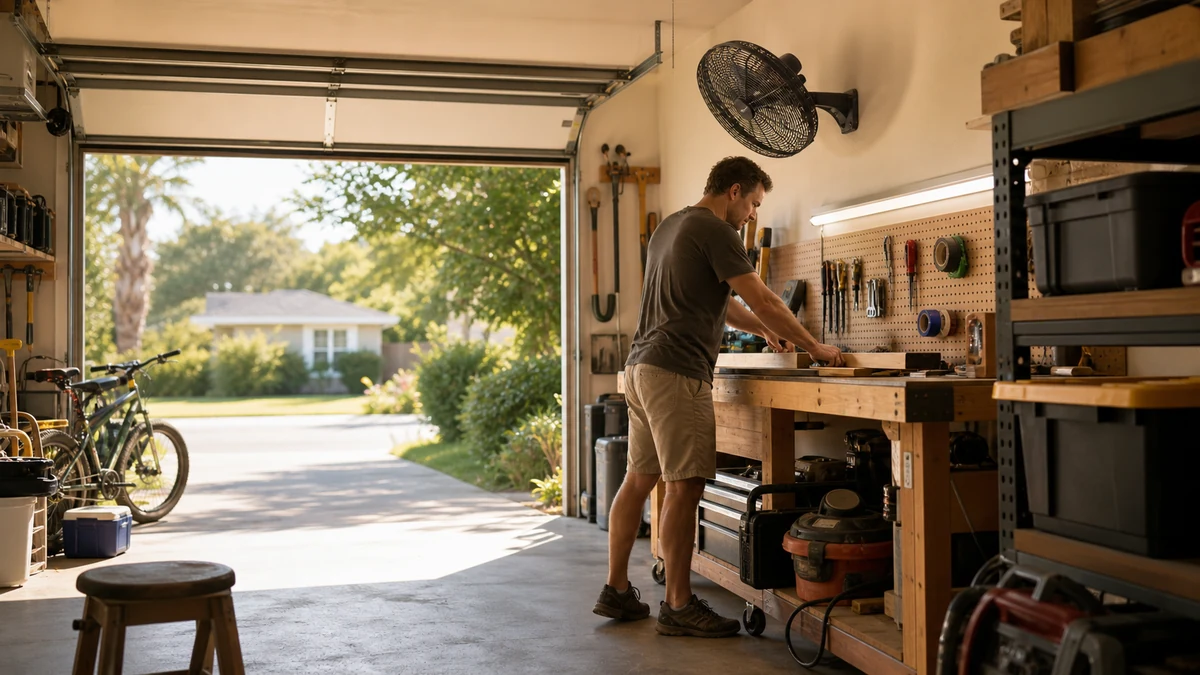
Mounting also changes the airflow angle. A floor fan often blasts ankles, sawdust, or a single corner. A wall fan can be set higher, tilted down, and aimed across a standing work area. Oscillating models cover more of a garage gym or bench.
The tradeoff is installation discipline. Buyers need a solid stud or masonry anchor, enough cord reach without unsafe extension-cord habits, and a location that keeps blades away from stored items.
| Category | Core Technology | Price Range | Representative Brands |
|---|---|---|---|
| Compact oscillating wall fan | Plastic cage, remote, timer | $35-$60 | Comfort Zone, Lasko, Genesis |
| High velocity shop fan | Metal cage, stronger motor | $60-$120 | NewAir, Air King, Simple Deluxe |
| Outdoor or damp-area wall fan | Weather-resistant housing | $55-$160 | VEVOR, Tornado, BILT HARD |
The value question is comfort per square foot
The best fan is not always the biggest fan. A one-car garage with a small bench might need a compact oscillating model more than a commercial air mover. A two-car garage with a treadmill or table saw may benefit from a higher velocity fan. The TIME fan cooling science reminder about fan use and comfort is relevant: moving air helps people feel cooler when the airflow reaches them.
Shoppers should think in zones. If the garage has one bench, mount near the bench. If it has a gym corner, aim across the lifting area. If the door stays open for yard work, consider dust, humidity, and cleaning access.
Noise is the hidden cost. A fan that is comfortable for ten minutes may be distracting for a two-hour project. Remote controls and timers matter more in a gym or laundry setup than in a woodworking corner where the fan is switched on before work starts.
“Airflow ratings, a key indicator of garage-fan performance, come in the form CFM, the volume of air moved.”
What to check before buying
Ready to compare your options?
I compared a high-CFM NewAir wall fan, a budget Comfort Zone remote model, and a VEVOR damp-area pick.
One practical note before buying: wall fans are permanent enough that planning matters. Mark the standing zone, check the stud location, confirm the cord route, and test the likely tilt angle before drilling. A quieter fan that reaches the right zone is usually more useful than a louder fan that looks stronger on paper but gets switched off after ten minutes.
Why garage cooling is having a moment
Garages have quietly turned into second living spaces. They are home gyms, woodworking shops, podcast corners, and overflow offices, and all of those uses fall apart once the room turns into an oven in summer. Unlike a bedroom, a garage rarely has its own air conditioning, so owners look for a cooling fix that is cheap to run and does not require rewiring or ductwork. That gap is exactly what a wall-mounted fan fills, which is why interest has climbed alongside the broader trend of finishing and using garage space year round.
The appeal is partly about floor space. A pedestal fan eats room that a busy garage cannot spare, and it tips over or gets bumped when you are moving tools and bins around. Mounting the fan on the wall clears the floor, keeps the blade cage out of harm, and aims a steady, directed breeze right at the work zone. For a space that is already crowded, that space-saving angle is often the deciding factor before airflow numbers even enter the conversation.
There is a cost story too. Running a fan for hours costs a small fraction of running a compressor-based cooler, and most buyers do not actually need to chill the whole room, they just need air moving across them while they work. That makes a wall fan an easy, low-risk purchase compared with a portable AC unit, and it explains why shoppers increasingly start their search with fans rather than air conditioners when the goal is a usable, comfortable garage.
What buyers are weighing before they commit
The most common hesitation is mounting. A wall fan has to anchor into a stud or masonry, and buyers who are not sure what is behind their drywall tend to pause before ordering. The second is environment: an open garage door or a humid climate calls for a damp-rated build, while a sealed, dry garage opens up cheaper indoor-style options. The third is control, since a fan mounted out of reach is far more pleasant to live with when it has a remote and useful speed settings.
Those three questions, where it mounts, how wet it gets, and how it is controlled, are shaping the kinds of products rising to the top of search results. Shoppers are gravitating toward models that are honest about their ratings and review counts, that clearly state whether they tolerate moisture, and that keep day-to-day operation simple. The takeaway from the trend is not that one fan wins for everyone, but that matching the fan to how the garage is actually used is what separates a purchase people keep from one they return.
Frequently Asked Questions
Why are wall mount garage fans trending in 2026?
Search demand is rising as homeowners use garages as gyms, shops, storage zones, and hobby rooms during hot months.
Do garage fans lower the air temperature?
Most fans cool people by moving air across skin. They do not work like air conditioners, so placement matters.
What CFM should I look for?
Small task zones can use less airflow, while larger garages need stronger CFM and better placement.
Should a garage fan be wall mounted?
Wall mounting saves floor space and keeps airflow aimed across workbenches, gym equipment, or parked vehicles.