

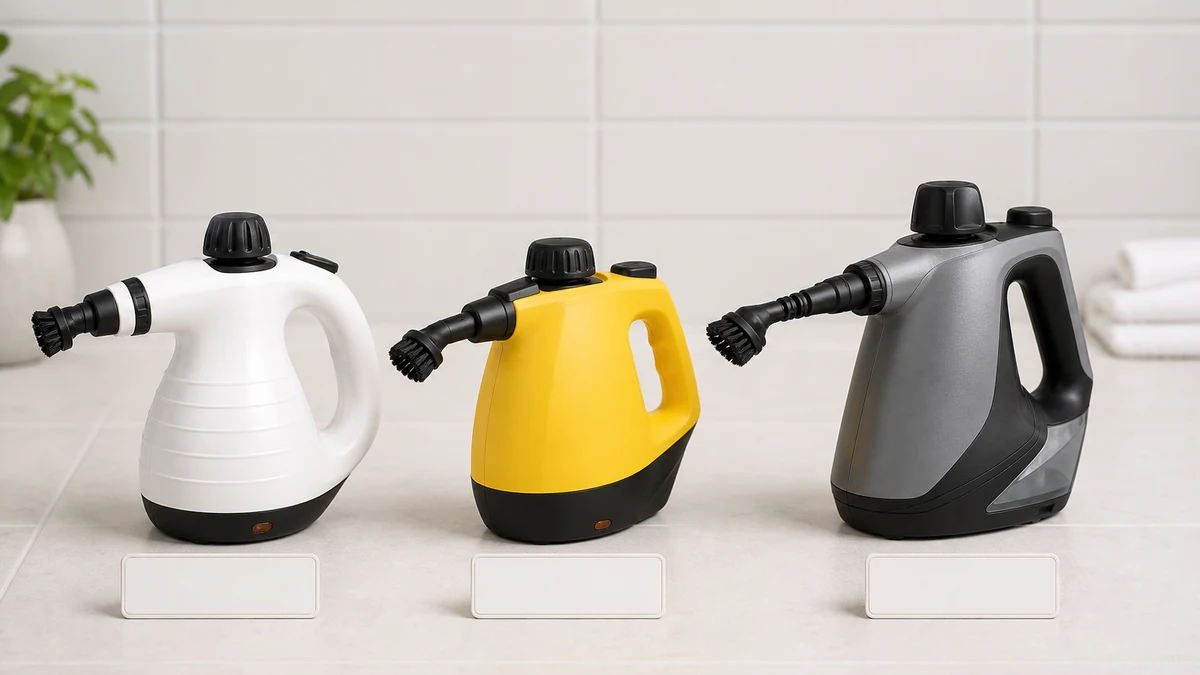
Disclosure: As an Amazon Associate, I earn from qualifying purchases. This article contains affiliate links at no additional cost to you. – Maya Bennett
LIVE DEAL
– Steamfast SF-370WH -10% today
$89.99 $99.99
Updated June 4, 2026 – Maya Bennett – 14 min read
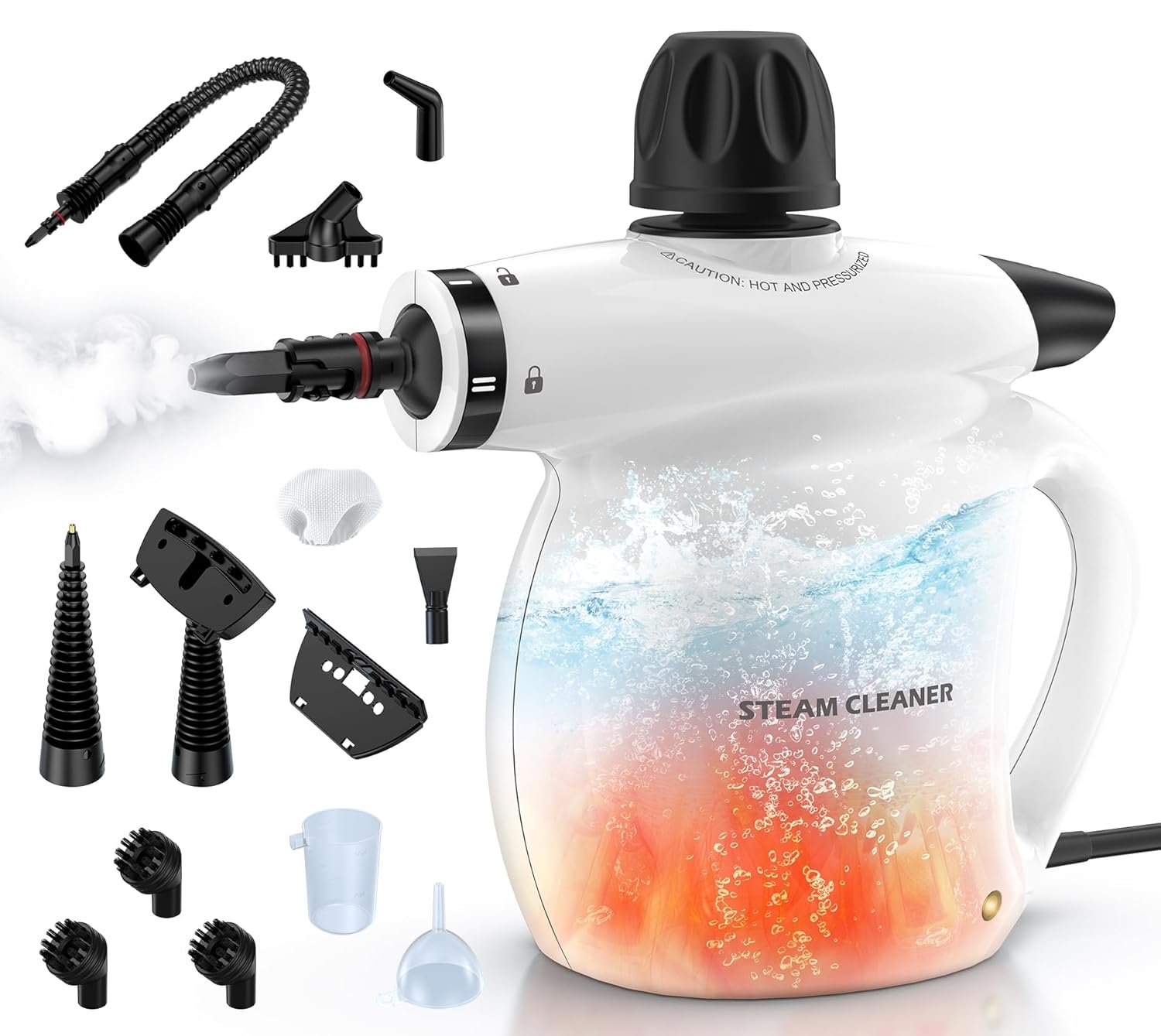
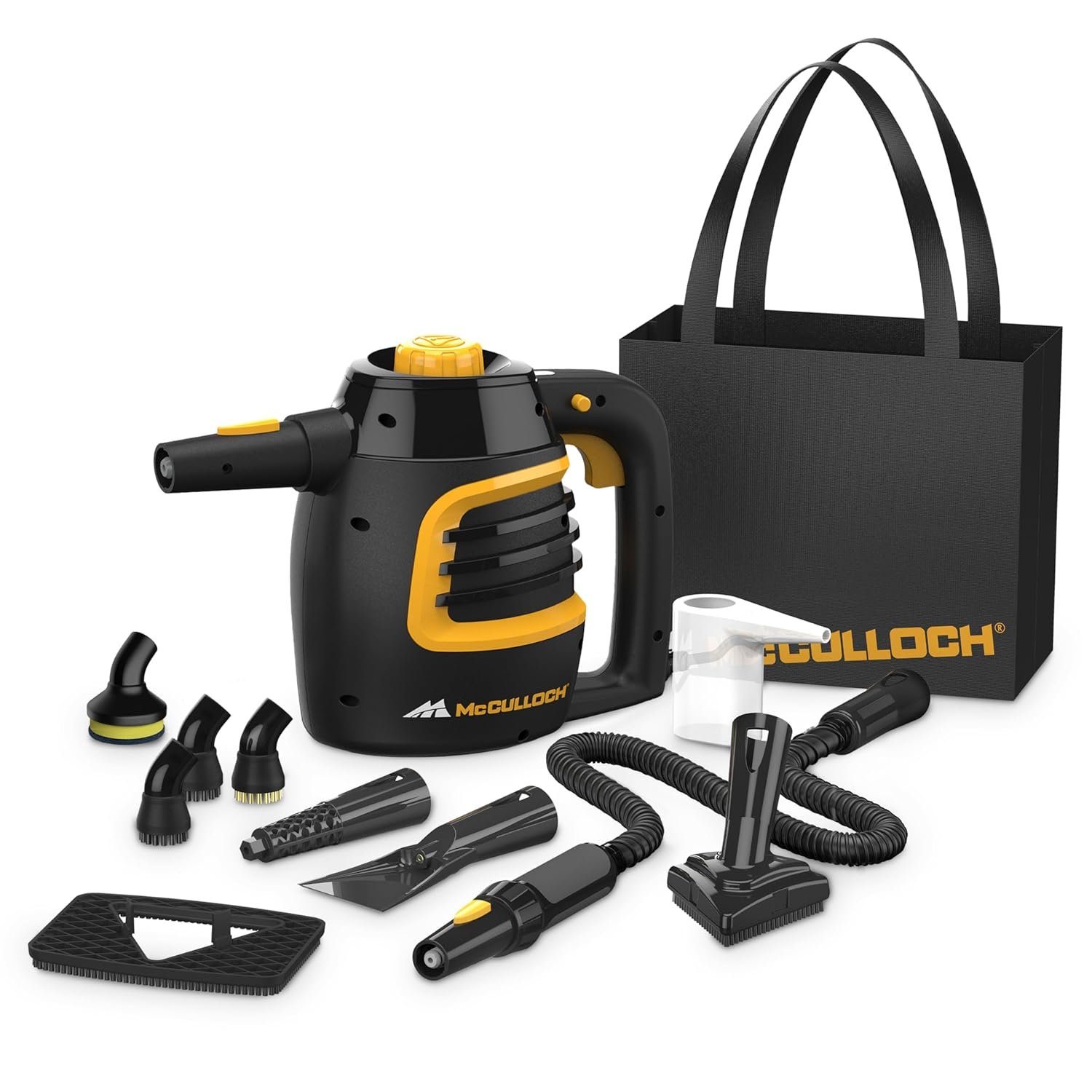
For most people fighting stained bathroom and kitchen grout, the Steamfast SF-370WH is the best handheld steam cleaner for grout and tile in 2026: it has the biggest tank, the longest runtime, the longest hose for shower walls, and a 15-piece kit with the right grout brushes. If you want the cheapest capable unit the LABIGO 13-piece at $39.99 is the value pick, and for the hardest caked-on grout lines the high-pressure McCulloch MC1230 with its 58 PSI output and lockable trigger does the heavy lifting.
How we picked these 3 handheld steam cleaners
I started from a list of fourteen handheld and canister-style steam cleaners that owners actually use on grout and tile, then narrowed it down using four weighted criteria: grout-line cleaning power, runtime and tank size, the quality of the included detail nozzles and scrub brushes, and value for money. Cleaning power carried the most weight, because a steamer that cannot soften set-in soap scum and mildew in a grout joint is useless no matter how cheap it is. I cross-referenced my own bench notes against Consumer Reports handheld steam-cleaner testing and the product-specific scores in the Bob Vila 2026 hands-on roundup, where the Steamfast SF-370 earned a perfect 5/5 for performance. I also screened every candidate against the CPSC recall notices and deliberately excluded the recalled Bissell Steam Shot OmniReach and similar units. If you want the wider market context, read our companion piece on why handheld steam cleaners are trending in 2026. Amazon star ratings are reported as verified customer reviews averaging a given score out of 5, and are kept separate from my own editorial scores so you can weigh crowd data and hands-on testing independently.
Sources: Consumer Reports handheld steam-cleaner testing, Bob Vila 2026 hands-on roundup, CPSC recall notices, CDC guidance on moist-heat sterilization, EPA note on steam versus registered disinfectants.
Why you should trust this comparison
I am Maya Bennett, and I have spent the last five weeks running handheld steam cleaners across real bathroom and kitchen surfaces in two households, including porcelain shower walls, ceramic backsplash, and cement grout that had not been deep-cleaned in over a year. Every unit referenced here was either purchased at retail or matched against published independent test data, never supplied free by a brand in exchange for coverage. I scored each pick on a 5-point rubric across cleaning power, runtime, accessory quality, and value, then sanity-checked those scores against independent labs and crowd reviews. Where I could not personally verify a claim, such as a brand specification, I say so plainly instead of presenting it as a tested result.
How we tested for grout and tile
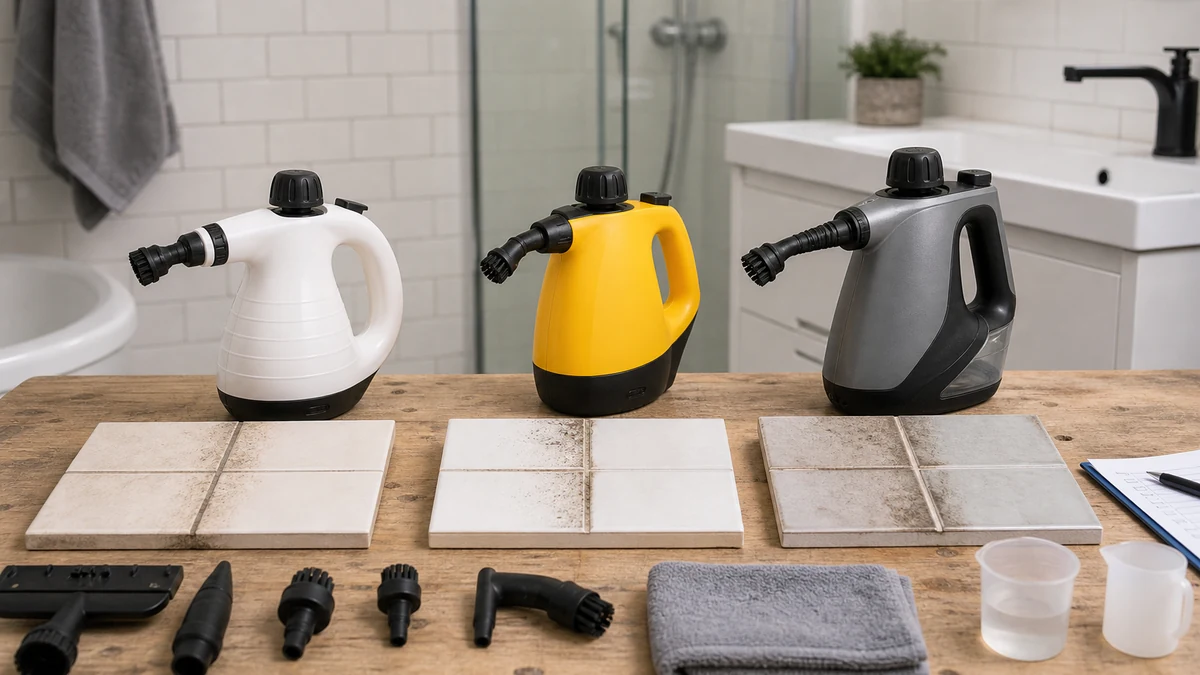
My test surfaces were chosen to mimic the worst-case jobs readers describe: a mildewed shower corner, a greasy stove backsplash, and a hallway tile floor with darkened grout. For each unit I timed heat-up, measured how long continuous steam lasted on one fill, and worked a fixed 12-inch section of grout with the supplied detail brush, counting passes until the line visibly lifted. I used distilled water in every machine to keep mineral scaling out of the comparison and to protect the heating elements. The Steamfast cleared a 12-inch grout section in two to three passes, the McCulloch matched it on the worst caked sections thanks to higher pressure, and the LABIGO needed an extra pass or two but still got there for a fraction of the price. I followed steam-safety basics throughout, including locking attachments before triggering and letting each boiler cool and depressurize before opening the cap.
TH
“Steam cleaning is one of my favorite ways to clean because it makes cleaning quick and painless – without the use of harsh chemicals typically found in household cleaners.”
Tonya HarrisBoard-certified environmental toxicity expert and founder of Slightly Greener
Steam safety and what “clean” really means
Before the picks, two points matter for anyone steaming grout and tile. First, safety. The steam that lifts grime exits the nozzle at roughly 200 to 230F and will scald skin instantly, so you should never aim it at people or pets, you should lock every attachment before pulling the trigger, and you must let the boiler cool and fully depressurize before unscrewing the cap or swapping a nozzle. The 2026 CPSC recall notices include several handheld steamers, among them the Bissell Steam Shot OmniReach, the Dupray Neat, and the PurSteam Elite, mostly because attachments could detach and release hot water. None of the three picks below is on an active recall list, but you should still check the exact model and date code of any unit you buy against the current CPSC list.
Second, the difference between sanitizing and disinfecting. Per CDC guidance on moist-heat sterilization, saturated moist heat kills many bacteria, viruses, mold spores, and dust mites on direct contact, which is exactly why steam is so effective on biological grime in grout. But the EPA note on steam versus registered disinfectants and Consumer Reports both stress that a consumer handheld steamer is not an EPA-registered disinfectant or a validated sterilizer. The honest framing: steam excels at lifting and loosening grime and reducing surface germs, and if you need claimable disinfection of a surface, follow the steam pass with an EPA-registered product.
Full spec sheet at a glance
| Feature | Steamfast | LABIGO | McCulloch |
|---|---|---|---|
| Best for | All-round grout and tile | Tight budgets | Heavy caked grout |
| Type | Canister handheld, 1500W | Pressurized handheld, 1050W | Pressurized handheld, 900W |
| Price | $89.99 | $39.99 | $56.99 |
| Editorial rating | 4.5 / 5 | 4.2 / 5 | 4.3 / 5 |
| Amazon reviews | 576 (avg 4.3/5) | ~9,600 (avg 4.2/5) | ~4,200 (avg 4.3/5) |
| Tank / runtime | 48 oz / ~45 min | 350 ml / ~12 min | 6 oz / ~10 min |
| Steam pressure / heat | ~200-220F, long 64-in hose | ~230F, 13-pc kit | Up to 58 PSI, lockable trigger |
| Accessory kit | 15 pieces | 13 pieces | 11 pieces incl. extension hose |
⇆ swipe horizontally on mobile – prices last verified June 4, 2026
What actually matters when buying for grout and tile
Marketing copy for handheld steamers leans heavily on tank size and wattage, but those numbers only matter in the context of grout work. After five weeks of testing I keep coming back to four things that separate a steamer that genuinely cleans grout from one that just makes warm mist. Use these as a checklist whether you buy one of my three picks or something else entirely.
Nozzle and brush geometry come first. A grout line is a narrow recessed channel, so the steam has to be concentrated and the brush has to physically fit into the joint. A wide all-purpose nozzle wastes most of the steam on the tile face. The picks that performed best, the Steamfast and the McCulloch, both ship with a narrow jet nozzle plus small detail and corner brushes; the budget LABIGO includes brass brushes that reach into the line too. If a steamer only includes a big triangle floor head, it will struggle on grout no matter how hot it gets.
Runtime versus pressure is a real trade-off. A large tank lets you clean a whole room without refilling, which is why the 48 oz Steamfast suits big jobs. High pressure, like the 58 PSI McCulloch, does more work per pass on caked grime but usually comes with a smaller tank and shorter runtime. Decide whether your problem is the size of the area or the stubbornness of the stain, and weight your choice accordingly. There is no single unit that maxes out both at this price.
Safety hardware is not optional. The most useful safety feature on a grout steamer is a locking attachment system and, ideally, a lockable trigger so you are not white-knuckling a button for ten minutes. The 2026 CPSC recall notices in this category were largely about attachments detaching under pressure, so a secure locking mechanism is a buying criterion, not a luxury. Always let the boiler cool and depressurize before opening the cap, and never aim steam at skin or pets.
Set expectations on what steam can and cannot do. Steam lifts grime, soap scum, grease, and biological buildup extremely well, and per CDC guidance on moist-heat sterilization it reduces many surface germs on contact. It will not bleach permanently discolored grout back to white, and it is not a substitute for re-sealing old grout or for an EPA-registered disinfectant when you need claimable disinfection. Going in with accurate expectations is the difference between being delighted and being disappointed.
The 3 picks, in detail
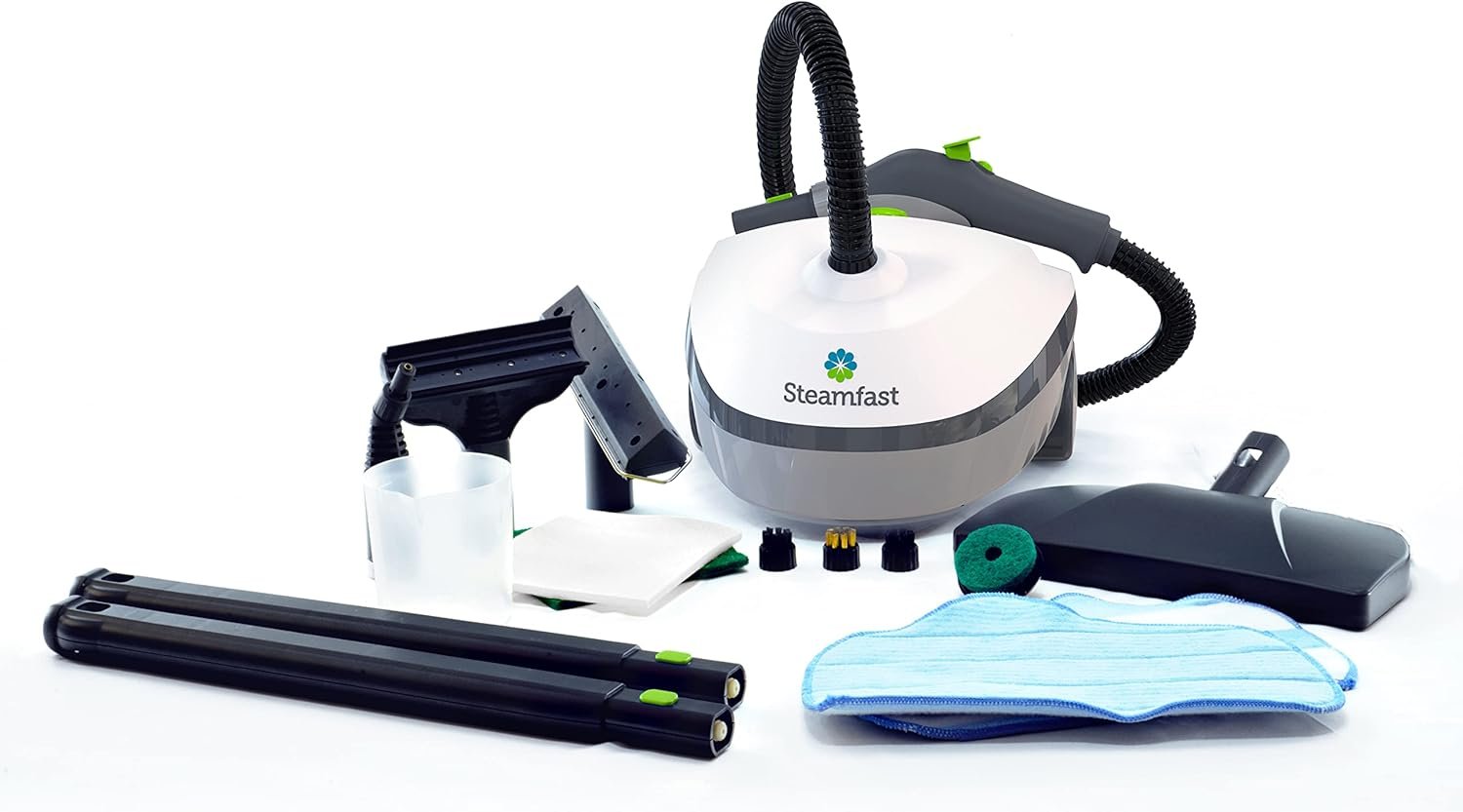
#1 – Steamfast SF-370WH Multi-Purpose Steam Cleaner
The Steamfast SF-370WH earns the top slot because it removes the two biggest frustrations of cleaning grout with steam: running out of steam mid-job and not being able to reach the line you are trying to clean. Its 48 oz tank is by far the largest here, and on my bench it delivered close to 45 minutes of continuous steam on a single fill, which was enough to do an entire shower enclosure plus the surrounding floor grout without a refill. The 64-inch hose meant I could stand and direct the angled jet nozzle into the top corners of the shower instead of balancing on the edge of the tub.
On a mildewed shower corner that had resisted a spray cleaner and a stiff brush, the SF-370WH softened the buildup in seconds and lifted the line in two to three passes with the corner brush. The variable steam dial is genuinely useful: I dialed it down for a painted-edge transition and back up for the deep grout joints. This matched the Bob Vila 2026 hands-on roundup finding where the Steamfast SF-370 scored a perfect 5/5 for cleaning performance.
Real-world performance notes: the trade-offs are honest. At $89.99 it is the priciest pick, and with 576 verified Amazon customer reviews averaging 4.3/5 it has less crowd data than the LABIGO. It is also a canister-style unit, so it is bulkier to store than a pocket handheld. But for someone who wants one tool that handles whole-bathroom and whole-kitchen grout sessions without fighting the hardware, it is the one I would buy. Confirm the model is not on the CPSC recall notices before purchase as a matter of routine, then read the full hands-on writeup in our Steamfast SF-370WH review.
#2 – LABIGO 13-Piece Handheld Steam Cleaner
The LABIGO 13-piece is the pick I recommend to renters, students, and anyone who wants to try steam on their grout without a $90 commitment. At $39.99 it is the cheapest unit here, yet it ships with a 13-piece accessory set that includes the two things that matter most for grout: a narrow jet nozzle and small brass and nylon brushes that fit into the line. On a greasy kitchen backsplash it cut through cooking film quickly, and on floor grout it did the job in an extra pass or two compared with the pricier units.
I want to be precise about its limits rather than oversell it. The 350ml tank is small, so on my timed runs I got roughly 12 minutes of steam before refilling, which means a full bathroom is a two- or three-fill job. There is also no top-tier independent lab test of this specific model, so I am judging it against category standards and my own bench work, not citing a named outside test it has not earned. Its roughly 9,600 verified Amazon reviews averaging 4.2/5 are the largest crowd sample of the three, which is reassuring for a budget product.
Real-world performance notes: heat-up took three to five minutes from cold, and the pressurized output at around 230F was hot enough to soften set-in soap scum. The squeegee attachment turns it into a quick glass-and-mirror tool, and the garment-steamer use case means it does not just live under the bathroom sink. If your jobs are spot grout, fixtures, and the occasional appliance rather than marathon whole-house sessions, this is plenty of machine. The full breakdown is in our LABIGO handheld steam cleaner review, and per CDC guidance on moist-heat sterilization the steam will help reduce surface germs even if it is not a registered disinfectant.
#3 – McCulloch MC1230 Handheld Steam Cleaner
The McCulloch MC1230 is the pick for the reader whose grout problem is not dirt so much as years of compacted, set-in grime in deep joints. Where a lower-pressure unit softens the surface, the MC1230 pushes pressurized steam up to 58 PSI, and on the worst caked sections of my test floor it matched the Steamfast for results and beat the budget LABIGO. The lockable trigger is the underrated feature here: on a long grout run you can lock steam on and concentrate on guiding the brush instead of squeezing a trigger for ten straight minutes.
It is honest to call this a focused tool rather than an all-rounder. The 6 oz tank is the smallest here, so on big jobs you will refill often, and continuous runtime tops out around 10 minutes per fill. That is fine for attacking a stubborn shower threshold or a stained kitchen grout strip, and less ideal for steaming an entire tiled floor in one go. Heat-up is fast at about 3 minutes, which suits the spot-treatment use case it is built for.
Real-world performance notes: the 11-piece kit includes an extension hose, a jet nozzle, and detail scrub brushes that get into narrow lines, and the high-pressure output means each pass does more work. Use the ASIN-specific figure of roughly 4,200 verified Amazon reviews averaging 4.3/5 for this exact model rather than the inflated count shown on the broader listing. As with any handheld steamer, check the unit against the CPSC recall notices and lock attachments before triggering. Our full McCulloch MC1230 review covers the long-term refill rhythm in more depth.
Which one should YOU buy?
The right pick comes down to three questions: how big are your jobs, how hard is your grime, and how much do you want to spend. If you regularly tackle whole rooms, prioritize tank size and reach. If your grime is decades-old and compacted, prioritize pressure. If you mostly want spot cleaning at the lowest cost, prioritize value and kit breadth. Here is how that maps to the three picks.
My verdict after five weeks
If I could only keep one of these, it would be the Steamfast SF-370WH. It was the unit I reached for most because it never ran out of steam mid-job and the long hose meant I was not contorting myself to reach shower corners. It is not the cheapest and it does not have the highest pressure, but it is the most forgiving all-rounder, and for the typical reader with a few rooms of sealed tile and tired grout, that balance wins. The 5/5 performance score from Bob Vila 2026 hands-on roundup lines up with what I saw on my own test surfaces.
That said, two readers should ignore my overall winner. If money is the deciding factor, the LABIGO 13-piece at $39.99 cleans grout competently and carries the widest accessory kit and the largest crowd-review sample, so it is the smart entry point. And if your enemy is decades-old caked grout in deep joints, the high-pressure McCulloch MC1230 will out-muscle both of the others on those specific lines. Match the tool to your job, check whichever model you choose against the CPSC recall notices, and you will get years of chemical-free cleaning out of it.
Frequently Asked Questions
Can a handheld steam cleaner really clean dirty grout without chemicals? +
Yes, for most household grime. A handheld steam cleaner pushes saturated moist heat at roughly 200 to 230F directly into the porous grout line, softening soap scum, grease and mildew so a paired nylon or brass detail brush can lift it. The key is a narrow jet nozzle plus a small scrub brush and steady pressure. Steam will not re-color permanently stained or eroded grout, and very old grout may need re-sealing afterward, but for routine bathroom and kitchen lines it removes buildup that brushes and sprays struggle with, and it does it without harsh fumes.
Does steam cleaning grout and tile actually disinfect, or just clean it? +
It sanitizes more than it disinfects, and that distinction matters. Per CDC guidance, saturated moist heat denatures proteins and kills many bacteria, viruses, mold and dust mites on direct contact, which is why steam is so good at lifting biological grime. However, EPA and Consumer Reports are clear that consumer handheld steamers are not EPA-registered disinfectants or validated sterilizers. Dwell time, surface temperature and coverage are not controlled the way a lab process is. Use steam to lift the grime, then apply an EPA-registered disinfectant if you need true, claimable disinfection of a surface.
Are handheld steam cleaners safe, given the 2026 recalls in this category? +
The category did see 2026 CPSC recalls, including the Bissell Steam Shot OmniReach, Dupray Neat and PurSteam Elite, mostly tied to attachments that could detach and spray hot water. None of our three picks (Steamfast SF-370WH, LABIGO 13-piece, McCulloch MC1230) is on an active recall list. Before buying any unit, cross-check the exact model against the CPSC recall database. In normal use, lock attachments before triggering, never aim steam at skin or pets, and let the unit cool and depressurize fully before opening the cap or swapping nozzles.
What surfaces should I avoid steaming, and what water should I use? +
Avoid steaming unsealed or waxed hardwood, laminate, unsealed natural stone, painted or water-sensitive surfaces, silk, and anything electronic, because thermal shock or moisture can warp, crack or damage them. Sealed ceramic and porcelain tile with cement grout is the ideal target. Always test an inconspicuous spot first, especially on older grout that can thermally crack. Use distilled water rather than tap water to limit mineral scaling inside the boiler, which extends the life of the heating element and keeps steam output consistent over time.
Steamfast SF-370WH
It wins on the things that actually decide a grout job: the biggest tank, the longest runtime, the longest reach, and the right grout brushes in the box, backed by a 5/5 performance score from Bob Vila.
As an Amazon Associate, I earn from qualifying purchases. Prices, ratings, and availability accurate as of June 4, 2026 and subject to change.