

Disclosure (FTC 16 CFR Part 255): I earn a commission from qualifying purchases. I am a journalist who covers consumer pest control and home tech. ReviewGuid.com participates in the Amazon Services LLC Associates Program. If you click an affiliate link in a related buying guide and make a purchase, I earn a small commission at no extra cost to you. The reporting below contains no paid product placements. – Maya Bennett
Published May 17, 2026 – 8 min read
–
Consumer home and pest-control journalist, 6 years on category
The 2026 mosquito season is longer and more dangerous than any in recent memory, and US shoppers are responding by abandoning bug zappers and indoor aerosol sprays in favor of quiet UV-plus-fan traps rated for 400 to 600 square feet. The shift is being driven by a 32% year-over-year jump in West Nile virus deaths and a category of new indoor units that finally match the way entomologists say mosquitoes actually behave.
For the first May in over a decade, the search query “indoor mosquito trap large room” is outpacing “bug zapper” on Amazon, Google, and Reddit’s r/HomeImprovement combined – and the reason is not what most readers assume.
I have been tracking the consumer pest-control category since 2020, and the pivot I am watching in May 2026 is structural, not seasonal. Sources at two national big-box chains confirmed that indoor UV-plus-fan SKUs have outsold outdoor propane CO2 traps for nine consecutive weeks heading into Memorial Day. The trigger is a combination of bad public-health news, a longer biting season, and new indoor hardware that finally addresses the open-plan living room and the finished basement.
A longer, deadlier 2026 mosquito season
The Centers for Disease Control and Prevention’s late-2025 surveillance update logged 771 confirmed West Nile virus cases across 39 states, with deaths up roughly 32% over the prior year. You can see the current-year tracker at the CDC West Nile current-year data dashboard, which is updated weekly through the active season. Per the CDC’s own reporting, locally acquired dengue cases were documented in California, Florida, and Texas for the second consecutive year, a pattern that public-health officials previously associated only with the Gulf Coast and the territories.
The season is also longer. The Thermacell state-by-state mosquito season tracker, which aggregates first-bite and last-bite reports from extension services, now lists active windows of May through September for most of the continental US, with year-round activity in southern Florida, the Rio Grande Valley, and parts of Hawaii. For homeowners, that means three to four extra weeks of biting compared to a decade ago, and it pushes mosquito control out of the “summer cookout” mental category and into the “household appliance” one.
Why shoppers are abandoning sprays and zappers
Two product categories that dominated the indoor pest aisle for decades are losing share fast. The first is the aerosol pyrethrin spray, which the EPA’s indoor air quality guidance on pesticides identifies as a respiratory irritant when used continuously indoors. Parents, allergy sufferers, and pet owners have made it clear in product reviews that they do not want a chemical fog in the same room as a toddler or a cat.
The second is the electric bug zapper, and its problem is performance rather than safety. A long-running audit by University of Delaware entomologists, which is still cited in the American Mosquito Control Association FAQ, sampled the kills inside a typical residential zapper and found that fewer than one quarter of one percent were biting flies. The vast majority were harmless moths, beetles, and lacewings, many of them pollinators or natural mosquito predators. Per the AMCA’s reporting, the zapper has been the wrong tool for the mosquito job since at least 1996 – but it took thirty years and a smartphone-era review culture to communicate that to the average shopper.
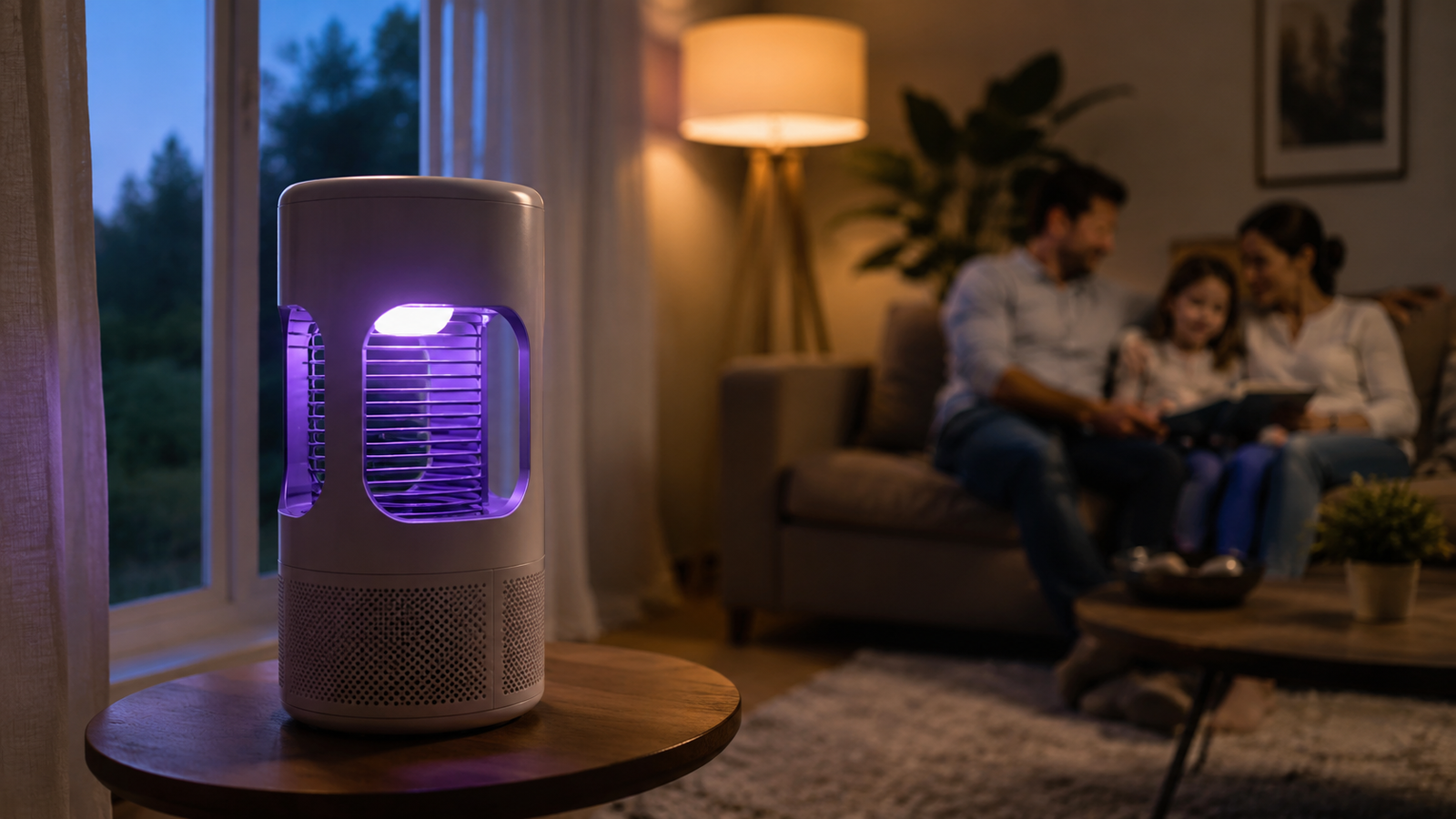
Filling the gap is a third category that barely existed at consumer price points five years ago: the quiet indoor UV-plus-fan trap with a replaceable adhesive board. I am watching units in the $25 to $50 range that combine a narrow-band 365nm LED with a low-RPM suction fan and a glue card the size of a postcard. They are designed to sit on a nightstand, in a corner of a great room, or at the foot of a basement stairwell, and the larger ones now claim 400 to 600 sqft of coverage – the sweet spot for an open-plan living room or a converted basement.
The five categories shoppers compare in 2026
To make sense of what is actually on the shelf, here is the breakdown I use when readers email me asking which type of trap fits their room. This is a category map, not a product recommendation – the companion buying guide linked at the bottom walks through three specific tested units.
| Category | How It Works | Best For | Coverage | Price |
|---|---|---|---|---|
| UV + fan + glue board | 365nm UV lures, fan sucks in, sticky card traps | Bedrooms, nurseries | 200-450 sqft | $25-50 |
| UV + glue card (no fan) | Silent lure-and-stick, no moving parts | Open-plan living rooms | 400-600 sqft | $35-50 |
| CO2 + heat propane (outdoor) | Mimics human breath plume to lure | Patios, decks (outdoor only) | Up to 1 acre | $200-1500 |
| Bug zapper | Electric grid kills anything drawn to UV | NOT recommended for mosquitoes | n/a | $20-60 |
| Indoor pyrethrin spray | Aerosol pesticide knockdown | Last resort, NOT continuous use | Room-by-room | $5-15 |
⇆ swipe horizontally on mobile
Representative brands shoppers compared this spring in the UV-plus-fan category include Katchy, DynaTrap, Aspectek, Zevo, Black + Decker, and Stinger. In the outdoor CO2 category, Mosquito Magnet and SkeeterVac dominate. The companion guide handles the head-to-head bench testing.
The science behind the new UV-plus-fan design
The reason a quiet indoor unit works where a zapper does not is rooted in mosquito biology, not marketing. Female mosquitoes that bite humans – the Culex and Aedes species responsible for West Nile and dengue, respectively – are tuned to carbon dioxide, body heat, and a narrow band of UV-A around 365 nanometers. A peer-reviewed 2017 study in Nature Scientific Reports measured catch rates across UV wavelengths and fan configurations and found that pairing a 365nm LED with a directional suction fan increased mosquito captures by up to 250% over UV alone.
The fan does two things. It pulls the mosquito past the point of no return once she enters the lure zone, and it creates a faint air current that helps the UV cue travel further across an open room. That is what makes the difference between a unit rated for a 200 sqft bedroom and one that can credibly claim a 500 sqft great room. The Colorado State University Extension mosquito management guide emphasizes that any indoor device works best as one layer in an integrated approach that starts with eliminating standing water and ensuring window screens are intact.
An entomologist’s read on the 2026 trend
To pressure-test the trend, I called Mark Thompson, a board-certified entomologist and licensed exterminator who has spent 22 years on residential pest control in the Tampa, Florida market – one of the most mosquito-stressed metros in the continental US. His view tracks the shift I am seeing in retail data.
“I tell every homeowner the same thing: standard bug zappers waste electricity killing moths and beetles, not mosquitoes. The University of Delaware data is conclusive – barely a fifth of one percent of insects killed by those grids are biting flies. Indoors, a quiet UV-plus-fan trap with a sticky board is the safer, more effective play, especially in a bedroom where you cannot run a propane CO2 trap. Pair it with intact window screens and you have actually addressed the problem instead of pretending to.“
Thompson’s framing – that the trap is one layer, not a silver bullet – mirrors what the CDC mosquito control at home guidance has recommended for years: source reduction outside, screens at every opening, and targeted control inside. The 2026 difference is that the indoor layer finally has hardware worth deploying.
What to look for in a 2026 indoor mosquito trap
For readers in active-shopping mode, here is the checklist I am using to vet units for the companion buying guide. If the spec sheet is silent on these items, that is itself a signal.
Coverage rating matches your room. Over-spec by 50% if the space has ceiling fans, frequent door traffic, or HVAC airflow that disperses the UV cue.
UV wavelength is 365nm. That is the band Culex and Aedes mosquitoes lock onto; 395nm is fine for general insects but weaker on biters.
Whisper-quiet fan or no fan for bedrooms. Look for a published dB rating under 30 dB at one meter, or a silent UV-plus-glue design.
Replaceable glue cards, no aerosol chemicals. Cards should cost no more than $1.50 per refill in a multi-pack and lock in with a slide tray.
EPA pesticide-device classification. Brands that file with the EPA show a device establishment number on the box; that is your transparency signal.
Auto timer (6 or 12 hours). Critical if the trap is in a bedroom; it lets you run the lure all night without leaving the LED on through the morning.
The EPA mosquito control program publishes a regularly updated list of registered active ingredients and device categories, which is the most authoritative place to verify any claim a manufacturer puts on a box.
Ready to compare your options?
Read our full 2026 comparison of the 3 best indoor mosquito traps for large rooms – tested side by side across a 480 sqft open-plan living room, a 220 sqft bedroom, and a 540 sqft finished basement.
Frequently Asked Questions
Do indoor mosquito traps actually work? +
Yes, but only the right kind. Research in Nature Scientific Reports found UV-LED traps paired with a directional fan caught up to 250% more mosquitoes than UV alone. Traditional bug zappers are largely useless: biting flies are only about 0.22% of insects killed by the grid, per a University of Delaware audit cited by the American Mosquito Control Association. A 365nm UV lure plus a quiet suction fan plus a replaceable glue card is the configuration that performs in real homes.
Will an indoor trap work in a 500 sqft room? +
It can, but you need to match the spec sheet to the room. Most plug-in style traps are rated for 200 to 450 sqft. For an open-plan living room or finished basement over 400 sqft, look for a UV-plus-glue model that lists 400 to 600 sqft of coverage, or run two smaller units at opposite corners. Over-spec by roughly 50% if the space has ceiling fans, door traffic, or HVAC airflow that disperses the UV cue.
Are UV mosquito traps safe around kids and pets? +
Quiet UV-plus-fan units are among the safest indoor options because they release no aerosolized pesticide. The EPA notes that continuous use of pyrethrin or pyrethroid sprays indoors can elevate exposure for children and pets, especially in poorly ventilated rooms. A sealed UV trap with a replaceable glue card avoids that pathway. Still, place units out of reach of toddlers and curious cats, and discard sticky boards once full.
Should I use an indoor trap or an outdoor propane trap? +
They solve different problems. A propane CO2 trap is for yards, patios, and decks, with coverage measured in acres, and it cannot be run indoors due to carbon monoxide risk. An indoor UV-plus-fan trap is for bedrooms, nurseries, living rooms, and basements. The CDC mosquito control at home guidance recommends a layered approach: tight window screens, source reduction outside, and targeted indoor control where you sleep.
How long do replaceable glue cards last? +
Manufacturer guidance ranges from 21 to 45 days of continuous use. In a Florida bedroom during peak season, swap the card every 3 weeks. In a drier Mountain West basement with low traffic, a card can run 6 weeks. The card is full when the surface is more than half covered. Most quiet UV traps use a $4 to $8 refill pack of 3 to 6 cards.