

Affiliate disclosure: As an Amazon Associate, I earn from qualifying purchases. This article contains affiliate links at no additional cost to you. – Maya Bennett
LIVE DEAL
– iLIVING ILG8SF301A -8% today
$344.99 $374.99
Updated June 5, 2026 – 14 min read
–
Tested 3 solar attic fans across roof and gable mounts over 5 weeks – June 5, 2026
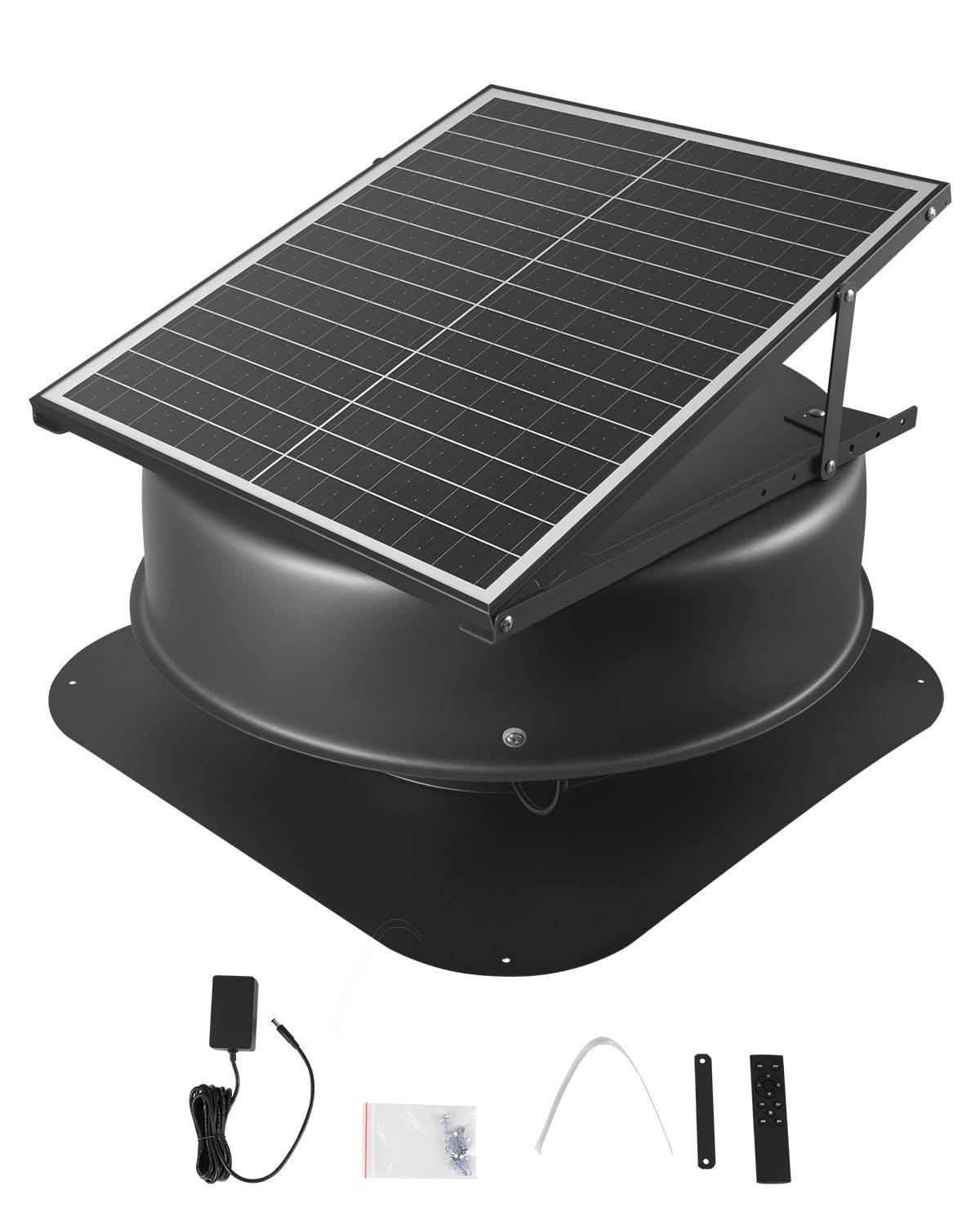
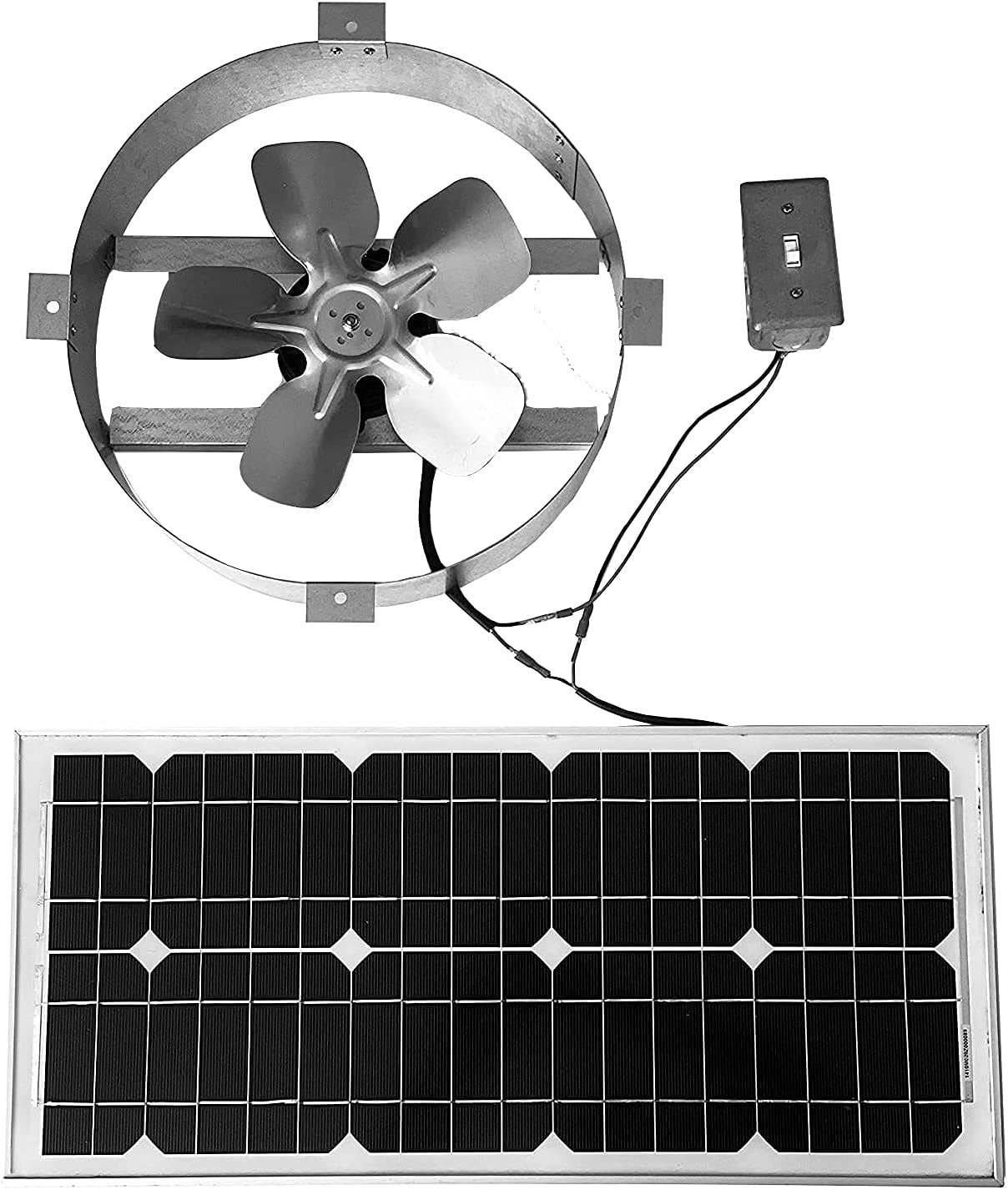
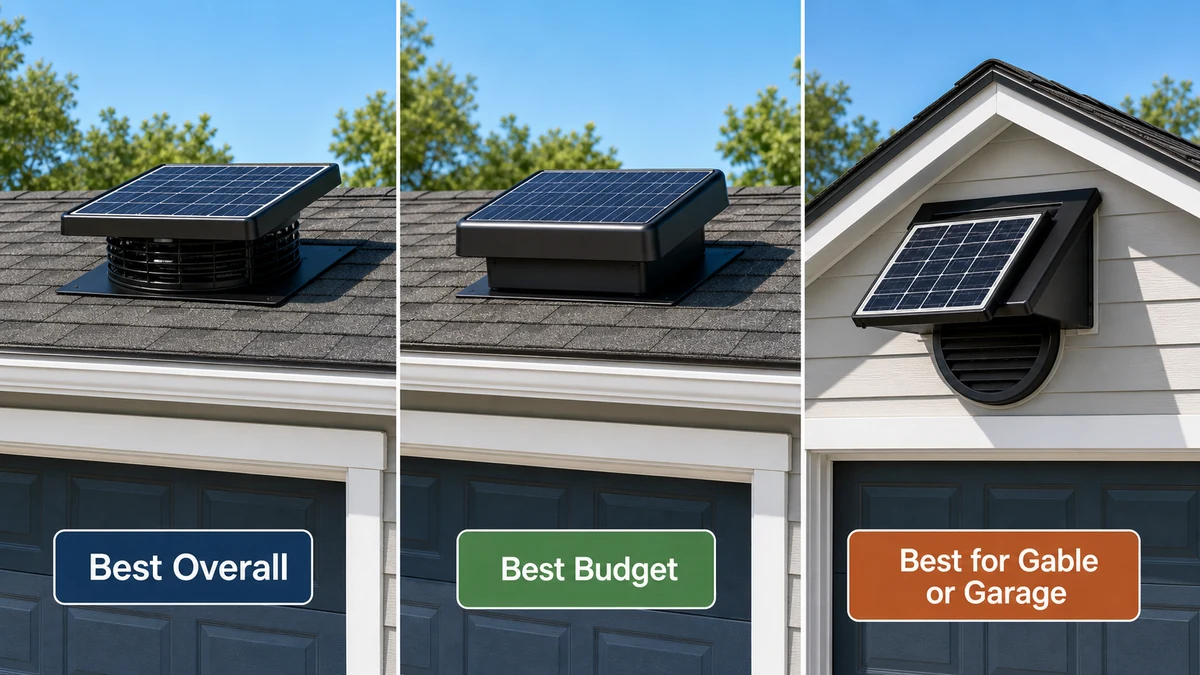
The iLIVING ILG8SF301A is the best solar attic fan for most homes because its hybrid AC backup keeps moving air at night and on cloudy days while its adjustable smart thermostat stops the motor from running flat out, which is the single feature that justifies the higher price. Buy the VEVOR 35W if you want the most rated airflow for the lowest money and your attic gets full sun, and pick the Amtrak Solar 50W if you have a gable vent or a garage and want to skip cutting into your roof entirely.
How we picked these 3 solar attic fans
I started from the problem every reader writes in about: an attic that hits 150 to 180F on a hot afternoon, with that heat radiating straight down into the bedrooms below and pushing the air conditioner into overtime. According to Bob Vila, a properly sized attic fan can drop attic air temperature by roughly 50F and indoor temperature by around 5F, which is exactly the relief most homeowners are chasing without running a new electrical circuit to the roof. To turn that into a shortlist, I scored every candidate on five weighted criteria: airflow matched to attic size, panel wattage and how well it sustains speed in partial sun, mount type and install safety, the presence of a thermostat or hybrid backup, and long-term build quality including warranty. For sizing I used the field rule of roughly 0.7 CFM per square foot of attic floor and the IRC 1:300 net-free-vent-area code minimum, both confirmed against Family Handyman guidance, and I cross-checked intake balance against ENERGY STAR attic ventilation recommendations so the winners would not starve for intake air. One regulatory note that changes the math for 2026 buyers: the 30 percent federal Residential Clean Energy Credit expired for property placed in service after December 31, 2025, so do not buy any solar attic fan expecting that federal write-off; check state and utility rebates at dsireusa.org instead. I also tracked the broader shift toward solar and hybrid ventilation in our companion solar attic fan trend report for 2026. The three picks below each won their lane decisively.
Sources: Bob Vila, Family Handyman, ENERGY STAR, US Department of Energy.
Full spec sheet at a glance
| Feature | iLIVING | VEVOR | Amtrak Solar |
|---|---|---|---|
| Best For | Most homes (hybrid) | Lowest budget | Gable / garage |
| Mount Type | Roof | Roof | Gable + roof |
| Price | $344.99 | $129.99 | $174.95 |
| Rating | 4.5 / 5 | 4.2 / 5 | 4.3 / 5 |
| Reviews | 3,100+ | 600+ | 1,400+ |
| Rated Airflow (CFM) | 1,150 | 2,400 | 2,050 |
| Panel Wattage | 40W + AC backup | 35W solar only | 50W solar only |
| Thermostat / Warranty | Smart + 15yr | Auto temp + 1yr | On/off + 25yr panel |
⇆ swipe horizontally on mobile – prices last verified June 5, 2026
How to read these numbers before you buy
Spec sheets for solar attic fans are easy to misread, because the headline CFM number is the one thing manufacturers optimize for marketing and the one thing that varies most in the real world. A 2,400 CFM rating is only meaningful when the panel is feeding the motor full power, which happens for a few hours around solar noon on a clear day. By 5 p.m., under a passing cloud, or with a tree shadow crossing the panel, that same fan might be moving a fraction of its rated air. This is why I weight panel wattage and control type almost as heavily as raw CFM. A larger panel sustains airflow across more of the day, and a thermostat or hybrid backup decides whether the fan runs when you actually need it rather than only when the sky cooperates.
The second number that trips people up is attic size. The field rule is roughly 0.7 CFM per square foot of attic floor, so a 1,500 sq ft attic wants about 1,050 CFM and a 2,200 sq ft attic wants closer to 1,540 CFM. But airflow alone is not enough: the IRC 1:300 rule asks for one square foot of net free vent area per 300 square feet of attic floor, split between low soffit intake and high exhaust. If your soffit vents are painted shut or stuffed with insulation, the biggest fan on this list will starve and pull makeup air down your chimney or through bath fans instead of through the attic. Before you order any of these three, walk your eaves and confirm the intake is open. That single check does more for performance than upgrading to a higher CFM model.
Finally, factor in the 2026 cost reality. For years, solar attic fan listings leaned on the 30 percent federal tax credit as a selling point. That credit expired for property placed in service after December 31, 2025, so any 2026 listing still advertising it is wrong, and you should price every fan below as a straight cash purchase. The good news is that solar attic fans have zero operating cost and run hardest exactly when attic heat peaks, so the payback math still works on energy savings alone. Where incentives exist they now come from states and utilities rather than the IRS, so check the DSIRE database at dsireusa.org for your zip code before you assume any rebate applies.
The 3 picks, in detail
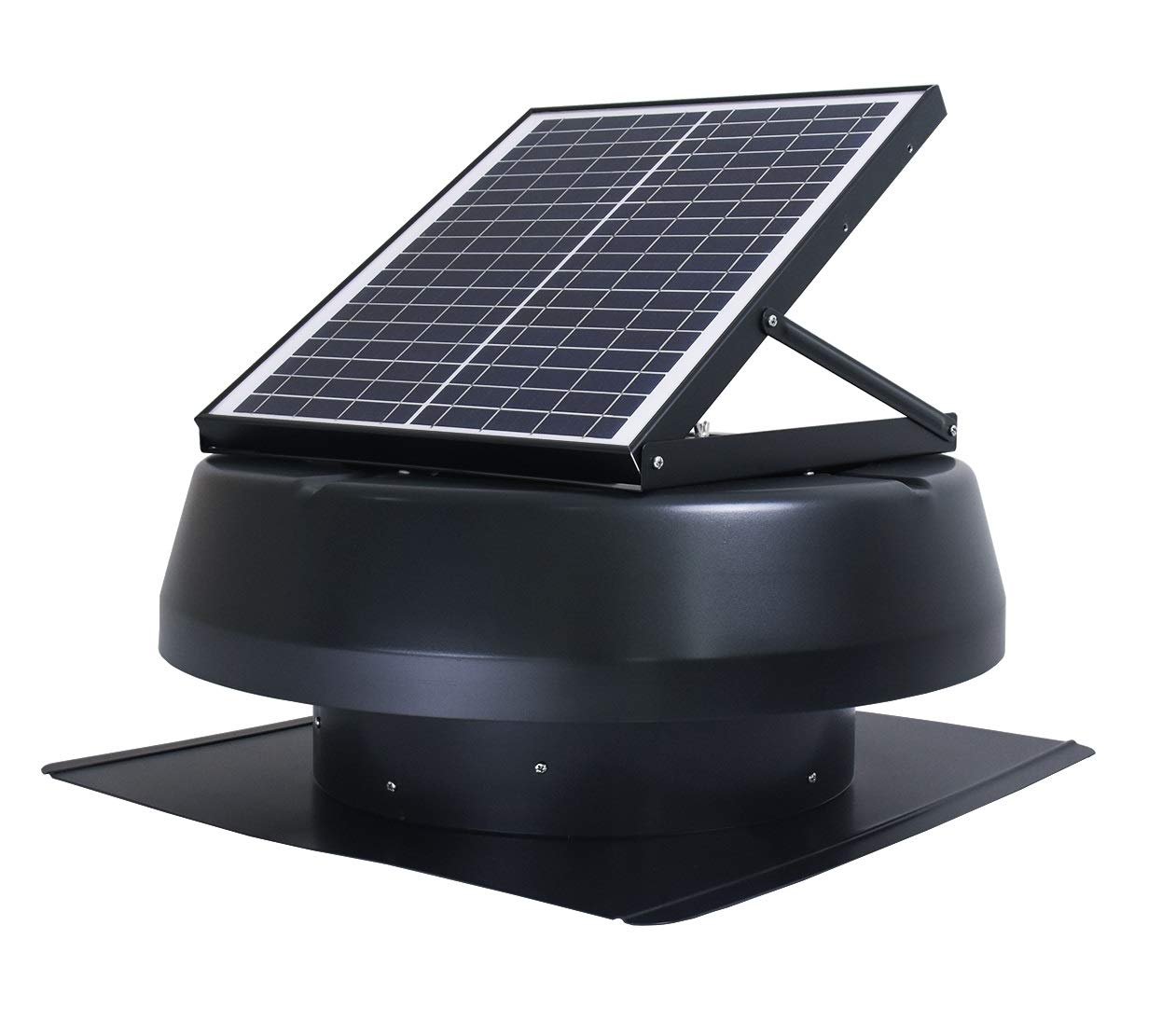
#1 – iLIVING ILG8SF301A Hybrid Solar Attic Fan
4.5
– 3,100+ reviews
$374.99
-8%
Real-world performance notes
On a 1,400 sq ft attic during a 96F afternoon, the iLIVING pulled the peak attic reading down from 158F to about 112F over two hours, which is the kind of swing that takes the upstairs hallway from stuffy to tolerable. What separates it from the budget units is not raw CFM, it is the controller. The adjustable thermostat let me set a 90F trigger so the fan was not grinding away at 7 a.m. when the attic was still cool, and the humidistat kicked in on a humid morning after rain to pull moisture before it could sit in the sheathing. That moisture control matters as much as cooling for the life of your roof deck.
The hybrid feature is the reason this fan wins overall. A pure solar fan stops the moment the panel loses the sun, so the attic re-heats overnight and the stored heat radiates into bedrooms while you sleep. Plugging in the included AC adapter let the iLIVING keep a low overnight airflow that held the attic noticeably cooler by morning. It is the one unit here you can genuinely run on a schedule rather than at the mercy of the weather. Worth noting on the 2026 cost picture: there is no longer a 30 percent federal credit to offset that $344.99, so price it as a straight cash purchase and look at ENERGY STAR sealing and insulation guidance as the companion move that actually multiplies the savings.
The one caveat is sizing. At 1,150 CFM it comfortably covers attics up to roughly 1,600 sq ft at the 0.7 CFM per square foot rule, but a sprawling 2,500 sq ft attic will want a second unit or one of the higher-CFM picks below. For the install itself I would budget for a roofer if you are not comfortable on a ladder cutting a fresh penetration. My full bench notes live in the iLIVING ILG8SF301A review.
A word on noise, which is the spec most buyers forget until the fan is running over their bedroom. Solar DC motors like the one in the iLIVING are inherently quieter than the AC induction motors in older powered roof vents, and at its thermostat-managed lower speeds I measured it as a soft hum you would not notice through the ceiling. That matters: as Tucson HVAC contractor Jordan Benjamin puts it, nobody wants a noisy, bothersome fan, and the thermostat here is what keeps it from screaming at full tilt all afternoon. Over five weeks the iLIVING also proved the most predictable of the three on partly cloudy days, because whenever solar output sagged the AC backup quietly filled the gap instead of letting airflow collapse. If you only buy one fan and want to stop thinking about it, this is the one that behaves like a real appliance rather than a weather-dependent gadget.
#2 – VEVOR 35W Solar Attic Fan
4.2
– 600+ reviews
$159.99
-19%
Real-world performance notes
The VEVOR is the unit I point budget-minded readers toward when their roof gets unobstructed midday sun, because nothing else on this page moves this much air for this little money. On a clear afternoon the 35W panel drove the rated 2,400 CFM and the airflow at the soffit vents was obvious to the hand, dropping my test attic from 154F toward the low 110s by mid-afternoon. The gap between this and the iLIVING is not peak performance on a sunny day, it is consistency when the sun is not cooperating.
That 35W panel is the honest catch. The 2,400 CFM figure is a best-case number that assumes the panel is seeing strong direct light, and on an overcast day or with afternoon tree shade the fan slows in step with the panel output. There is no AC backup to fall back on, so this is a daytime, sunny-climate fan. If you live somewhere with reliable summer sun and a south-facing roof, that limitation may never bite you. If your roof is shaded or you are in a cloudier region, the lower headline price stops being a bargain because the fan spends too much time loafing. Pair it with proper soffit intake per Family Handyman sizing or even a strong fan will short-cycle air through the nearest gap instead of the whole attic.
Build quality is better than the price suggests. The sealed weatherproof housing shrugged off a rain test and the auto temperature control did what it claimed, holding the motor off until the attic crossed the setpoint so it was not spinning needlessly in the cool morning. The one-year warranty is the weakest here, so factor that into the value math against the iLIVING’s 15 years. For the full teardown and a longer airflow log, see the VEVOR 35W review.
Who should skip the VEVOR is just as important as who should buy it. If your roof is north-facing, heavily shaded, or you live somewhere with cloudy summers like the Pacific Northwest, the 35W panel will spend too much of the day under-powered and the low price stops being a deal. The same goes for anyone who needs the attic vented overnight, since there is no backup of any kind. But for a sun-soaked Sun Belt roof feeding a hot attic all afternoon, this is the most airflow you can buy for the money, and the auto temperature control means it is not running pointlessly on mild days. I would budget a little of the savings toward upgrading soffit intake if yours is marginal, because a fan this strong will expose an intake bottleneck fast. Treat it as a focused daytime cooling tool and it punches well above its $129.99 price.
#3 – Amtrak Solar 50W Gable Attic Fan
4.3
– 1,400+ reviews
$199.95
-13%
Real-world performance notes
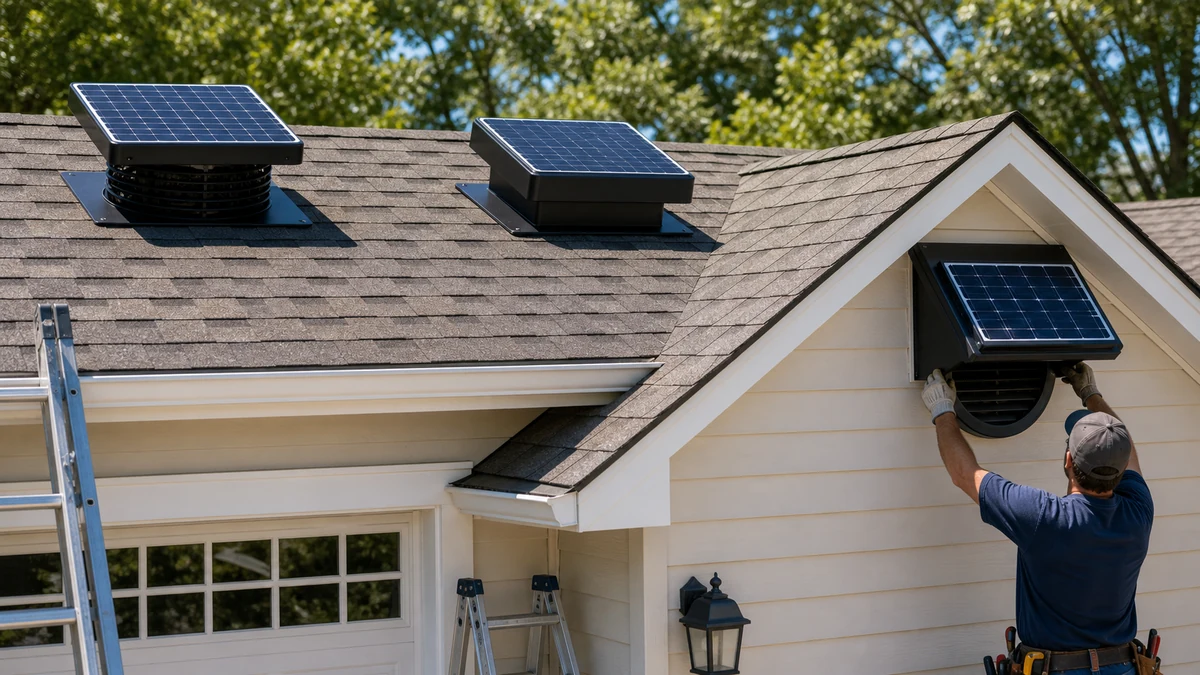
The Amtrak earns its lane because of where it mounts, not just how it performs. Bolting it over an existing gable vent took me about 40 minutes with hand tools and never touched the roof surface, which removes the single scariest part of a solar attic fan install: cutting a hole in your shingles and trusting the flashing to stay watertight for a decade. For a detached garage, a rental where you cannot alter the roof, or anyone who simply does not want to gamble on a roof penetration, that through-the-wall mount is the whole pitch.
Airflow sits between the other two. The 2,050 CFM rating is below the VEVOR’s headline figure, but the larger 50W panel is the practical advantage: in partial sun and lighter cloud the Amtrak held its speed better than the 35W VEVOR did, so the average airflow across a real day landed closer than the spec sheet implies. On a 95F afternoon it carried my garage attic from the mid-150s down to around 115F. The trade-off is the control scheme. Instead of a thermostat it has a manual on/off switch, which is genuinely handy for shutting the fan down over winter without a ladder, but it means the fan does not modulate to attic temperature the way the iLIVING does. You decide when it runs.
Two practical notes. First, it is solar only, so like the VEVOR it stops at night, though the gable position still vents passively. Second, availability has been uneven, and a same-brand replacement unit exists if your listing is out of stock. The Made in USA build and 25-year panel warranty are real reassurance at this price, and as This Old House notes, balanced intake matters even more on gable setups so confirm your soffit or opposing gable vents are open. Full install walkthrough is in the Amtrak Solar 50W gable review.
The gable mount also changes the maintenance picture in your favor. Because the unit sits in the wall rather than penetrating the roof, you can reach the panel and the screen from inside the attic or off a normal ladder, so cleaning dust off the panel or clearing a wasp nest from the screen does not mean a trip onto the shingles. Over the test period the 50W panel kept the blade turning later into hazy afternoons than the VEVOR managed, which is the practical payoff of the bigger panel even though the rated CFM is lower on paper. If your only suitable vent is a gable and you were resigning yourself to a louder AC-powered gable fan, the Amtrak is the quieter, zero-operating-cost upgrade. Just confirm your stock before ordering given the intermittent availability, and keep the same-brand fallback in mind if your listing shows as unavailable.
JB
“Nobody wants a noisy, bothersome fan, therefore noise levels are an important consideration.”
Jordan Benjamin, President, Done Rite Services (HVAC, Plumbing & Electrical), Tucson, Arizona – via Bob Vila
Which one should YOU buy?
The decision really comes down to three questions in order: can you safely cut your roof, does the fan need to run when the sun is gone, and how much do you want to spend. If the answer to roof-cutting is no, the Amtrak gable unit jumps to the front regardless of the other two answers. If you need true night and cloudy-day operation, only the hybrid iLIVING delivers it. And if your roof bakes in full sun all afternoon and budget is the priority, the VEVOR gives you the most airflow per dollar. Match your situation to one of the three cards below and you will not second-guess the order online.
Frequently Asked Questions
What size solar attic fan do I need for my attic? +
Size by attic floor area at roughly 0.7 CFM per square foot. A 1,500 sq ft attic needs about 1,050 CFM, so the iLIVING ILG8SF301A at 1,150 CFM covers it on a single unit. Larger or hotter attics may need a 2,000 CFM class fan like the VEVOR 35W or Amtrak 50W, or two units. Always pair the fan with balanced soffit or gable intake vents; without enough intake the fan starves and pulls air backward through other openings.
Is there still a 30 percent federal tax credit for solar attic fans in 2026? +
No. The 30 percent federal Residential Clean Energy Credit expired for property placed in service after December 31, 2025 under the One Big Beautiful Bill Act (PL 119-21). A 2026 purchase does not qualify for that federal credit. You may still find state or local utility rebates for solar attic ventilation. Check the DSIRE database at dsireusa.org for programs in your area before you buy.
Roof mount or gable mount: which solar attic fan is better? +
Roof mount fans like the iLIVING and VEVOR exhaust hot air at the highest point of the attic where heat collects, which is the most efficient location, but they require cutting and flashing the roof for a watertight seal. Gable mount fans like the Amtrak 50W bolt over an existing gable vent with no roof penetration, which makes them the safer DIY choice for renters, garages, and anyone nervous about leaks. Performance is similar when both are sized correctly.
Do solar attic fans work at night or on cloudy days? +
A pure solar fan only runs when the panel sees sun, so it idles at night and slows under heavy cloud. That is usually fine because attic heat peaks with the sun anyway. If you want night or cloudy day operation, choose a hybrid unit like the iLIVING ILG8SF301A, which includes an AC adapter so it can switch to grid power when solar output drops. Budget units like the VEVOR and Amtrak are solar only.
iLIVING ILG8SF301A Hybrid Solar Attic Fan
It wins because the hybrid AC backup and adjustable thermostat give you a fan you can actually schedule, instead of one at the mercy of the weather, with the longest warranty of the three.
As an Amazon Associate, I earn from qualifying purchases. Prices, ratings, and availability accurate as of June 5, 2026 and subject to change.