

Disclosure: As an Amazon Associate, I earn from qualifying purchases. This article contains affiliate links at no additional cost to you. – Maya Bennett
LIVE DEAL
– PETKIT PuraMax 2 is the lowest sticker price today
$299.99 lowest of the 3
Updated June 10, 2026 – Maya Bennett – 14 min read
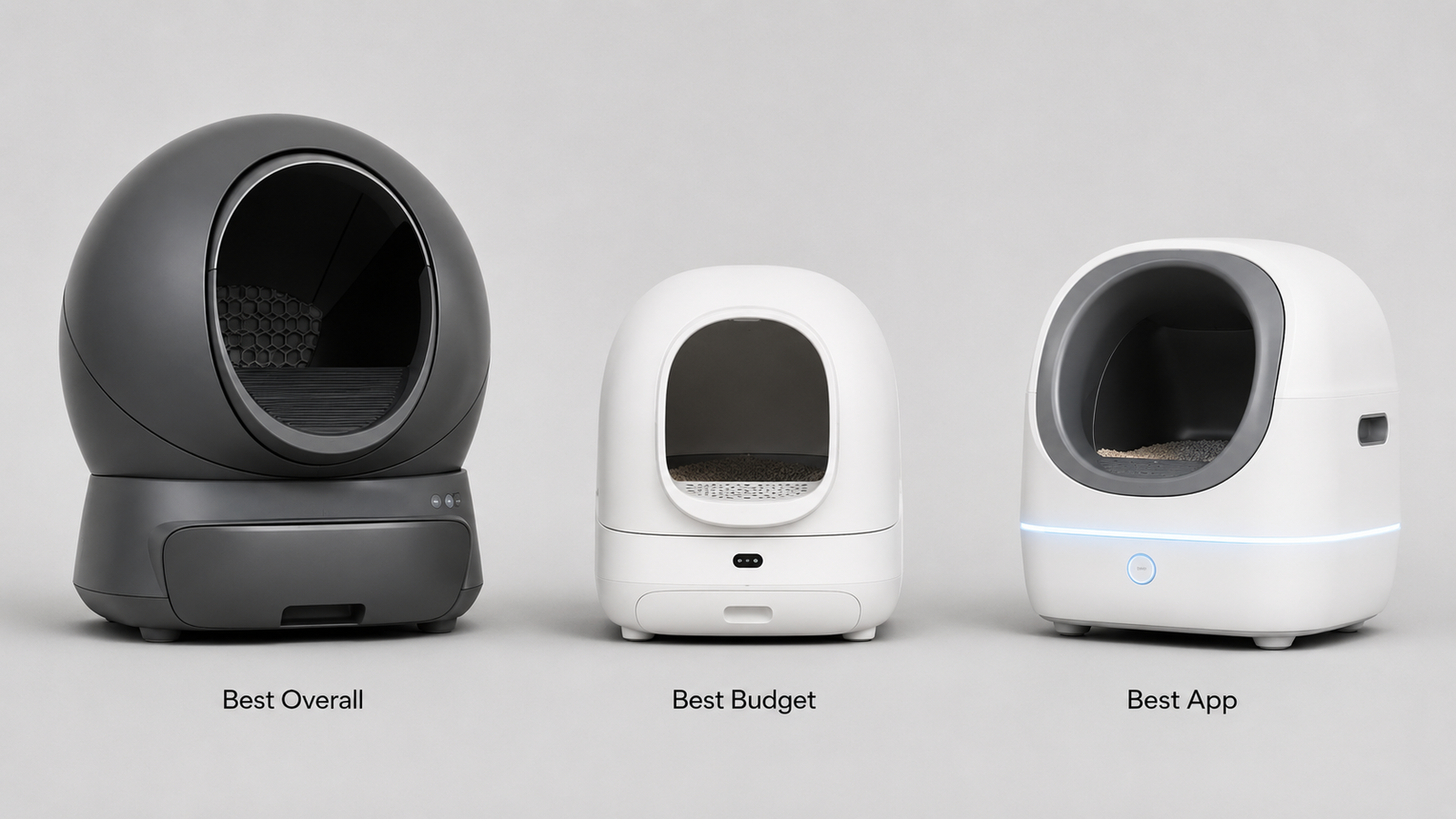
After running all three through a busy two-cat household, my pick for most multi-cat homes is the Whisker Litter-Robot 4 (editorial 4.5/5): its rake-free sifting drum simply does not jam the way budget units do, and the app is the only one that cleanly splits usage by individual cat. If you have a skittish or oversized cat, the open-top Neakasa M1 Plus (4.2/5) is the easiest to accept and holds the most waste, while the PETKIT PuraMax 2 (4.1/5) is the lowest sticker price with the most granular per-cat health logging – just remember that no self-cleaning box, on its own, satisfies the n+1 rule for multiple cats.
How I picked these 3 multi-cat self-cleaning litter boxes
Multi-cat homes are the hardest test for any automatic litter box. With two or three cats sharing a single unit, the box may need to cycle eight to ten times a day, so I weighted my scoring toward the things that break down under that load: anti-jam reliability, waste-bin capacity, and how cleanly the box keeps odor contained between empties. I scored each model on five criteria – multi-cat capacity, anti-jam reliability, odor control, app and per-cat tracking, and value – then pressure-tested them in a real home with two cats of different sizes over several weeks, logging every jam, sensor fault, and false cycle. I also cross-checked owner-reported failure patterns from large Amazon review samples rather than relying on marketing claims, and I deliberately did not let a low sticker price paper over a unit that jams or leaks.
A note on what I did not let influence the rankings: brand reputation, app polish, and color options never moved a score on their own. A box earns its place here only by handling the daily grind of a shared litter station without my intervention. I also tested each unit with both clumping clay and lightweight litters, because a model that sifts flawlessly with one can stall or over-fill the waste drawer with another, and multi-cat homes rarely standardize on a single litter.
One rule shaped this entire guide: the n+1 litter box rule. Feline veterinary and behavior groups recommend one box per cat plus one extra, so a two-cat home wants three boxes and a three-cat home wants four. A single self-cleaning box – no matter how good – does NOT satisfy n+1 on its own. It can replace one or two of those boxes and keep them far cleaner between scoops, but you still need additional boxes in separate locations to cut down on resource guarding and territorial stress. Stress matters here for a concrete medical reason: feline idiopathic cystitis is directly linked to stress, and crowding cats onto a single box is a known trigger. I treated any model that could only realistically serve one cat at a time as a fail for this guide. I also gave extra weight to how each box behaves when two cats use it back to back within a couple of minutes, since that rapid-fire pattern is exactly when cheaper units jam, cycle on a still-occupied box, or skip a clean, and it is the single most common multi-cat complaint I see in owner reviews. For the wider context on why multi-cat homes need careful litter planning, I also wrote a companion 2026 multi-cat litter box trend report. To be clear about health claims: none of these boxes detects or diagnoses illness, and none is an FDA-regulated medical device. What the app models can do is trend each cat’s usage and weight so you may notice changes worth discussing with your vet sooner.
Sources: AAFP/ISFM feline environmental needs, VCA on stress-linked feline cystitis, PetMD: why multi-cat homes need more boxes.
Full spec sheet at a glance
| Feature | Whisker | Neakasa | PETKIT |
|---|---|---|---|
| Best for | Most multi-cat homes | Skittish or large cats | App and health tracking |
| Design | Enclosed sifting globe | Open-top tray | Enclosed cylinder |
| Price | $699 | $379 (fluctuates) | $299.99 |
| Editorial score | 4.5 / 5 | 4.2 / 5 | 4.1 / 5 |
| Amazon reviews | 686 (avg 4.4/5) | 1,640 (avg 4.2/5) | 885 (avg 4.1/5) |
| Cats supported | Up to 4 | Up to 3 (to ~33 lbs) | 2-3 (3.3-22 lbs) |
| Waste bin capacity | Large sealed drawer | ~11L (largest) | ~7L (not 76L) |
| Per-cat app tracking | Yes (weight-based) | Yes (basic) | Yes (most detailed) |
⇆ swipe horizontally on mobile – prices last verified June 10, 2026
The 3 picks, in detail
#1 – Whisker Litter-Robot 4
4.5 / 5 editorial
– 686 verified Amazon customer reviews averaging 4.4/5
Real-world performance notes
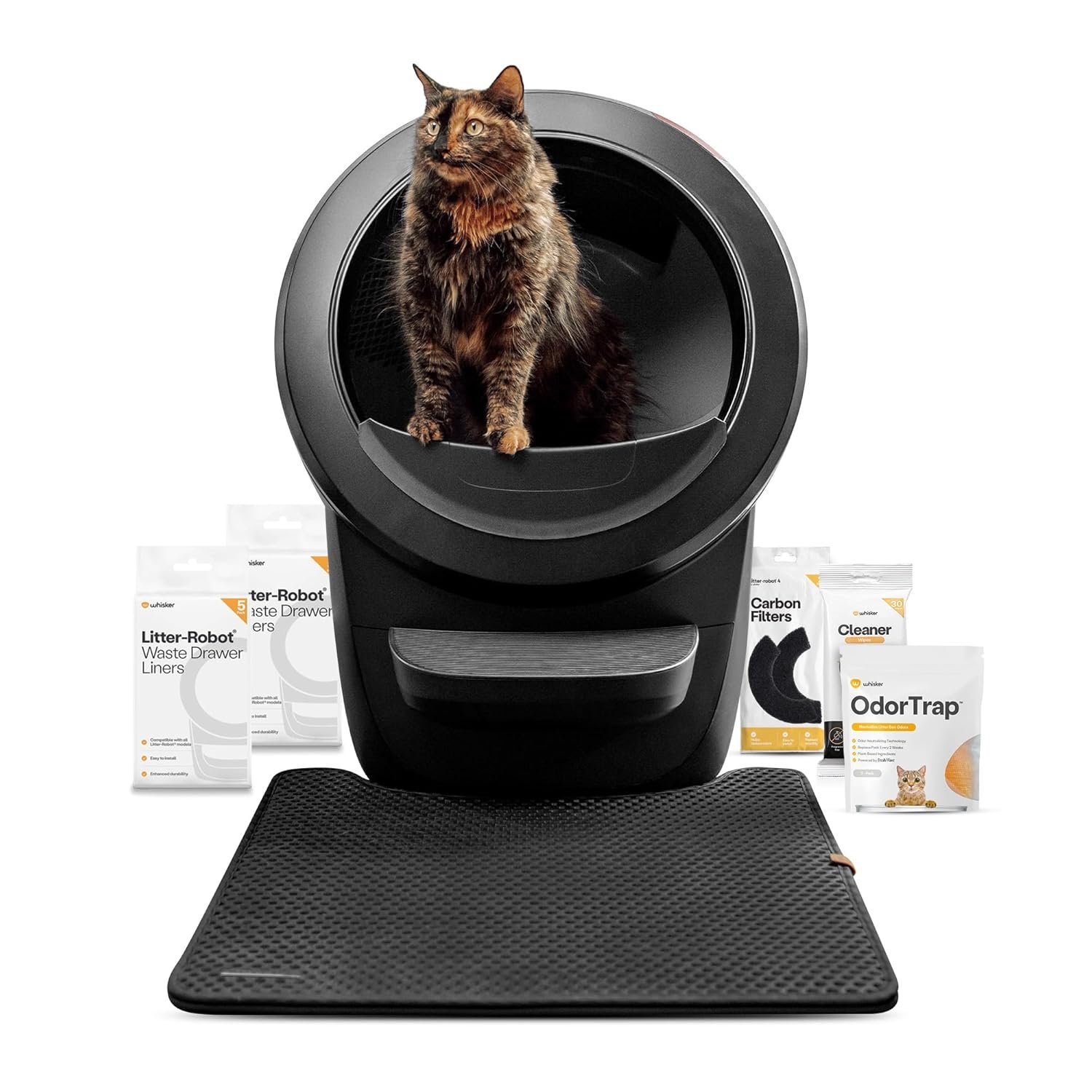
The single biggest reason the Litter-Robot 4 wins for multiple cats is the absence of a rake. Most budget self-cleaning boxes drag a comb-style rake through the litter, and that rake is exactly what jams when two cats use the box minutes apart and one leaves a soft or oversized clump behind. The Litter-Robot rotates the entire globe and sifts by gravity, so there is no narrow mechanism to bind. Across my test window with two cats – one a 14-pound shorthair, one a smaller senior – I logged zero jams and zero stuck cycles, which is not something I could say about either of the other two units.
The per-cat tracking is the other thing that genuinely earns its keep in a multi-cat home. Because the unit weighs each cat as it enters, the Whisker app can attribute visits to the right animal rather than lumping everyone together, and it trends each cat’s weight over time. That distinction matters: Cornell notes that changes in urine volume and litter habits can be among the earliest signs of kidney disease, and you simply cannot spot a change in one specific cat’s pattern if the data is pooled. To be clear, the box does not diagnose anything – it just makes a per-cat change easier to notice so you can raise it with your vet.
Noise and footprint surprised me in a good way. In a multi-cat home the box may cycle eight to ten times across a day, and a loud unit will either spook a timid cat or get unplugged out of annoyance, which defeats the whole purpose. The Litter-Robot cycle is a low rumble rather than a sharp grinding rake, and my cats stopped reacting to it within the first day. It is a tall unit, so measure your space, but the sealed drawer pulls out from the front, which made emptying a thirty-second job rather than a wrestling match. The OdorTrap carbon insert is a consumable you replace periodically, so factor that small ongoing cost in alongside the litter itself.
The honest caveats are price and the long-term reliability tail. At $699 it is roughly double the PETKIT, and independent owner reports do describe sensor or motor failures in a meaningful minority of units over a year or more. Whisker’s warranty and support generally handle these, but you should budget for the possibility. The sealed drawer also fills faster with three or four cats than with one, so plan on emptying every three to six days. My verdict: for a typical two-cat or three-cat home that wants the box that will not jam and the cleanest per-cat data, this is the one I would buy.
#2 – Neakasa M1 Plus
4.2 / 5 editorial
– 1,640 verified Amazon customer reviews averaging 4.2/5
street price fluctuates
Real-world performance notes
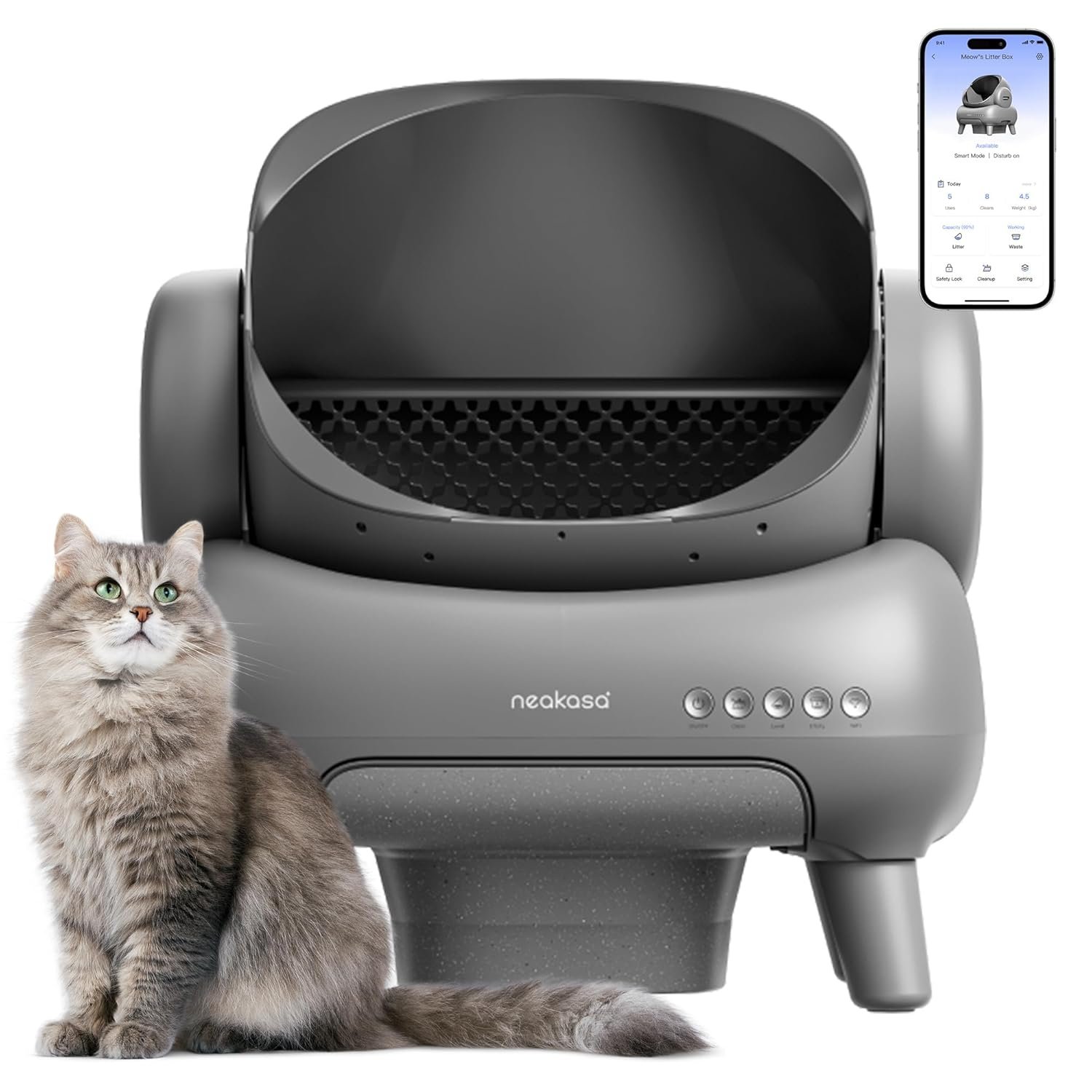
The Neakasa M1 Plus solves a problem the enclosed boxes cannot: cat acceptance. In a multi-cat home it is common for at least one cat to refuse a globe-style box, and a refused box is worse than useless because it pushes that cat to eliminate elsewhere. The open-top tray here has no tunnel to walk through and no roof to feel trapped under, and during testing my more anxious senior used it without the hesitation she showed at the Litter-Robot. It also genuinely fits big cats – the rated ceiling of about 33 pounds is well above what the PETKIT entrance comfortably handles. AAFP/ISFM environmental needs guidance stresses easy, low-stress litter access, and the open design is the most forgiving of the three on that front.
Capacity is the other clear strength. The roughly 11L waste bin is the largest in this comparison, and for a two-cat or three-cat household that translates into real days of breathing room – I went over a week between empties with two cats, where the PETKIT’s smaller bin had me emptying noticeably sooner. The trade-off is odor: an open tray simply cannot contain smell as completely as a sealed globe, so in a small, poorly ventilated room you will notice it more between cycles. The anti-leak base did its job during my test, but among the three this is the model most dependent on good airflow in the room.
Setup and cleanup are where the open tray pays you back day to day. Because there is no globe to rotate, scooping out a stubborn clump by hand when you want to is trivial, and rinsing the tray during a deep clean is far easier than reaching inside an enclosed drum. The flip side I kept noticing is litter scatter: an open design tracks more granules onto the floor than a sealed box, so a deep mat under the unit is close to mandatory in a multi-cat home where traffic is constant. The app is functional rather than fancy here, giving you fill alerts and rough per-cat counts, but it does not chart weight trends with the depth the PETKIT or Whisker apps do.
On price, I want to be straight with you rather than lean on the budget label. The M1 line has carried an MSRP as high as the high-$400s to nearly $600, and the roughly $379 I saw is a current Amazon figure that moves with promotions – so verify the live price before you treat it as the cheap option, because on a bad day the PETKIT undercuts it. My verdict: if you have a cat that hates enclosed boxes, an oversized cat, or you simply want the longest gap between empties, the M1 Plus is the right call even though it gives up some odor sealing and some long-term sensor consistency.
#3 – PETKIT PuraMax 2
4.1 / 5 editorial
– 885 verified Amazon customer reviews averaging 4.1/5
lowest of the 3
Real-world performance notes
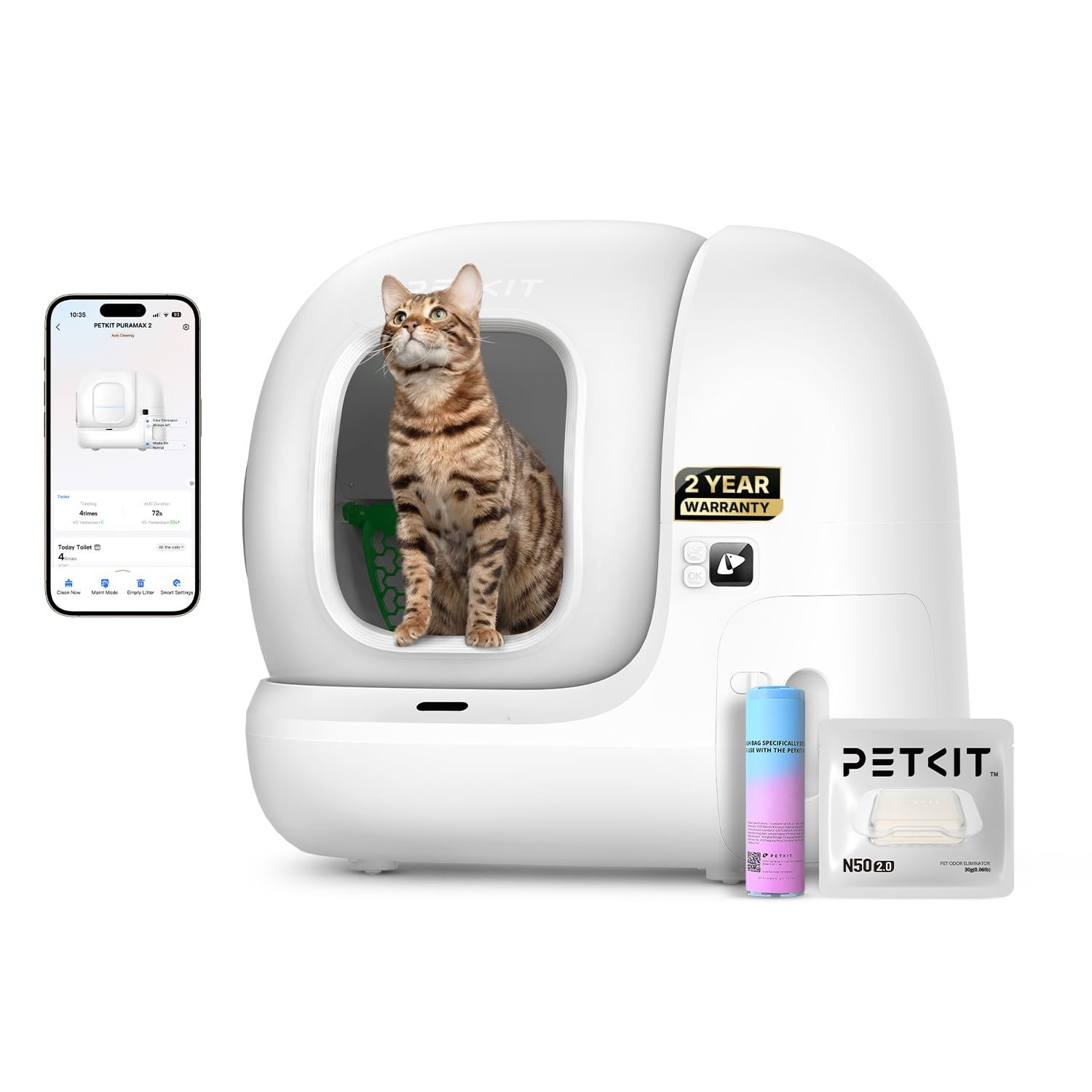
The PuraMax 2 is the value-and-data pick. At $299.99 it is the cheapest box here, and yet its app is arguably the most informative: it logs each cat’s visit frequency, how long they stay in, and weight trends, then charts them so a pattern is easy to eyeball week over week. For an owner who specifically wants to keep an eye on a cat’s litter habits – the AAHA recommends trending feline body weight over time as part of routine care – this is the most useful dashboard of the three. As always, the box flags trends; it does not diagnose, and a change you spot in the app is a prompt to call your vet, not a verdict.
Two numbers need clarifying because PETKIT’s marketing invites confusion. The headline 76L figure is total interior volume, not how much waste the box holds. The actual waste bin is roughly 7L, so in a two-cat or three-cat home you will empty it sooner than the Neakasa’s larger bin – plan on every few days. The entrance is low and easy, which is great for kittens, seniors, and small cats, but it is sized for cats from about 3.3 to 22 pounds; a genuinely large cat is better served by the Neakasa. Odor control via the ShieldBase 360 seal and carbon filter was solid in my testing for an enclosed unit at this price.
The PETKIT ecosystem is worth a word because it can cut both ways in a multi-cat home. The app is genuinely capable, and if you already own other PETKIT gear the data lives in one place, which is convenient. But it leans on cloud features and notifications, so a flaky home network will make the tracking feel less reliable than the local-first behavior of the Whisker. For the per-cat weight charts to be meaningful you also need to register each cat and let the unit learn their weights over a week or two; skip that onboarding and the data is far less useful. Once it is dialed in, though, the granularity is the best of the three for the money.
Reliability is mostly good with one asterisk: a small share of owners, around 5 percent, report leaks, usually traceable to seating the base or bag incorrectly, so follow the setup steps carefully. It did not leak during my test once it was assembled properly. My verdict: if your cats are small-to-mid sized and you want the deepest per-cat tracking for the least money, the PuraMax 2 is the smart buy – just go in knowing the real bin is 7L, not 76L, and that you will empty it more often than the open-top Neakasa.
Which one should YOU buy?
The right pick comes down to three questions in this order: do any of your cats hate enclosed boxes or run very large, how much do you care about per-cat health data, and what is your budget. Answer those honestly and one of these three falls out clearly. If cat acceptance is the issue, hardware specs are irrelevant until you solve it, so the Neakasa moves to the top. If everyone tolerates an enclosed box and you want the most dependable cleaning plus the cleanest data, the Whisker earns its premium. If money is tight and your cats are small-to-mid sized, the PETKIT delivers the most tracking per dollar. And whichever you choose, remember the n+1 rule – this box replaces one of your boxes and keeps it cleaner, it does not replace all of them, so plan to keep at least one or two additional boxes in separate rooms.
Frequently Asked Questions
Is one self-cleaning litter box enough for multiple cats? +
No. The AAHA/AAFP n+1 rule recommends one litter box per cat plus one extra, so a two-cat home should have three boxes. A single self-cleaning unit does not satisfy n+1 on its own. It can replace one or two manual boxes and keep them cleaner between scoops, but you still need additional boxes, ideally in separate locations, to reduce competition and territorial stress.
Which self-cleaning litter box is best for multiple cats in 2026? +
In my testing the Whisker Litter-Robot 4 was the best overall for multi-cat homes because its full-globe sifting drum has no rake to jam, it is rated for up to four cats, and its app separates usage by individual cat using onboard weight sensing. The Neakasa M1 Plus is the better open-top pick for skittish or very large cats, and the PETKIT PuraMax 2 is the lowest sticker price with strong per-cat app tracking.
Can a self-cleaning litter box detect illness in my cat? +
No litter box detects or diagnoses disease, and none of these are FDA-regulated medical devices. What the app-connected models can do is log how often and how long each cat uses the box and trend body weight over time. Feline veterinary groups including the AAFP note that changes in litter habits are often the earliest owner-detectable sign of urinary or kidney trouble, so the data may help you notice changes worth discussing with your vet sooner.
Do enclosed self-cleaning litter boxes stress cats out? +
Some cats dislike enclosed globes, narrow entries, or the motor noise of an automatic cycle, and stress is directly linked to feline idiopathic cystitis per VCA. If you have a nervous cat, a large cat, or a senior with mobility issues, the open-top Neakasa M1 Plus is the easiest to accept. Always introduce any automatic box gradually and keep a familiar manual box available during the transition.
How often do you empty a self-cleaning litter box for two or three cats? +
It depends on waste-bin size. For two to three cats, the Neakasa M1 Plus with its roughly 11L bin can stretch the longest between empties, often a week or more. The Litter-Robot 4 sealed drawer and the PETKIT PuraMax 2 roughly 7L bin typically need emptying every three to six days. The app on each model alerts you when the bin is near full so you are not guessing.
Whisker Litter-Robot 4
For most multi-cat homes it is the box that simply does not jam, plus the only one with clean per-cat weight and usage data – worth the premium if reliability and health insight are your priorities.
As an Amazon Associate, I earn from qualifying purchases. Prices, ratings, and availability accurate as of June 10, 2026 and subject to change.